• Fri frakt över 249 kr
  • •
  • Snabba leveranser
  • •
  • Billiga böcker
Kundservice

Du är på sajten för privatpersoner.

Företag, bibliotek eller offentlig verksamhet?

Du handlar på classic.bokus.com, där alla dina funktioner finns intakta.
Till classic.bokus.com
Bokus logotyp. Gå till startsidan.
  • Erbjudanden
  • Nyheter
  • Student
  • Topplistor
  • Barn & ungdom
  • Bokus Play
  • E-böcker
  • Pocketböcker
  • Spel & pussel

10% rabatt på allt med kod NYSTART10 →

Sidfot

Mina sidor

    Hjälp

    • Kundservice
    • Vanliga frågor och svar
    • Frakt och leverans
    • Retur vid ångerrätt
    • Reklamera vara
    • Betalning
    • Köpvillkor
    • Allmänna villkor
    • Information om webbplatsens tillgänglighet

    Om Bokus

    • Om oss
    • Pressrum
    • För studenter
    • För företag
    • För bibliotek och offentlig verksamhet
    • För leverantörer
    • Hållbarhet

    Populärt

    • Aktuella erbjudanden
    • Presentkort
    • Studentlitteratur
    • Nya böcker
    • Topplistor
    • Signerade böcker
    • Engelska böcker

    Inspiration

    • Boktips
    • BookTok
    • Populära bokserier
    • Barnbokskaraktärer
    • Populära författare
    Logotyp för Bokus
    Följ oss på Facebook (extern länk)Följ oss på Instagram (extern länk)Följ oss på YouTube (extern länk)Följ oss på TikTok (extern länk)
    bokus @ CookiesAnpassa cookiesIntegritetspolicyKöpvillkor
    Till Citymail hemsida (extern länk)Till Budbee hemsida (extern länk)Till Postnord hemsida (extern länk)Till Schenker hemsida (extern länk)Till Early Bird hemsida (extern länk)Till Walleys hemsida (extern länk)
    1. Samhälle och politik
    2. Samhälle och kultur
    3. Kultur och medier
    4. Referensverk och tvärvetenskap

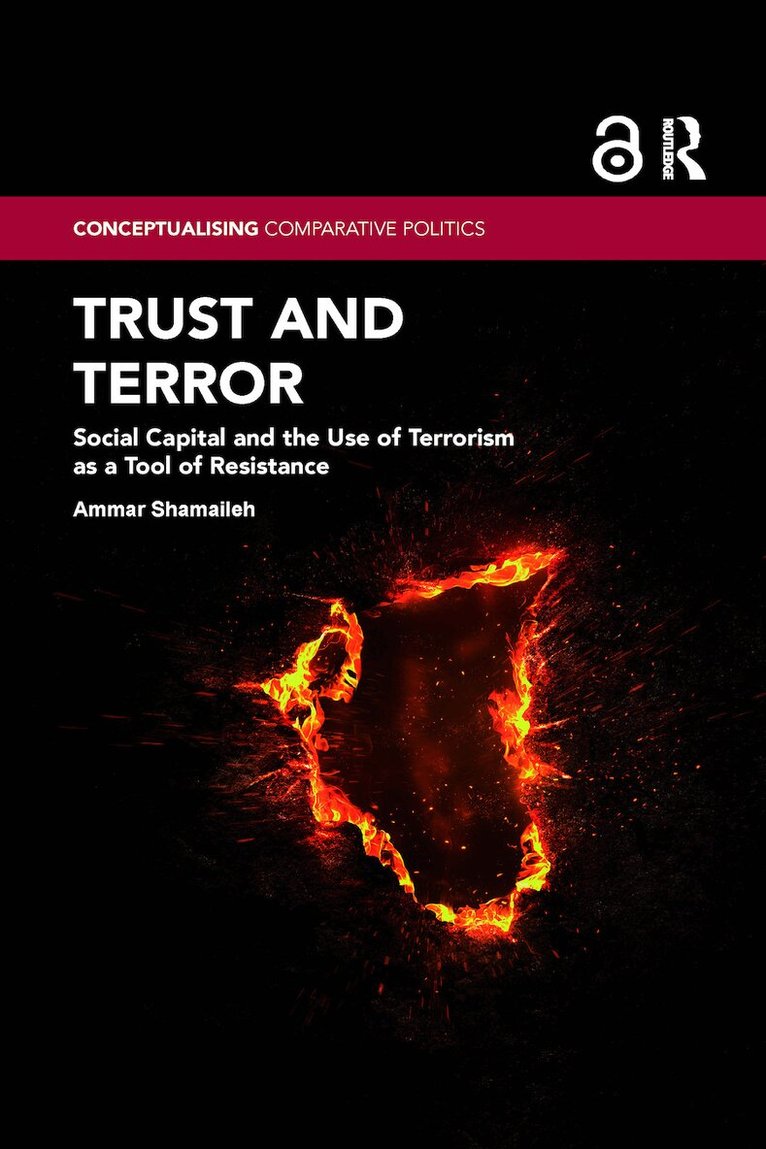
    Trust and Terror

    Social Capital and the Use of Terrorism as a Tool of Resistance

    AvAmmar Shamaileh

    Häftad, Engelska, 2020

    Del i serien Conceptualising Comparative Politics

    667 kr

    Beställningsvara. Skickas inom 10-15 vardagar. Fri frakt över 249 kr.

    Fler format och utgåvor

    Inbunden

    2 422 kr

    Beskrivning

    Why do some individuals choose to protest political grievances via non-violent means, while others take up arms? What role does whom we trust play in how we collectively act? This book explores these questions by delving into the relationship between interpersonal trust and the nature of the political movements that individuals choose to join. Utilizing the examples of the Arab Spring uprisings in Egypt, Libya and Syria, a novel theoretical model that links the literature on social capital and interpersonal trust to violent collective action is developed and extended. Beyond simply bringing together two lines of literature, this theoretical model can serve as a prism from which the decision to join terrorist organizations or violent movements may be analyzed. The implications of the theory are then examined more closely through an in-depth look at the behavior of members of political movements at the outset of the Arab Spring, as well as statistical tests of the relationship between interpersonal trust and terrorism in the Middle East and globally.Trust and Terror will be of interest to scholars of Comparative Politics and International Relations.The Open Access version of this book, available at https://doi.org/10.4324/9781315505817, has been made available under a Creative Commons Attribution-Non Commercial-No Derivatives 4.0 license.

    Produktinformation

    • Utgivningsdatum:2020-09-30
    • Mått:152 x 229 x 14 mm
    • Vikt:260 g
    • Format:Häftad
    • Språk:Engelska
    • Serie:Conceptualising Comparative Politics
    • Antal sidor:168
    • Förlag:Taylor & Francis Ltd
    • ISBN:9780367878207

    Utforska kategorier

    • Referensverk och tvärvetenskap inom Samhälle och politik
    • Politisk aktivism inom Samhälle och politik
    • Politik och statsskick inom Samhälle och politik

    Mer om författaren

    Ammar Shamaileh is an assistant professor in the Department of Political Science at the University of Louisville, USA. His current research agenda focuses primarily on the relationship between informal institutions or cultural phenomena and political behavior and violence in the Middle East.

    Recensioner i media

    'This book provides a very unorthodox treatment of the Arab Spring by looking into the association between interpersonal trust and terrorism. Shamaileh develops a novel theory that explains how the state of social capital at individual level might have shaped the differential outcomes of the Arab Spring in Egypt, Libya, Syria, and beyond. The theoretical and empirical analysis presented in this timely book is a fine example of social scientific inquiry at its best. The author brings a wealth of evidence ranging from in-depth analysis of cases to large-N quantitative analysis to test the rich theoretical propositions. Trust and Terror will be a valuable resource for students of comparative politics and Middle Eastern studies as well as to policymakers.' - Sabri Ciftci, Michael W. Suleiman Chair in Arab and Arab-American Studies, Kansas State University'To illustrate the critical interaction between general levels of interpersonal trust and the options to which individuals resort when addressing grievances, Shamaileh shows the depth of his analytical range, adeptly bringing together formal modeling, case studies, interviews, statistical analysis, and even Foucauldian interpretative analysis of satirical comic caricatures of Assad and popular comedy skits. Throughout the work, the author’s logic drives home the mechanisms behind the inevitable outcome of the Syrian protests and the relationship between the cultivated lack of trust in Syrian society and the recourse to terrorism as the means to counter the state.' - Michael Wuthrich, Academic Director of Global & International Studies Programs, University of Kansas'Shamaileh offers a novel and persuasive argument about the effects of trust and interpersonal ties on individuals’ choices to pursue non-violent versus violent means of resistance. The book makes a major contribution to growing research on how the characteristics of societies and relations between militants and communities affect the trajectory of violent movements. It provides a fascinating lens through which to analyze variation in the protest movements that emerged in the Arab Spring--and beyond.' - Risa A. Brooks, Allis Chalmers Associate Professor, Marquette University

    Innehållsförteckning

    • Table of ContentsPrefaceChapter 1: IntroductionChapter 2: Trust, Terror and The Arab Spring: Egypt, Libya And SyriaChapter 3: Theory: The Relationship Between Trust And TerrorChapter 4: Islamist Political Mobilization In Egypt, Libya And SyriaChapter 5: The Syrian Protester’s DilemmaChapter 6: Generalized And Particularized Interpersonal Trust And Support For Terrorism: Evidence From Five Arab StatesChapter 7: Generalized Interpersonal Trust And The Prevalence Of Domestic Terrorist Activity: A Cross-Country StudyChapter 8: ConclusionReferencesAppendicesAppendix AAppendix BAppendix CIndex