E-bok, Engelska, 2007
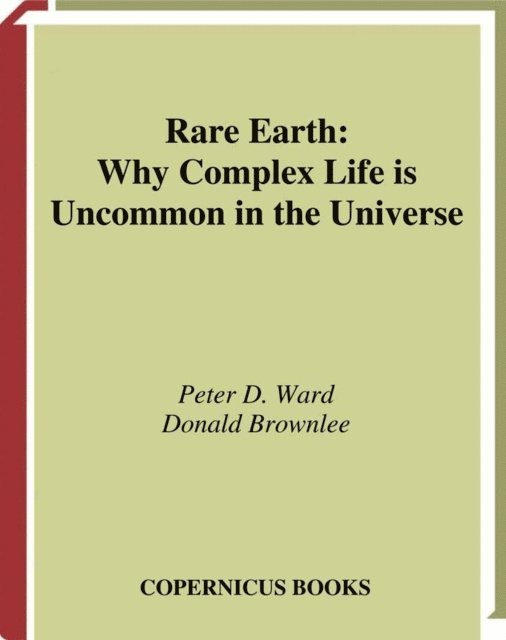
Rare Earth
Av Donald Brownlee, Peter D. Ward
554 kr
Läs direkt i Bokus Reader – eller ladda ned till din enhet (PDF kräver ofta zoom och scroll på små skärmar).
Beskrivning
In November 12, 2002, Dr. John Chambers of the NASA Ames Research Center gave a seminar to the Astrobiology Group at the University of Washington. The audience of about 100 listened with rapt attention as Chambers described results from a computer study of how planetary systems form. The goal of his research was to answer a deceptively simple question: How often would newly forming planetary systems produce Earth-like planets, given a star the size of our own sun? By “Earth-like” Chambers meant a rocky planet with water on its surface, orbiting within a star’s “habitable zone. ” This not-too-hot and not-too-cold inner region, relatively close to the star, supports the presence of liquid water on a planet surface for hundreds of million of years—the time-span probably necessary for the evolution of life. To answer the question of just how many Earth-like planets might be spawned in such a planetary system, Chambers had spent thousands of hours running highly sophisticated modeling programs through arrays of powerful computers. The results presented at the meeting were startling. The simulations showed that rocky planets orbiting at the “right” distances from the central star are easily formed, but they can end up with a wide range of water content. Earth seems to be quite a gem—a rocky planet where not only can liquid water exist for long periods of time, but where water can be found as a heathy oceanful—not too little and not too much. Our planet seems to reside in a benign region of the Galaxy, where comet and asteroid bombardment is tolerable and habitable-zone planets can commonly grow to Earth size. Such real estate in our galaxy—perhaps in any galaxy—is prime for life. And rare as well.
Produktinformation
- Utgivningsdatum: 2007-05-08
- Språk: Engelska
- Filformat: PDF
- Kopieringsskydd: LCP
- ISBN: 9780387218489
- Förlag: Springer New York
Utforska kategorier
Betyg & recensioner
0 recensioner
Inga recensioner tillgängliga.