• Fri frakt över 249 kr
  • •
  • Snabba leveranser
  • •
  • Billiga böcker
Kundservice

Du är på sajten för privatpersoner.

Företag, bibliotek eller offentlig verksamhet?

Du handlar på classic.bokus.com, där alla dina funktioner finns intakta.
Till classic.bokus.com
Bokus logotyp. Gå till startsidan.
  • Erbjudanden
  • Nyheter
  • Student
  • Topplistor
  • Barn & ungdom
  • Bokus Play
  • E-böcker
  • Pocketböcker
  • Spel & pussel

10% studentrabatt med kod TERM26

Sidfot

Mina sidor

    Hjälp

    • Kundservice
    • Vanliga frågor och svar
    • Frakt och leverans
    • Retur vid ångerrätt
    • Reklamera vara
    • Betalning
    • Köpvillkor
    • Allmänna villkor
    • Information om webbplatsens tillgänglighet

    Om Bokus

    • Om oss
    • Pressrum
    • För studenter
    • För företag
    • För bibliotek och offentlig verksamhet
    • För leverantörer
    • Hållbarhet

    Populärt

    • Aktuella erbjudanden
    • Presentkort
    • Studentlitteratur
    • Nya böcker
    • Topplistor
    • Signerade böcker
    • Engelska böcker

    Inspiration

    • Boktips
    • BookTok
    • Populära bokserier
    • Barnbokskaraktärer
    • Populära författare
    Logotyp för Bokus
    Följ oss på Facebook (extern länk)Följ oss på Instagram (extern länk)Följ oss på YouTube (extern länk)Följ oss på TikTok (extern länk)
    bokus @ CookiesAnpassa cookiesIntegritetspolicyKöpvillkor
    Till Citymail hemsida (extern länk)Till Budbee hemsida (extern länk)Till Postnord hemsida (extern länk)Till Schenker hemsida (extern länk)Till Early Bird hemsida (extern länk)Till Walleys hemsida (extern länk)
    1. Naturvetenskap och teknik
    2. Matematik och naturvetenskap
    3. Biologi
    4. Biovetenskap

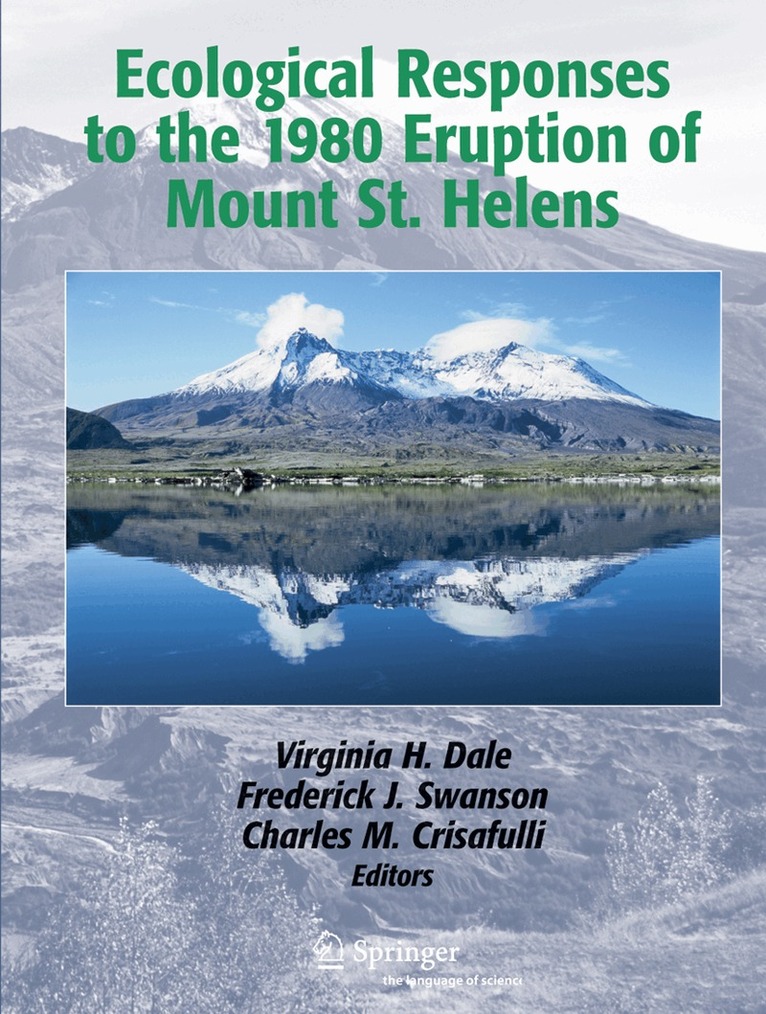
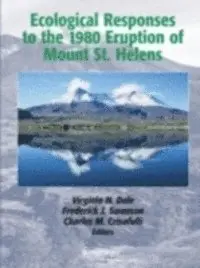
    Ecological Responses to the 1980 Eruption of Mount St. Helens

    AvVirginia H. Dale,Frederick J. Swanson

    Häftad, Engelska, 2005

    504 kr

    Beställningsvara. Skickas inom 10-15 vardagar. Fri frakt över 249 kr.
    Beskrivning

    Recon?guring Disturbance, Succession, and Forest Management: The Science of Mount St. Helens When Mount St. Helens erupted on May 18, 1980, it did more than just recon?gure a large piece of Cascadian landscape. It also led to dramatic revisions in our perspectives on disturbances, secondary succession, and forestry practices. The Mount St. Helens landscape turned out to be a far more complex place than the “moonscape” that it initially appeared to be. Granted, a large area was literally scoured and sterilized, and that vast expanse of newly formed rock, mud?ows, and avalanche debris up and down the mountain made the Mount St. Helens landscape unique. But I still remember my surprise when, as I stepped out of the helicopter on ?rst landing within the extensive “devastated zone,” I saw hundreds of plants pushing their way up through the mantel of tephra. Surviving organisms were stunning in their diversity, abundance, and the mechanisms by which they survived. They persisted as whole organisms living below ground, encased within late-persisting snowbanks, and buried in lake and stream sediments. They survived as rhizomes transported along with the massive landslide that accompanied the eruption and as stems that suffered the abrasion of mud?ows. Mud?ows ?oated nurse logs covered with tree seedlings and then redeposited them on the ?oor of a forested river terrace. Millions, perhaps billions, of plants survived as rootstocks and rhizomes that pushed their way up through the tephra, and others survived on the bases of uprooted trees.

    Produktinformation

    • Utgivningsdatum:2005-05-20
    • Mått:216 x 279 x 22 mm
    • Vikt:859 g
    • Format:Häftad
    • Språk:Engelska
    • Antal sidor:342
    • Upplaga:2005
    • Förlag:Springer-Verlag New York Inc.
    • Medarbetare:J.F. Franklin
    • ISBN:9780387238500

    Utforska kategorier

    • Biovetenskap inom Naturvetenskap och teknik

    Mer om författaren

    Virginia Dale is a Corporate Fellow in the Environmental Sciences Division at Oak Ridge National Laboratory.  She is also an adjunct faculty member in the Department of Ecology and Evolutionary Biology at the University of Tennessee.Fred Swanson is a Research Geologist at the USDA Forest Service Pacific NW Research Station in Corvallis, OR.Charles Crisafulli is an Ecologist at the USDA Forest Service Pacific Northwest Research station in Olympia, WA.

    Recensioner i media

    From the reviews: "On May 18, 1980, Mount St. Helens in Washington state erupted violently ... . In 20 chapters written by 48 contributors, this book provides an overview of the ecological and geological setting before the 1980 eruption and the geophysical environment created afterward. ... A major contribution to disturbance ecology, this book belongs on every ecologist's bookshelf. Summing Up: Highly recommended. Lower-level undergraduates through faculty/researchers." (R. L. Smith, CHOICE, November, 2005) "The eruption of Mt. St. Helens in 1980 was one of the most significant events of recent times. It allowed us to haven an almost unprecedented chance to examine ecological processes ... . This is a fascinating book. It provides one of the very few detailed accounts of change. ... It follows that for those interested in this study, this is a crucial text. Mt. St. Helens makes a superb case study: this text makes the work accessible for those outside the immediate research community." (TENews, August, 2005) "The eruption of the Mount St. Helens in May 1980 was the most spectacular eruption since that of Krakatau in 1880 ... . Due to the great progress in science, it was possible to organize immediately systematic and very complex research, results of which are comprehensively presented in the book published for 25th anniversary of the eruption. ... The book is relevant not only for ecological theory, but also for practical restoration of disturbed sties. Moreover, one can read the book as a thrilling story." (Karel Prach, Folia Geobotanica, Vol. 41 (4), 2006)

    Innehållsförteckning

    • Disturbance, Survival, and Succession: Understanding Ecological Responses to the 1980 Eruption of Mount St. Helens.- Geological and Ecological Settings of Mount St. Helens Before May 18, 1980.- Physical Events, Environments, and Geological—Ecological Interactions at Mount St. Helens: March 1980–2004.- Survival and Establishment of Plant Communities.- Plant Responses in Forests of the Tephra-Fall Zone.- Plant Succession on the Mount St. Helens Debris-Avalanche Deposit.- Geomorphic Change and Vegetation Development on the Muddy River Mudflow Deposit.- Proximity, Microsites, and Biotic Interactions During Early Succession.- Remote Sensing of Vegetation Responses During the First 20 Years Following the 1980 Eruption of Mount St. Helens: A Spatially and Temporally Stratified Analysis.- Survival and Establishment of Animal Communities.- Arthropods as Pioneers in the Regeneration of Life on the Pyroclastic-Flow Deposits of Mount St. Helens.- Posteruption Arthropod Succession on the Mount St. Helens Volcano: The Ground-Dwelling Beetle Fauna (Coleoptera).- Causes and Consequences of Herbivory on Prairie Lupine (Lupinus lepidus) in Early Primary Succession.- Responses of Fish to the 1980 Eruption of Mount St. Helens.- Amphibian Responses to the 1980 Eruption of Mount St. Helens.- Small-Mammal Survival and Colonization on the Mount St. Helens Volcano: 1980–2002.- Responses of Ecosystem Processes.- Mycorrhizae and Mount St. Helens:Story of a Symbiosis.- Patterns of Decomposition and Nutrient Cycling Across a Volcanic Disturbance Gradient: A Case Study Using Rodent Carcasses.- Lupine Effects on Soil Development and Function During Early Primary Succession at Mount St. Helens.- Response and Recovery of Lakes.- Lessons Learned.- Ecological Perspectives on Management of the MountSt. Helens Landscape.- Overview of Ecological Responses to the Eruption of Mount St. Helens: 1980–2005.