E-bok, Engelska, 2009
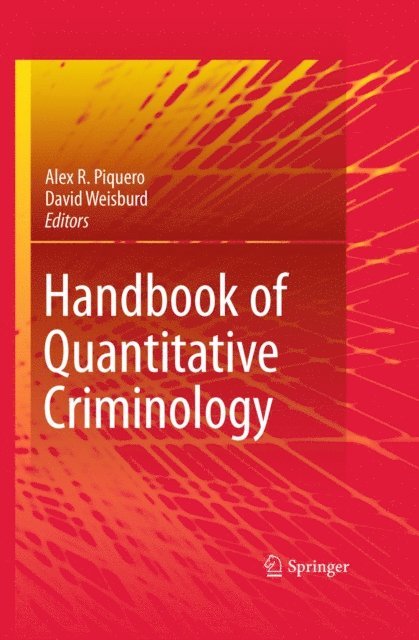
Handbook of Quantitative Criminology
Av David Weisburd, Alex R. Piquero
1720 kr
Läs direkt i Bokus Reader – eller ladda ned till din enhet (PDF kräver ofta zoom och scroll på små skärmar).
Beskrivning
Quantitative criminology has certainly come a long way since I was ?rst introduced to a largely qualitative criminology some 40 years ago, when I was recruited to lead a task force on science and technology for the President’s Commission on Law Enforcement and Administration of Justice. At that time, criminology was a very limited activity, depending almost exclusively on the Uniform Crime Reports (UCR) initiated by the FBI in 1929 for measurement of crime based on victim reports to the police and on police arrests. A ty- cal mode of analysis was simple bivariate correlation. Marvin Wolfgang and colleagues were makingan importantadvancebytrackinglongitudinaldata onarrestsin Philadelphia,an in- vation that was widely appreciated. And the ?eld was very small: I remember attending my ?rst meeting of the American Society of Criminology in about 1968 in an anteroom at New York University; there were about 25–30 people in attendance, mostly sociologists with a few lawyers thrown in. That Society today has over 3,000 members, mostly now drawn from criminology which has established its own clear identity, but augmented by a wide variety of disciplines that include statisticians, economists, demographers, and even a few engineers. This Handbook provides a remarkable testimony to the growth of that ?eld. Following the maxim that “if you can’t measure it, you can’t understand it,” we have seen the early dissatisfaction with the UCR replaced by a wide variety of new approaches to measuring crime victimization and offending.
Produktinformation
- Utgivningsdatum: 2009-12-16
- Språk: Engelska
- Filformat: PDF
- Kopieringsskydd: LCP
- ISBN: 9780387776507
- Förlag: Springer New York
Utforska kategorier
Betyg & recensioner
0 recensioner
Inga recensioner tillgängliga.