• Fri frakt över 249 kr
  • •
  • Snabba leveranser
  • •
  • Billiga böcker
Kundservice

Du är på sajten för privatpersoner.

Företag, bibliotek eller offentlig verksamhet?

Du handlar på classic.bokus.com, där alla dina funktioner finns intakta.
Till classic.bokus.com
Bokus logotyp. Gå till startsidan.
  • Erbjudanden
  • Nyheter
  • Student
  • Topplistor
  • Barn & ungdom
  • Bokus Play
  • E-böcker
  • Pocketböcker
  • Spel & pussel

10% rabatt på allt med kod NYSTART10 →

Sidfot

Mina sidor

    Hjälp

    • Kundservice
    • Vanliga frågor och svar
    • Frakt och leverans
    • Retur vid ångerrätt
    • Reklamera vara
    • Betalning
    • Köpvillkor
    • Allmänna villkor
    • Information om webbplatsens tillgänglighet

    Om Bokus

    • Om oss
    • Pressrum
    • För studenter
    • För företag
    • För bibliotek och offentlig verksamhet
    • För leverantörer
    • Hållbarhet

    Populärt

    • Aktuella erbjudanden
    • Presentkort
    • Studentlitteratur
    • Nya böcker
    • Topplistor
    • Signerade böcker
    • Engelska böcker

    Inspiration

    • Boktips
    • BookTok
    • Populära bokserier
    • Barnbokskaraktärer
    • Populära författare
    Logotyp för Bokus
    Följ oss på Facebook (extern länk)Följ oss på Instagram (extern länk)Följ oss på YouTube (extern länk)Följ oss på TikTok (extern länk)
    bokus @ CookiesAnpassa cookiesIntegritetspolicyKöpvillkor
    Till Citymail hemsida (extern länk)Till Budbee hemsida (extern länk)Till Postnord hemsida (extern länk)Till Schenker hemsida (extern länk)Till Early Bird hemsida (extern länk)Till Walleys hemsida (extern länk)
    1. Naturvetenskap och teknik
    2. Teknik och industri
    3. Elektronik och kommunikationer

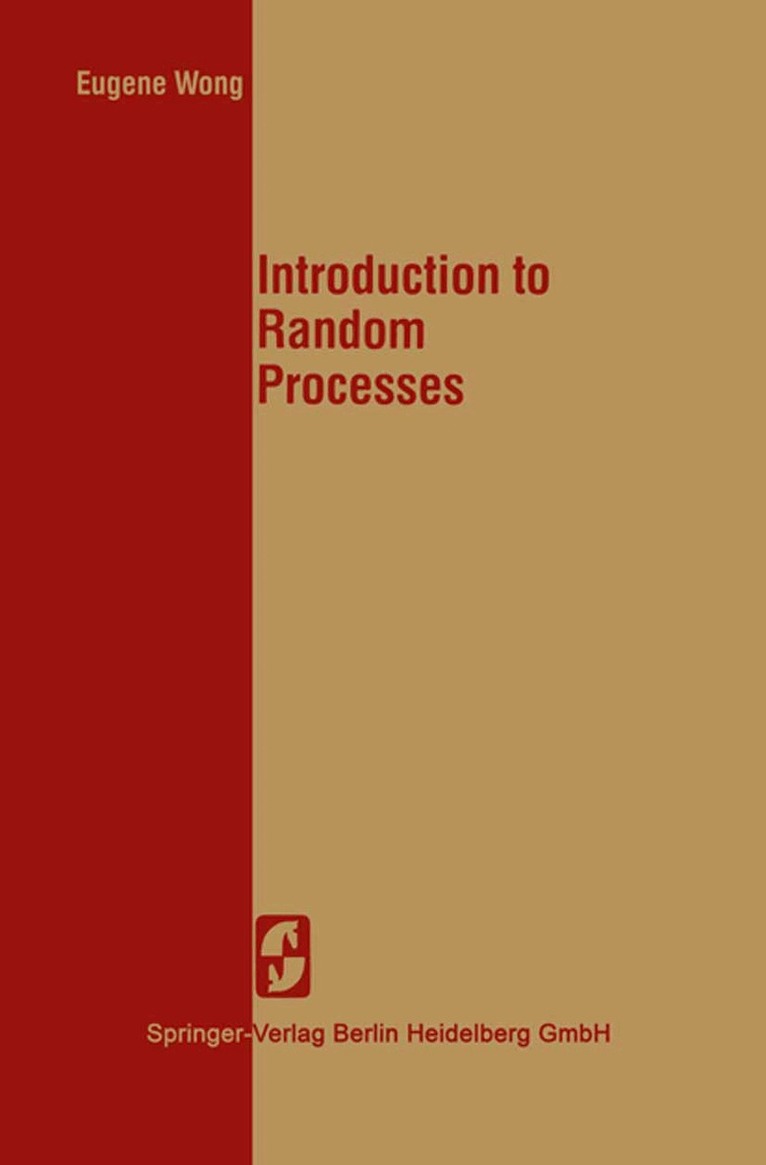
    Introduction to Random Processes

    AvE. Wong,J.B. Thomas

    Häftad, Engelska, 1983

    Del i serien Springer Texts in Electrical Engineering

    546 kr

    Beställningsvara. Skickas inom 10-15 vardagar. Fri frakt över 249 kr.

    Fler format och utgåvor

    E-bok

    712 kr

    Beskrivning

    For most people, intuitive notions concerning probabilities are connected with relative frequencies of occurrence. For example, when we say that in toss- ing a coin, the probability of its coming up "heads" is 1/2, we usually mean that in a large number of tosses, about 1/2 of the tosses will come up heads. Unfortunately, relative frequency of occurrence has proved to be an unsatis- factory starting point in defining probability. Although there have been attempts to make frequency of occurrence part of the axiomatic structure of probability theory, the currently accepted formu1ation is one based on measure theory due to Ko1mogorov. In this formulation frequency of occurrence is an interpretation for probability rather than adefinition. This inter- pretation is justified under suitab1e conditions by the 1aw of 1arge numbers. The starting point of probability theory is usua11y taken to be an experi- ment the outcome of which is not fixed apriori. Some fami1iar examples inc1ude tossing a die, observation of a noise vo1tage at a fixed time, the error in measuring a physica1 parameter, and the exact touchdown time of an aircraft.Let ~ denote the set of all possib1e outcomes of an experiment. For examp1e, for the experiment of tossing one die, ~ = {1, 2, 3, 4, 5, 6}, whi1e for the touchdown time of an aircraft, ~ might be chosen to be 0 ~ t < 00. We note that for a given experiment on1y one outcome is ever observed.

    Produktinformation

    • Utgivningsdatum:1983-03-14
    • Mått:155 x 235 x 11 mm
    • Vikt:295 g
    • Format:Häftad
    • Språk:Engelska
    • Serie:Springer Texts in Electrical Engineering
    • Antal sidor:176
    • Upplaga:1983
    • Förlag:Springer-Verlag New York Inc.
    • ISBN:9780387907574

    Utforska kategorier

    • Elektronik och kommunikationer inom Naturvetenskap och teknik
    • Matematisk statistik inom Naturvetenskap och teknik
    • Tillämpad matematik inom Naturvetenskap och teknik

    Innehållsförteckning

    • 1 Event and Probability.- 2 Random Variables.- 3 Random Sequences.- 4 Stochastic Processes.- 5 Frequency-Domain Analysis.- 6 Dynamical Systems.- 7 Likelihood Ratios and Applications.- Suggested Further Readings.- Exercises.