• Fri frakt över 249 kr
  • •
  • Snabba leveranser
  • •
  • Billiga böcker
Kundservice

Du är på sajten för privatpersoner.

Företag, bibliotek eller offentlig verksamhet?

Du handlar på classic.bokus.com, där alla dina funktioner finns intakta.
Till classic.bokus.com
Bokus logotyp. Gå till startsidan.
  • Erbjudanden
  • Nyheter
  • Student
  • Topplistor
  • Barn & ungdom
  • Bokus Play
  • E-böcker
  • Pocketböcker
  • Spel & pussel

10% rabatt på allt med kod NYSTART10 →

Sidfot

Mina sidor

    Hjälp

    • Kundservice
    • Vanliga frågor och svar
    • Frakt och leverans
    • Retur vid ångerrätt
    • Reklamera vara
    • Betalning
    • Köpvillkor
    • Allmänna villkor
    • Information om webbplatsens tillgänglighet

    Om Bokus

    • Om oss
    • Pressrum
    • För studenter
    • För företag
    • För bibliotek och offentlig verksamhet
    • För leverantörer
    • Hållbarhet

    Populärt

    • Aktuella erbjudanden
    • Presentkort
    • Studentlitteratur
    • Nya böcker
    • Topplistor
    • Signerade böcker
    • Engelska böcker

    Inspiration

    • Boktips
    • BookTok
    • Populära bokserier
    • Barnbokskaraktärer
    • Populära författare
    Logotyp för Bokus
    Följ oss på Facebook (extern länk)Följ oss på Instagram (extern länk)Följ oss på YouTube (extern länk)Följ oss på TikTok (extern länk)
    bokus @ CookiesAnpassa cookiesIntegritetspolicyKöpvillkor
    Till Citymail hemsida (extern länk)Till Budbee hemsida (extern länk)Till Postnord hemsida (extern länk)Till Schenker hemsida (extern länk)Till Early Bird hemsida (extern länk)Till Walleys hemsida (extern länk)
    1. Naturvetenskap och teknik
    2. Matematik och naturvetenskap
    3. Matematik
    4. Matematisk statistik

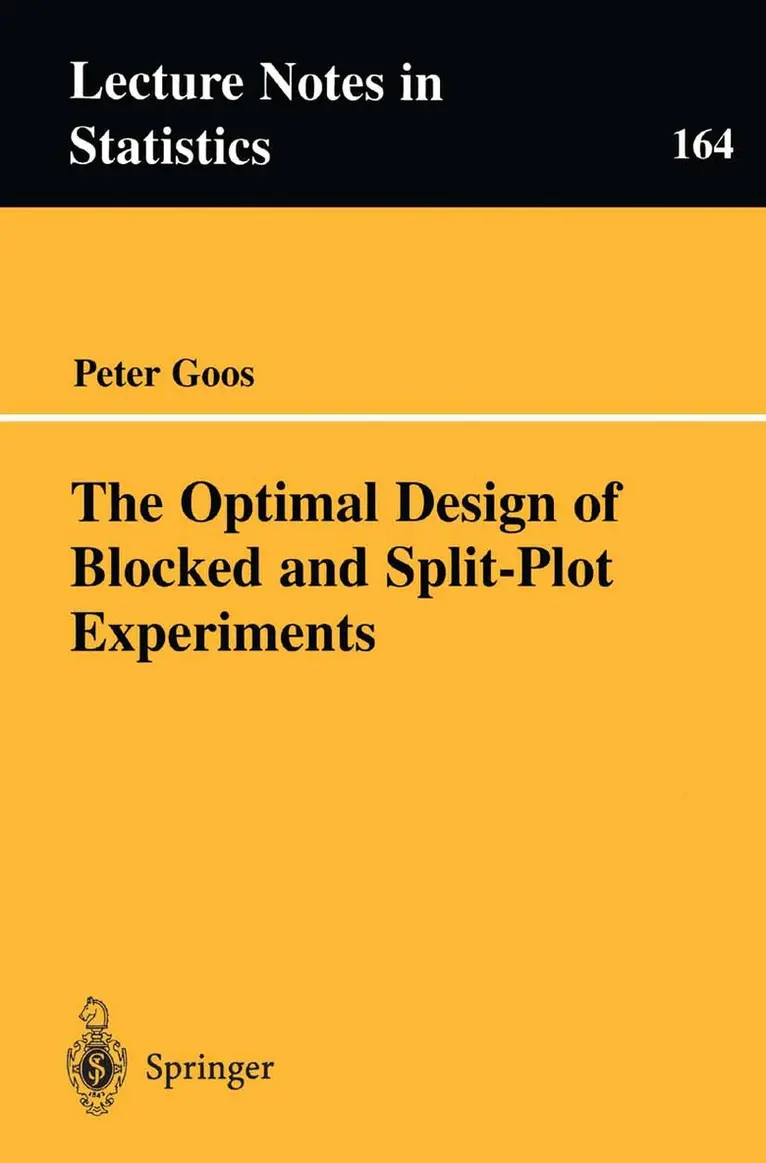
    Optimal Design of Blocked and Split-Plot Experiments

    AvPeter Goos

    Häftad, Engelska, 2002

    Del 164 i serien Lecture Notes in Statistics

    1 085 kr

    Beställningsvara. Skickas inom 10-15 vardagar. Fri frakt över 249 kr.

    Fler format och utgåvor

    E-bok

    1 413 kr

    Beskrivning

    Quality has become an important source of competitive advantage for the modern company. Therefore, quality control has become one of its key ac­ tivities. Since the control of existing products and processes only allows moderate quality improvements, the optimal design of new products and processes has become extremely important. This is because the flexibility, which characterizes the design stage, allows the quality to be built in prod­ ucts and processes. In this way, substantial quality improvements can be achieved. An indispensable technique in the design stage of a product or a process is the statistically designed experiment for investigating the effect of sev­ eral factors on a quality characteristic. A number of standard experimental designs like, for instance, the factorial designs and the central compos­ ite designs have been proposed. Although these designs possess excellent properties, they can seldom be used in practice. One reason is that using standard designs requires a large number of observations and can therefore be expensive or time-consuming. Moreover, standard experimental designs cannot be used when both quantitative and qualitative factors are to be in­ vestigated or when the factor levels are subject to one or more constraints.

    Produktinformation

    • Utgivningsdatum:2002-07-10
    • Mått:155 x 235 x 15 mm
    • Vikt:406 g
    • Format:Häftad
    • Språk:Engelska
    • Serie:Lecture Notes in Statistics
    • Antal sidor:264
    • Upplaga:2002
    • Förlag:Springer-Verlag New York Inc.
    • ISBN:9780387955155

    Utforska kategorier

    • Matematisk statistik inom Naturvetenskap och teknik
    • Naturvetenskap:allmänt inom Naturvetenskap och teknik

    Recensioner i media

    "Many books and papers discussing the blocking of experimental designs have been published since the appearance of the pioneer work of Ronald Fisher nearly a century ago. Unlike most of them, the author of the book approaches this topic as an application of the theory of optimum design. This is achieved without presenting too complex mathematical derivations of results, while those provided are clearly presented and easy to follow...A valuable addition to the literature on Design of Experiments." -Biometrics, June 2004 "The Optimal Design of Blocked and Split-Plot Experiments is a good overview of the techniques available in the optimal design of blocked and split-plot experiments, including the author's own great research in this field. The optimal design approach advocated in this book will help practitioners of statistics in setting up tailor-made experiments. It is also a good reference book for researchers and students in applied statistics." Techometrics, February 2005

    Innehållsförteckning

    • 1 Introduction.- 1.1 A practical design problem.- 1.2 Analysis of experiments.- 1.3 Design of experiments.- 1.4 Optimal designs.- 1.5 Standard response surface designs.- 1.6 Categorical designs.- 1.7 The D-optimality criterion.- 1.8 Updating the information matrix, its inverse and its determinant.- 1.9 Constructing discrete D-optimal designs.- 2 Advanced Topics in Optimal Design.- 2.1 Heterogeneous variance.- 2.2 Correlated observations.- 2.3 Blocking experiments.- 3 Compound Symmetric Error Structure.- 3.1 Restricted randomization.- 3.2 Model.- 3.3 Analysis.- 3.4 Information matrix.- 3.5 Equivalence of OLS and GLS.- 3.6 Small sample properties of the design criterion.- 4 Optimal Designs in the Presence of Random Block Effects.- 4.1 Introduction.- 4.2 The random block effects model.- 4.3 Optimal designs that do not depend on ?.- 4.4 Optimal designs when ? ? + ?.- 4.5 The general case.- 4.6 Computational results.- 4.7 Pastry dough mixing experiment..- 4.8 More than three factor levels.- 4.9 Efficiency of blocking.- 4.10 Optimal number of blocks and block sizes.- 4.11 Optimality of orthogonal blocking.- Appendix A. Design construction algorithm.- Appendix B. Adjustment algorithm.- 5 Optimal Designs for Quadratic Regression on One Variable and Blocks of Size Two.- 5.1 Introduction.- 5.2 Optometry experiment.- 5.3 Model.- 5.4 Continuous D-optimal designs.- 5.5 Exact D-optimal designs.- 5.6 Discussion.- 6 Constrained Split-Plot Designs.- 6.1 Introduction.- 6.2 Model.- 6.3 Analysis of a split-plot experiment.- 6.4 Design of a split-plot experiment.- 6.5 Some theoretical results.- 6.6 Design construction algorithm.- 6.7 Computational results.- 6.8 The protein extraction experiment.- 6.9 Algorithm evaluation.- 6.10 Cost efficiency and statistical efficiency.- Appendix A.Optimality of crossed split-plot designs.- Appendix B. V-optimality of 2m and 2m–f designs.- Appendix C. The construction algorithm.- Appendix D. Estimated expected efficiency.- 7 Optimal Split-Plot Designs in the Presence of Hard-to-Change Factors.- 7.1 Introduction.- 7.2 Model.- 7.3 Design construction algorithm.- 7.4 Computational results.- Appendix A. The construction algorithm.- Appendix B. Saturated designs with correlated observations.- 8 Optimal Split-Plot Designs.- 8.1 Introduction.- 8.2 Increasing the number of level changes.- 8.3 Design construction.- 8.4 Computational results.- 8.5 Discussion.- Appendix. The construction algorithm.- 9 Two-Level Factorial and Fractional Factorial Designs.- 9.1 Introduction.- 9.2 Blocking 2m and 2m–f factorial designs.- 9.3 2m and 2m–f split-plot designs.- 9.4 Discussion.- 10 Summary and Future Research.