• Fri frakt över 249 kr
  • •
  • Snabba leveranser
  • •
  • Billiga böcker
Kundservice

Du är på sajten för privatpersoner.

Företag, bibliotek eller offentlig verksamhet?

Du handlar på classic.bokus.com, där alla dina funktioner finns intakta.
Till classic.bokus.com
Bokus logotyp. Gå till startsidan.
  • Erbjudanden
  • Nyheter
  • Student
  • Topplistor
  • Barn & ungdom
  • Bokus Play
  • E-böcker
  • Pocketböcker
  • Spel & pussel

10% rabatt på allt med kod: NYSTART10 →

Sidfot

Mina sidor

    Hjälp

    • Kundservice
    • Vanliga frågor och svar
    • Frakt och leverans
    • Retur vid ångerrätt
    • Reklamera vara
    • Betalning
    • Köpvillkor
    • Allmänna villkor
    • Information om webbplatsens tillgänglighet

    Om Bokus

    • Om oss
    • Pressrum
    • För studenter
    • För företag
    • För bibliotek och offentlig verksamhet
    • För leverantörer
    • Hållbarhet

    Populärt

    • Aktuella erbjudanden
    • Presentkort
    • Studentlitteratur
    • Nya böcker
    • Topplistor
    • Signerade böcker
    • Engelska böcker

    Inspiration

    • Boktips
    • BookTok
    • Populära bokserier
    • Barnbokskaraktärer
    • Populära författare
    Logotyp för Bokus
    Följ oss på Facebook (extern länk)Följ oss på Instagram (extern länk)Följ oss på YouTube (extern länk)Följ oss på TikTok (extern länk)
    bokus @ CookiesAnpassa cookiesIntegritetspolicyKöpvillkor
    Till Citymail hemsida (extern länk)Till Budbee hemsida (extern länk)Till Postnord hemsida (extern länk)Till Schenker hemsida (extern länk)Till Early Bird hemsida (extern länk)Till Walleys hemsida (extern länk)
    1. Samhälle och politik
    2. Samhälle och kultur
    3. Kultur och medier
    4. Referensverk och tvärvetenskap

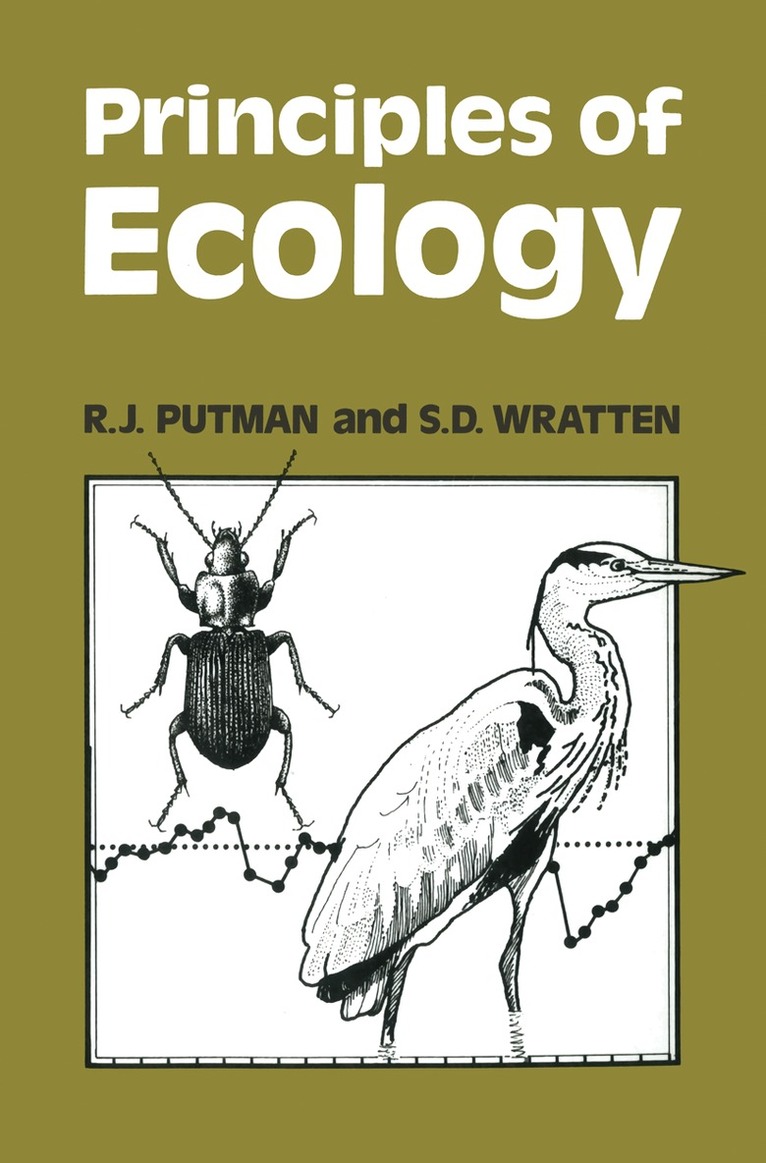
    Principles of Ecology

    AvRory Putman

    Häftad, Engelska, 1983

    1 086 kr

    Beställningsvara. Skickas inom 10-15 vardagar. Fri frakt över 249 kr.

    Beskrivning

    As Ecology teachers ourselves we have become increasingly aware of the lack of a single comprehensive textbook of Ecvlogy which we can recommend unreservedly to our students. While general, review texts are readily available in other fields, recent publications in Ecology have tended for the most part to be small, specialised works on single aspects of the subject. Such general texts as are available are often rather too detailed and, in addition, tend to be somewhat biased towards one aspect of the discipline or another and are thus not truly balanced syntheses of current knowledge. Ecology is, in addition, a rapidly developing subject: new information is being gathered all the time on a variety of key questions; new approaches and techniques open up whole new areas of research and establish new principles. Already things have changed radically since the early '70s and we feel there is a need for an up to date student text that will include some of this newer material. We have tried, therefore, to create a text that will review all the major principles and tenets within the whole field of Ecology, presenting the generally accepted theories and fundamentals and reviewing carefully the evidence on which such principles have been founded. While recent developments in ecological thought are emphasised, we hope that these will not dominate the material to the extent where the older-established principles are ignored or overlooked.

    Produktinformation

    • Utgivningsdatum:1983-04-01
    • Mått:155 x 235 x 21 mm
    • Vikt:587 g
    • Format:Häftad
    • Språk:Engelska
    • Antal sidor:388
    • Upplaga:1984
    • Förlag:Chapman and Hall
    • ISBN:9780412319303

    Utforska kategorier

    • Referensverk och tvärvetenskap inom Samhälle och politik
    • Miljövetenskap och miljöpolitik inom Naturvetenskap och teknik
    • Biovetenskap inom Naturvetenskap och teknik

    Innehållsförteckning

    • 1: The Organism and its Environment.- 1.1 The organism and its abiotic environment: limits to tolerance.- 1.2 Interactions between environmental variables.- 1.3 Macro-environment and micro-environment.- 1.4 Adjustment of tolerance limits.- 1.5 Homeostasis: avoidance of the problem.- 1.6 Behavioural mechanisms for homeostasis.- 1.7 Adaptive suites.- 1.8 Organism and abiota: a two-way interaction.- 2: The Ecological Community.- 2.1 Introduction.- 2.2 Communities and ecosystems.- 2.3 Biotic relationships.- 2.4 The organism in the community.- 2.5 The community level of organisation.- 2.6 Tropho-dynamic analyses.- 2.7 Community structure.- 2.8 Analyses of food web design.- 2.9 Subcompartments in community structure.- 2.10 Common denominators of community design.- 2.11 Species-abundance relationships.- 2.12 Species associations.- 2.13 Niche relationships and design rules.- 2.14 The structure of particular communities.- 2.15 Community flux.- 3: Community Dynamics.- 3.1 Introduction.- 3.2 The community as a system of energy transformations.- 3.3 Energy relationships of individuals.- 3.4 Energy relationships in the community.- 3.5 Energy flow within the community: the tropho-dynamic approach.- 3.6 Limitations of energy analysis.- 3.7 The flow of nutrients within communities.- 3.8 The importance of the decomposers.- 4: Temporal Change in Community Structure and Function.- 4.1 Introduction.- 4.2 Short-term cycles in community structure.- 4.3 Shifts in community structure: colonisation and extinction.- 4.4 Succession.- 4.5 Characteristics of succession.- 4.6 The mechanics of succession.- 4.7 What stops the successional process?.- 4.8 Climax communities.- 4.9 Succession as a necessary mathematical consequence.- 5: The Concept of the Niche.- 5.1 Introduction and definition of niche.-5.2 Parameters of the niche.- 5.3 Factors affecting the niche and its parameters.- 5.4 Niche separation.- 5.5 Niche overlap.- 5.6 Measures of niche width, separation and overlap.- 5.7 Niche relationships and community structure.- 5.8 Parallel niches.- 6: Interspecific Competition and Community Structure.- 6.1 Introduction and definitions of competition.- 6.2 Interspecific competition.- 6.3 The mechanics of competition.- 6.4 Niche overlap and competition.- 6.5 The effects of interspecific competition within the community: exclusion and coexistence.- 6.6 Diffuse competition and indirect competitive effects.- 6.7 Competition as a selection pressure promoting change.- 6.8 Niche shifts and evolutionary change due to competition.- 6.9 Interspecific competition in natural systems.- 7: Population Structure and Analysis.- 7.1 What is population ecology?.- 7.2 Theoretical population growth.- 7.3 The analytic (life table) approach.- 7.4 Simulation of population events.- 7.5 Towards a general population theory.- 8: Competition and Population Stability.- 8.1 Introduction: inter and intra-specific competition and population stability.- 8.2 Regulation in vertebrate populations.- 8.3 Population cycles in vertebrates.- 8.4 Population cycles in invertebrates.- 9: Predators, Parasitoids and Population Stability.- 9.1 Why study predators and parasitoids?.- 9.2 Analytical models and the components of prédation.- 9.3 Predator development and accumulation.- 9.4 A theoretical basis for biological control.- 9.5 Polyphagous predators and analytical models.- 9.6 Field studies of the role of polyphagous predators.- 9.7 The effects of prédation on prey productivity and community structure.- 10: Evolution and Adaptation.- 10.1 Evolution and ecology.- 10.2 Adaptation.- 10.3 Bionomic strategies.-10.4 Implications of r- and K-selection.- 10.5 Adaptiveness of foraging strategy.- 10.6 Optimal foraging.- 10.7 Reproductive strategy.- 10.8 Adaptiveness of social group.- 10.9 Optimality and evolutionarily stable strategies.- 10.10 The evolution of stable strategies.- 11: Coevolution.- 11.1 Insect-plant interactions.- 11.2 Larger herbivores.- 11.3 Interaction of plant-herbivore populations.- 11.4 Coevolution to mutualism.- 11.5 Coadapted systems.- 12: Species Diversity.- 12.1 Diversity as a descriptor of ecological communities.- 12.2 Measures of diversity.- 12.3 Resolution of chaos in diversity indices.- 12.4 The S component of diversity: why are there so many kinds of organisms?.- 12.5 Colonisation, extinction and island biogeography.- 12.6 Saturation point.- 12.7 Equitability.- 12.8 Factors promoting species diversity.- 12.9 Theories of diversity.- 13: Stability.- 13.1 Definitions.- 13.2 Stability of single species populations.- 13.3 Stability of two or three species systems.- 13.4 Community stability.- 13.5 Diversity and stability.- 13.6 May’s Paradox.- 13.7 Stability and food web design.- 13.8 The energetics of stable systems.- 13.9 Causes for stability.- References.- Acknowledgements.