• Fri frakt över 249 kr
  • •
  • Snabba leveranser
  • •
  • Billiga böcker
Kundservice

Du är på sajten för privatpersoner.

Företag, bibliotek eller offentlig verksamhet?

Du handlar på classic.bokus.com, där alla dina funktioner finns intakta.
Till classic.bokus.com
Bokus logotyp. Gå till startsidan.
  • Erbjudanden
  • Nyheter
  • Student
  • Topplistor
  • Barn & ungdom
  • Bokus Play
  • E-böcker
  • Pocketböcker
  • Spel & pussel

Må bättre, för mindre! Upp till 50% rabatt på hälsoböcker

Sidfot

Mina sidor

    Hjälp

    • Kundservice
    • Vanliga frågor och svar
    • Frakt och leverans
    • Retur vid ångerrätt
    • Reklamera vara
    • Betalning
    • Köpvillkor
    • Allmänna villkor
    • Information om webbplatsens tillgänglighet

    Om Bokus

    • Om oss
    • Pressrum
    • För studenter
    • För företag
    • För bibliotek och offentlig verksamhet
    • För leverantörer
    • Hållbarhet

    Populärt

    • Aktuella erbjudanden
    • Presentkort
    • Studentlitteratur
    • Nya böcker
    • Topplistor
    • Signerade böcker
    • Engelska böcker

    Inspiration

    • Boktips
    • BookTok
    • Populära bokserier
    • Barnbokskaraktärer
    • Populära författare
    Logotyp för Bokus
    Följ oss på Facebook (extern länk)Följ oss på Instagram (extern länk)Följ oss på YouTube (extern länk)Följ oss på TikTok (extern länk)
    bokus @ CookiesAnpassa cookiesIntegritetspolicyKöpvillkor
    Till Citymail hemsida (extern länk)Till Budbee hemsida (extern länk)Till Postnord hemsida (extern länk)Till Schenker hemsida (extern länk)Till Early Bird hemsida (extern länk)Till Walleys hemsida (extern länk)
    1. Samhälle och politik
    2. Politik och statsskick
    3. Politisk aktivism

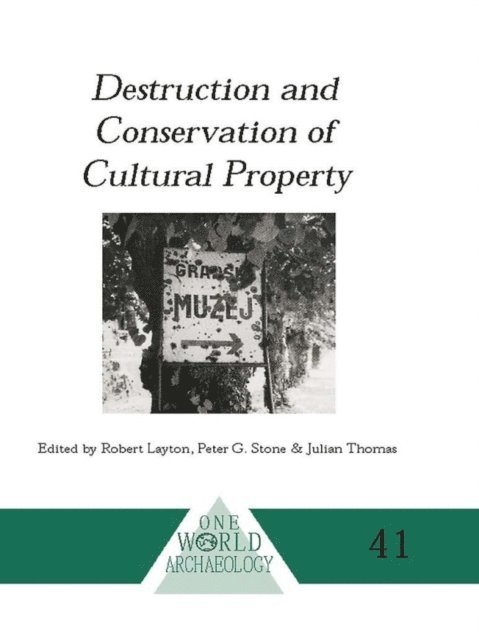
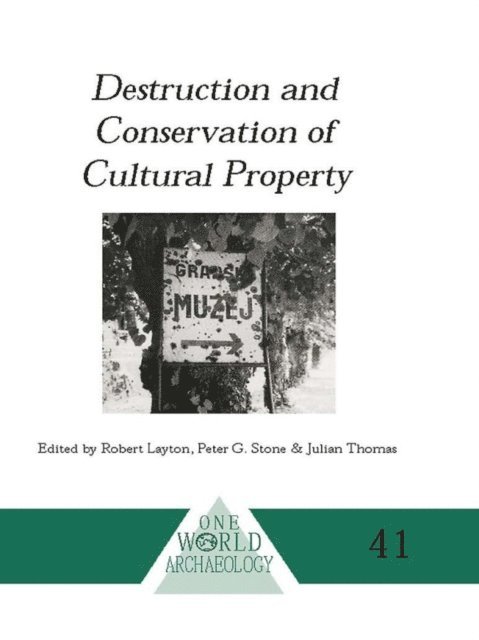
    Destruction and Conservation of Cultural Property

    AvR Layton,P Stone

    Inbunden, Engelska, 2001

    Del i serien One World Archaeology

    2 421 kr

    Beställningsvara. Skickas inom 10-15 vardagar. Fri frakt över 249 kr.

    Beskrivning

    In 1991 the mosque at Ayodhya in India was demolished by Hindu fundamentalists who claim that it stood on the birthplace of a legendary Hindu hero. During recent conflicts in former Yugoslavia, ethnic groups destroyed mosques and churches to eliminate evidence of long-term settlement by other communities. Over successive centuries, however, a single building in Cordoba functioned as a mosque, a church and a synagogue. The Roman Emperor Diocletian's Palace in Split is occupied today by shops and residential apartments. What circumstances have lead to the survival and reinterpretation of some monuments, but the destruction of others?This work asks whether the idea of world heritage is an essential mechanism for the protection of the world's cultural and natural heritage, or whether it subjugates a diversity of cultural traditions to specifically Western ideas. How far is it acceptable for one group of people to comment upon, or intercede in, the way in which another community treats the remains which it claims as its own? What are the responsibilities of multinational corporations and non-governmental organisations operating in the Developing World? Who actually owns the past: the landowner, indigenous people, the State or humankind?

    Produktinformation

    • Utgivningsdatum:2001-08-23
    • Mått:156 x 234 x 25 mm
    • Vikt:725 g
    • Format:Inbunden
    • Språk:Engelska
    • Serie:One World Archaeology
    • Antal sidor:348
    • Förlag:Taylor & Francis Ltd
    • ISBN:9780415216951

    Utforska kategorier

    • Politisk aktivism inom Samhälle och politik
    • Religion: allmänt inom Filosofi och religion

    Mer om författaren

    Robert Layton is Professor of Anthropology at the University of Durham. Peter G. Stone is Chief Executive of the World Archaeological Congress and Lecturer in Heritage Studies at the University of Newcastle. Julian Thomas is Chair of Archaeology at the University of Manchester.

    Innehållsförteckning

    • 1 Introduction: the destruction and conservation of cultural property 2 The uneasy bedfellows: universality and cultural heritage 3 Should developing countries restore and conserve? 4 The end of history? Archaeology and the politics of identity in a globalized world 5 Return to Alexandria: conflict and contradiction in discourses of origins and heritage revivalism 6 Renovating Hue (Vietnam): authenticating destruction, reconstructing authenticity 7 Destruction and conservation of cultural property in Brazil: academic and practical challenges 8 From museum to mantelpiece: the antiquities trade in the United Kingdom 9 A note on the excavations at Ayodhya with reference to the Mandir-Masjid issue 10 The Ayodhya Issue 11 Ayodhya, the print media and communalism 12 The protection of Croatia's cultural heritage during war 1991-95 13 Challenges and dilemmas facing the reconstruction of war-damaged cultural heritage: the case study of Pocitelj, Bosnia-Herzegovina 14 Imminent or eminent domain? The contest over Thessaloniki’s Rotonda 15 The politics of the past: Emain Macha (Navan), Northern Ireland 16 Making news out of archaeological sites: the experience at Ijaye Orile, Nigeria 17 The changing use of worship in Roman and medieval Cordoba 18 The Adriatic Islands Project: monument destruction and protection in the Central Dalmatian Islands 19 'Pios vandals': restoration or destruction in Sri Lanka? 20 Destruction or conservation? Some aspects of monument policy in British India (1899-1905) 21 Use, value and significance in heritage management 22 Is the past a non-renewable resource? 23 Cape Town's District Six and archaeology of memory