• Fri frakt över 249 kr
  • •
  • Snabba leveranser
  • •
  • Billiga böcker
Kundservice

Du är på sajten för privatpersoner.

Företag, bibliotek eller offentlig verksamhet?

Du handlar på classic.bokus.com, där alla dina funktioner finns intakta.
Till classic.bokus.com
Bokus logotyp. Gå till startsidan.
  • Erbjudanden
  • Nyheter
  • Student
  • Topplistor
  • Barn & ungdom
  • Bokus Play
  • E-böcker
  • Pocketböcker
  • Spel & pussel

10% rabatt på allt med kod: NYSTART10 →

Sidfot

Mina sidor

    Hjälp

    • Kundservice
    • Vanliga frågor och svar
    • Frakt och leverans
    • Retur vid ångerrätt
    • Reklamera vara
    • Betalning
    • Köpvillkor
    • Allmänna villkor
    • Information om webbplatsens tillgänglighet

    Om Bokus

    • Om oss
    • Pressrum
    • För studenter
    • För företag
    • För bibliotek och offentlig verksamhet
    • För leverantörer
    • Hållbarhet

    Populärt

    • Aktuella erbjudanden
    • Presentkort
    • Studentlitteratur
    • Nya böcker
    • Topplistor
    • Signerade böcker
    • Engelska böcker

    Inspiration

    • Boktips
    • BookTok
    • Populära bokserier
    • Barnbokskaraktärer
    • Populära författare
    Logotyp för Bokus
    Följ oss på Facebook (extern länk)Följ oss på Instagram (extern länk)Följ oss på YouTube (extern länk)Följ oss på TikTok (extern länk)
    bokus @ CookiesAnpassa cookiesIntegritetspolicyKöpvillkor
    Till Citymail hemsida (extern länk)Till Budbee hemsida (extern länk)Till Postnord hemsida (extern länk)Till Schenker hemsida (extern länk)Till Early Bird hemsida (extern länk)Till Walleys hemsida (extern länk)
    1. Ekonomi och Ledarskap
    2. Företagsekonomi
    3. Affärsstrategi

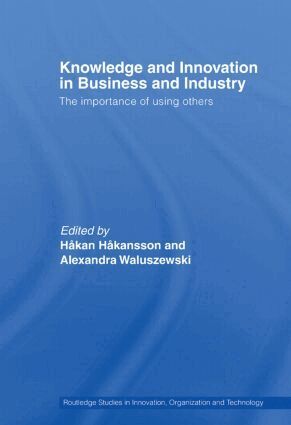
    Knowledge and Innovation in Business and Industry

    The Importance of Using Others

    AvHåkan Håkansson,Alexandra Waluszewski

    Häftad, Engelska, 2012

    Del i serien Routledge Studies in Innovation, Organizations and Technology

    744 kr

    Beställningsvara. Skickas inom 10-15 vardagar. Fri frakt över 249 kr.

    Beskrivning

    Provocative and reflective, this volume on the notion of knowledge and innovation in the business industry provides readers with a holistic approach to the subject of ‘knowledge’.Structuring their arguments around four case studies of innovation within four entirely different contexts, Håkansson and Waluszewski invite the business-minded reader to consider the costs of adopting new knowledge and innovation within a business setting.This book: questions the long-held assumption that new knowledge and innovation are universally advantageousfollows the tremor of an innovation as new knowledge reverberates through, or is dampened by the larger economic community - including cultural structures, the industrial standards and the foundational assumptions that rule a particular economic domainfocuses in particular on the interfaces where the innovative agent connects to its customers, suppliers and competitors.An ideal reference source for postgraduate students taking advanced courses in science and technology studies, innovation management, industrial marketing and purchasing, technological development and innovation systems.

    Produktinformation

    • Utgivningsdatum:2012-06-14
    • Mått:156 x 234 x 11 mm
    • Vikt:310 g
    • Format:Häftad
    • Språk:Engelska
    • Serie:Routledge Studies in Innovation, Organizations and Technology
    • Antal sidor:182
    • Förlag:Taylor & Francis Ltd
    • ISBN:9780415541572

    Utforska kategorier

    • Affärsstrategi inom Ekonomi och Ledarskap
    • Ledarskapsböcker inom Ekonomi och Ledarskap
    • Affärsförhandlingar inom Ekonomi och Ledarskap

    Mer om författaren

    Håkan Håkansson is Professor in International Management, Norwegian School of Management.Alexandra Waluszewski is Director of the Science & Technology Studies Center (STS) at Uppsala University, as well as a senior lecturer in the Department of Business Studies.

    Innehållsförteckning

    • 1. Economic Use of Knowledge 2. Resources in Use: The Embedded Electricity 3. Introducing 'Old' Knowledge in an Established User Context: Or How to Use Wood in the Construction Industry 4. Conscious Use of Others’ Interface Knowledge: Or How IKEA Can Keep the Price of the Lack Table Constant over Decades 5. Handling Resource Interfaces in a Planned Economy or How Tipografiya Solves Interaction Issues Without Direct Interaction 6. Use of Knowledge in the Model World: Lessons to Learn from Economic Literature 7. The Only Means to Create Use