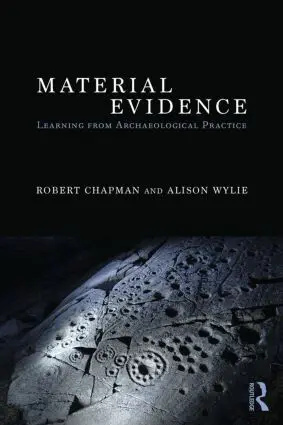
Häftad, Engelska, 2014
Material Evidence
Learning from Archaeological Practice
Av Robert Chapman, Alison Wylie
854 kr
Beställningsvara. Skickas inom 10-15 vardagar. Fri frakt över 249 kr.
Fler format och utgåvor
Beskrivning
Produktinformation
- Utgivningsdatum: 2014-12-12
- Mått: 156 x 234 x 15 mm
- Vikt: 740 g
- Format: Häftad
- Språk: Engelska
- Antal sidor: 380
- Förlag: Taylor & Francis Ltd
- ISBN: 9780415837460
Utforska kategorier
Mer om författaren
Bob Chapman is Emeritus Professor of Archaeology at the University of Reading, UK. His research focuses on archaeological theory, Mediterranean later prehistory, the development of human inequality and the means by which this can be studied with archaeological data. He has pursued these interests in fieldwork projects in southeast Spain and the Balearic Islands, as well as in books such as The Archaeology of Death (1981), Emerging Complexity (1990) and Archaeologies of Complexity (2003). In recent years his research has turned increasingly to the use of historical materialism in archaeological interpretation, especially in relation to inequality and human exploitation. Running through this research activity has been a strong concern for the nature of archaeological interpretation, working with the complementary evidence of how people lived (e.g. what they produced, exchanged and consumed, centred on settlement evidence) and how they were treated in death (e.g. their disposal, centred on burial evidence).Alison Wylie is Professor of Philosophy and Anthropology at the University of Washington, and of Philosophy at Durham University. She is a philosopher of the social and historical sciences who works on questions about objectivity, evidence, and research ethics raised by archaeological practice and by feminist research in the social sciences. Her longstanding interest in evidential reasoning is represented by Thinking from Things (2002) and by contributions to Evidence, Inference and Enquiry (Dawid, Twining and Vasilaki, 2011), How Well do 'Facts' Travel? (Morgan, 2010), and Agnatology (Proctor and Schiebinger, 2008). In recent work she focuses on the role of contextual values in science and on how research can be improved by internal diversity and by collaborations that extend beyond the research community. These interests are reflected in Value-free Science? (co-edited with Kincaid and Dupré, 2007) and Epistemic Diversity and Dissent (edited for Episteme 2006), as well as in essays on stewardship and feminist standpoint theory.
Recensioner i media
Select Guide Rating
Betyg & recensioner
0 recensioner
Inga recensioner tillgängliga.