• Fri frakt över 249 kr
  • •
  • Snabba leveranser
  • •
  • Billiga böcker
Kundservice

Du är på sajten för privatpersoner.

Företag, bibliotek eller offentlig verksamhet?

Du handlar på classic.bokus.com, där alla dina funktioner finns intakta.
Till classic.bokus.com
Bokus logotyp. Gå till startsidan.
  • Erbjudanden
  • Nyheter
  • Student
  • Topplistor
  • Barn & ungdom
  • Bokus Play
  • E-böcker
  • Pocketböcker
  • Spel & pussel

10% rabatt på allt med kod NYSTART10 →

Sidfot

Mina sidor

    Hjälp

    • Kundservice
    • Vanliga frågor och svar
    • Frakt och leverans
    • Retur vid ångerrätt
    • Reklamera vara
    • Betalning
    • Köpvillkor
    • Allmänna villkor
    • Information om webbplatsens tillgänglighet

    Om Bokus

    • Om oss
    • Pressrum
    • För studenter
    • För företag
    • För bibliotek och offentlig verksamhet
    • För leverantörer
    • Hållbarhet

    Populärt

    • Aktuella erbjudanden
    • Presentkort
    • Studentlitteratur
    • Nya böcker
    • Topplistor
    • Signerade böcker
    • Engelska böcker

    Inspiration

    • Boktips
    • BookTok
    • Populära bokserier
    • Barnbokskaraktärer
    • Populära författare
    Logotyp för Bokus
    Följ oss på Facebook (extern länk)Följ oss på Instagram (extern länk)Följ oss på YouTube (extern länk)Följ oss på TikTok (extern länk)
    bokus @ CookiesAnpassa cookiesIntegritetspolicyKöpvillkor
    Till Citymail hemsida (extern länk)Till Budbee hemsida (extern länk)Till Postnord hemsida (extern länk)Till Schenker hemsida (extern länk)Till Early Bird hemsida (extern länk)Till Walleys hemsida (extern länk)
    1. Psykologi och pedagogik
    2. Pedagogik
    3. Utbildningsstrategier och utbildningspolitik

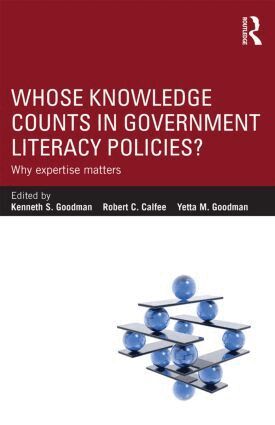
    Whose Knowledge Counts in Government Literacy Policies?

    Why Expertise Matters

    AvKenneth S. Goodman,Robert C. Calfee

    Häftad, Engelska, 2013

    689 kr

    Beställningsvara. Skickas inom 10-15 vardagar. Fri frakt över 249 kr.

    Beskrivning

    Accountability, in the form of standardized test scores, is built into many government literacy policies, with severe consequences for schools and districts that fail to meet ever-increasing performance levels. The key question this book addresses is whose knowledge is considered in framing government literacy policies? The intent is to raise awareness of the degree to which expertise is being ignored on a worldwide level and pseudo-science is becoming the basis for literacy policies and laws. The authors, all leading researchers from the U.S., U.K., Scotland, France, and Germany, have a wide range of views but share in common a deep concern about the lack of respect for knowledge among policy makers. Each author comes to the common subject of this volume from the vantage point of his or her major interests, ranging from an exposition of what should be the best knowledge utilized in an aspect of literacy education policy, to how political decisions are impacting literacy policy, to laying out the history of events in their own country. Collectively they offer a critical analysis of the condition of literacy education past and present and suggest alternative courses of action for the future.

    Produktinformation

    • Utgivningsdatum:2013-10-01
    • Mått:152 x 229 x 13 mm
    • Vikt:340 g
    • Format:Häftad
    • Språk:Engelska
    • Antal sidor:217
    • Förlag:Taylor & Francis Ltd
    • ISBN:9780415858014

    Utforska kategorier

    • Utbildningsstrategier och utbildningspolitik inom Psykologi och pedagogik
    • Skolan och förskolan inom Psykologi och pedagogik
    • Undervisning i specifika ämnen inom Psykologi och pedagogik

    Mer om författaren

    Kenneth S. Goodman is Professor Emeritus, Language, Reading and Culture, University of Arizona, USA. Robert C. Calfee is Professor Emeritus, Stanford University School of Education, USA.Yetta M. Goodman is Regents Professor Emerita, Language, Reading and Culture, University of Arizona, USA.

    Recensioner i media

    "Curriculum and policy are informed by assumptions about what counts as knowledge, grounded in notions of human nature, and affected by determinations about whose knowledge counts in the construction and delivery of knowledge in formal educational settings. The diversity of ideas offered within the book affords the reader a rich opportunity to consider foundational issues of policy and practice. Summing up: Recommended. All readership levels." - J.A. Helfer, Illinois State Board of Education, in CHOICE, August 2014"Part II explores many important aspects of literacy teaching, including the curriculum, text complexity, the role of children’s literature, diversity in children’s literature and the roles of writing teachers." - Margaret Clark, Newman University - Birmingham, Education Journal“Finally! A book that offers smart thinking about federal literacy education policies by the professionals who know literacy best…. This book connects the dots between current literacy policies, who is writing those policies, and what ultimately happens when the policies are implemented in school classrooms. These international scholars provide glimpses of parallel events happening around the world, beg us to question why knowledge about literacy research is being ignored, and challenge us to consider who really gains when “science” is valued over knowledge.” - Renita Schmidt, The University of Iowa, USA"A thorough critique of government literacy policies ... Whose Knowledge Counts not only confirms the need for policy makers to work with literacy experts, but from a larger perspective, it re-emphasizes the need for families, educators, scholars, researchers, and policy makers to work in tandem to bring meaningful change that keeps the focus on the betterment of all human beings." - Teachers College Record

    Innehållsförteckning

    • CONTENTSForeword: Joel SpringAcknowledgmentsChapter 1: Introduction: Knowledge, Evidence, and Faith: How the Federal Government Used Science to Take Over Public Schools, Robert CalfeePart 1: The Political RealtiesChapter 2: Whose Knowledge Counts? The Pedagogy of the Absurd, Kenneth S. GoodmanChapter 3: Re-reading Poverty; Reorienting Educational Policy, Patrick ShannonChapter 4: Neoliberal and Neoconservative Literacy Education Policies in Contemporary France, Jacques FijalkowChapter 5: Flying Blind: Government Policy on the Teaching of Reading in England and Research on Effective Literacy Education, Henrietta DombeyChapter 6: Whose Knowledge Counts, For Whom, In What Circumstances?: The Ethical Constraints on Who Decides, Sue EllisChapter 7: About the Dubious Role of Phonological Awareness in the Discussion of Literacy Policies, Renate Valtin Part 2: Aspects of Literacy: The Knowledge BaseChapter 8: The Role of Story and Literature in a World of Tests and Standards, Kathy G. ShortChapter 9: The Staircase Curriculum: Whole-School Collaboration to Improve Literacy Achievement, Kathryn H. Au and Taffy E. RaphaelChapter 10: Diversity in Children's Literature: What Does It Matter in Today's Educational Climate? Rudine Sims Bishop Chapter 11: Examining Three Assumptions about Text Complexity: Standard 10 of the Common Core State Standards, Elfrieda H. Hiebert and Katie Van Sluys Chapter 12: The Role of Literature and Literary Reasoning in English Language Arts and English Classrooms, Judith A. LangerChapter 13: Writing Teachers: The Roles Exploration, Evaluation, and Time Play in Their Lives, Jane HansenChapter 14: What Do Children Need to Succeed in Early Literacy—And Beyond? William H. Teale, Jessica L. Hoffman, and Kathleen A. PacigaChapter 15: The Impact of Changing Conceptions of Language on Curriculum and Instruction of Literacy and the Language Arts, David Bloome and Melissa Wilson,Comments: Nu!.... So!... Where do We Go from Here? Yetta M. GoodmanList of Contributors