• Fri frakt över 249 kr
  • •
  • Snabba leveranser
  • •
  • Billiga böcker
Kundservice

Du är på sajten för privatpersoner.

Företag, bibliotek eller offentlig verksamhet?

Du handlar på classic.bokus.com, där alla dina funktioner finns intakta.
Till classic.bokus.com
Bokus logotyp. Gå till startsidan.
  • Erbjudanden
  • Student
  • Topplistor
  • Barn & ungdom
  • Bokus Play
  • E-böcker
  • Ljudböcker
  • Pocketböcker
  • Spel & pussel

10% rabatt på allt med kod NYSTART10 →

Sidfot

Mina sidor

    Hjälp

    • Kundservice
    • Vanliga frågor och svar
    • Frakt och leverans
    • Retur vid ångerrätt
    • Reklamera vara
    • Betalning
    • Köpvillkor
    • Allmänna villkor
    • Information om webbplatsens tillgänglighet

    Om Bokus

    • Om oss
    • Pressrum
    • För studenter
    • För företag
    • För bibliotek och offentlig verksamhet
    • För leverantörer
    • Hållbarhet

    Populärt

    • Aktuella erbjudanden
    • Presentkort
    • Studentlitteratur
    • Nya böcker
    • Topplistor
    • Signerade böcker
    • Engelska böcker

    Inspiration

    • Boktips
    • BookTok
    • Populära bokserier
    • Barnbokskaraktärer
    • Populära författare
    Logotyp för Bokus
    Följ oss på Facebook (extern länk)Följ oss på Instagram (extern länk)Följ oss på YouTube (extern länk)Följ oss på TikTok (extern länk)
    bokus @ CookiesAnpassa cookiesIntegritetspolicyKöpvillkor
    Till Citymail hemsida (extern länk)Till Budbee hemsida (extern länk)Till Postnord hemsida (extern länk)Till Schenker hemsida (extern länk)Till Early Bird hemsida (extern länk)Till Walleys hemsida (extern länk)
    1. Psykologi och pedagogik
    2. Pedagogik
    3. Pedagogisk psykologi

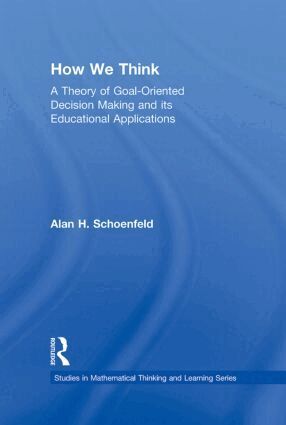
    How We Think

    A Theory of Goal-Oriented Decision Making and its Educational Applications

    AvAlan H. Schoenfeld

    Häftad, Engelska, 2010

    Del i serien Studies in Mathematical Thinking and Learning Series

    838 kr

    Beställningsvara. Skickas inom 10-15 vardagar. Fri frakt över 249 kr.
    Fler format och utgåvor

    Inbunden

    2 350 kr

    E-bok

    994 kr

    E-bok

    994 kr

    Beskrivning

    Teachers try to help their students learn. But why do they make the particular teaching choices they do? What resources do they draw upon? What accounts for the success or failure of their efforts? In How We Think, esteemed scholar and mathematician, Alan H. Schoenfeld, proposes a groundbreaking theory and model for how we think and act in the classroom and beyond. Based on thirty years of research on problem solving and teaching, Schoenfeld provides compelling evidence for a concrete approach that describes how teachers, and individuals more generally, navigate their way through in-the-moment decision-making in well-practiced domains. Applying his theoretical model to detailed representations and analyses of teachers at work as well as of professionals outside education, Schoenfeld argues that understanding and recognizing the goal-oriented patterns of our day to day decisions can help identify what makes effective or ineffective behavior in the classroom and beyond.

    Produktinformation

    • Utgivningsdatum:2010-10-05
    • Mått:152 x 229 x 14 mm
    • Vikt:490 g
    • Format:Häftad
    • Språk:Engelska
    • Serie:Studies in Mathematical Thinking and Learning Series
    • Antal sidor:264
    • Förlag:Taylor & Francis Ltd
    • ISBN:9780415878654

    Utforska kategorier

    • Pedagogisk psykologi inom Psykologi och pedagogik
    • Undervisning i specifika ämnen inom Psykologi och pedagogik

    Mer om författaren

    Alan H. Schoenfeld is the Elizabeth and Edward Conner Professor of Education and Affiliated Professor of Mathematics at the University of California, Berkeley.

    Recensioner i media

    "[It] constitutes an important scholarly contribution to our understanding of a key determinant to the quality of what takes place in the complex activity known as teaching and learning. In How We Think, Schoenfeld homes in on a facet of instructional practice that is central and yet invisible. The results are illuminating." --Teachers College Record"How We Think is an important resource for mathematics education, as well as the decision making sciences…The book is highly recommended to anyone interested in self analyzing teaching practice, researching teacher practices, building a program of research, or simply interested in how we think. The moderate length of the book also facilitates it being accessible for semester long graduate seminars. Last but not least the appendices contain a wealth of real data with notes and URL’s for those interested in learning fine grained analysis of teaching data."—Journal for Research in Mathematics Education"In-the-moment decision making is perhaps the most central activity of teaching; it is also one of the most elusive teaching activities to study. How We Think presents an approach to modeling in-the-moment decision making as a function of the teacher’s goals, orientations, and resources, and invites the educational community to explore the use of this model as a tool for understanding and improving teaching. The product of over a decade of scholarship, it is a wonderful example of theory building through careful, detailed empirical analysis."--Hilda Borko, Professor of Education, Stanford University"Alan H. Schoenfeld presents a general scheme for analyzing a person's activity in a dynamic environment by which he frames explanatory accounts of classroom mathematics teaching. There is much here that contributes to understanding important aspects of teaching and that shows how standard assumptions of psychological choice theory can be modified and extended to provide explanations of teaching."--James Greeno, Visiting Professor, School of Education, University of Pittsburgh"Reading this book is a must for members of the mathematics education community, not only because of the standing of its author and his writing style, but also because of the issue it addresses which is at the core of today’s agenda: mathematics teaching and the need for theoretical frameworks to study it."—Abraham Arcavi, ZDM: The International Journal on Mathematics Education

    Innehållsförteckning

    • Introduction and Acknowledgments1. The Big Picture2. Reflections, Caveats, Doubts, and Rationalizations3. The Structure of the Representations Used in this Book4. Lesson Analysis I: A beginning teacher carrying out a traditional lesson5. Lesson Analysis II: An experienced teacher carrying out a non-traditional lesson6. Lesson Analysis III: Third graders! A non-traditional lesson with an emergent agenda7. Lesson Analysis IV: The analysis of a doctor-patientConsultation – an act of joint problem solving 8. Next Steps Indices, etc