• Fri frakt över 249 kr
  • •
  • Snabba leveranser
  • •
  • Billiga böcker
Kundservice

Du är på sajten för privatpersoner.

Företag, bibliotek eller offentlig verksamhet?

Du handlar på classic.bokus.com, där alla dina funktioner finns intakta.
Till classic.bokus.com
Bokus logotyp. Gå till startsidan.
  • Erbjudanden
  • Nyheter
  • Student
  • Topplistor
  • Barn & ungdom
  • Bokus Play
  • E-böcker
  • Pocketböcker
  • Spel & pussel

10% rabatt på allt med kod: NYSTART10 →

Sidfot

Mina sidor

    Hjälp

    • Kundservice
    • Vanliga frågor och svar
    • Frakt och leverans
    • Retur vid ångerrätt
    • Reklamera vara
    • Betalning
    • Köpvillkor
    • Allmänna villkor
    • Information om webbplatsens tillgänglighet

    Om Bokus

    • Om oss
    • Pressrum
    • För studenter
    • För företag
    • För bibliotek och offentlig verksamhet
    • För leverantörer
    • Hållbarhet

    Populärt

    • Aktuella erbjudanden
    • Presentkort
    • Studentlitteratur
    • Nya böcker
    • Topplistor
    • Signerade böcker
    • Engelska böcker

    Inspiration

    • Boktips
    • BookTok
    • Populära bokserier
    • Barnbokskaraktärer
    • Populära författare
    Logotyp för Bokus
    Följ oss på Facebook (extern länk)Följ oss på Instagram (extern länk)Följ oss på YouTube (extern länk)Följ oss på TikTok (extern länk)
    bokus @ CookiesAnpassa cookiesIntegritetspolicyKöpvillkor
    Till Citymail hemsida (extern länk)Till Budbee hemsida (extern länk)Till Postnord hemsida (extern länk)Till Schenker hemsida (extern länk)Till Early Bird hemsida (extern länk)Till Walleys hemsida (extern länk)
    1. Djur och Natur
    2. Naturböcker
    3. Växtböcker

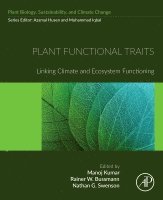
    Plant Functional Traits

    Linking Climate and Ecosystem Functioning

    AvManoj Kumar,Rainer W Bussmann

    Häftad, Engelska, 2025

    Del i serien Plant Biology, Sustainability, and Climate Change

    1 440 kr

    Beställningsvara. Skickas inom 10-15 vardagar. Fri frakt över 249 kr.

    Beskrivning

    Plant Function Traits: Linking Climate and Ecosystem Functioning, part of the Plant Biology, Sustainability and Climate Change series, presents a wholistic understanding of Plant Functional Traits. As global climate change advances, natural resources are facing increasing survival challenges, hence this book directly addresses that need, exploring the morphological, physiological, and phenological properties of a plant that can be used as a proxy to understand plant environment interactions. Users will find great illustrations throughout individual chapters, along with case studies that demonstrate applications of functional traits in classifying vegetation of a region into distinct type groups as Plant Functional Types (PFTs).

    Additional information includes applications in the development of new generation of Dynamic Global Vegetation Model (DGVM) and an understanding of the response of vegetation to changing environments.


    • Presents foundational insights into multiple functional trait axes
    • Describes the quantification of functional traits from individuals to regions
    • Includes the role of functional traits in developing new vegetation models for assessing the impact of climate change on plants

    Produktinformation

    • Utgivningsdatum:2025-03-20
    • Mått:191 x 235 x 23 mm
    • Vikt:450 g
    • Format:Häftad
    • Språk:Engelska
    • Serie:Plant Biology, Sustainability, and Climate Change
    • Antal sidor:432
    • Förlag:Elsevier Science
    • ISBN:9780443133671

    Utforska kategorier

    • Växtböcker inom Djur och Natur
    • Biokemi inom Naturvetenskap och teknik
    • Botanik inom Naturvetenskap och teknik

    Mer om författaren

    Dr. Kumar is a senior scientist working at Indian Council of Forestry Research & Education, Ministry of Environment, Forest & Climate Change, Government of India. Kumar primarily works in the field of forestry, environment, climate change, and related interdisciplinary fields with wider applications of Information Technology, Remote Sensing and GIS tools and has a working experience of more than fifteen years. His research area includes testing and development of dynamic vegetation models for the climate change impact studies. He has initiated work on developing forest growth simulation model (ForestInfo) to study functional relationship of plants with the environment that could be used for climate change impact studies and has published high impact international papers on various themes of agriculture, forestry, environment, and climate change. He has successfully implemented more than twenty research projects funded by national and international agencies. Prof. Dr. Rainer W. Bussmann is a vegetation ecologist and an ethnobotanist. He is Head and Full Professor at the Department of Ethnobotany, Institute of Botany, Ilia State University, Georgia. Before moving to Georgia, he was director of William L. Brown Center at Missouri Botanical Garden, USA. He held academic appointments as Associate Professor of Botany and Scientific Director of Harold Lyon Arboretum at University of Hawaii, USA and Assistant Professor at University of Bayreuth, Germany. He holds affiliate appointments and serves as external thesis advisor at universities worldwide. He has authored over 330 peer-reviewed papers, over 1200 peer-reviewed book chapters, and authored or edited 38 books. According to Stanford University, he is recognized among the 2% most influential scientists worldwide. He is past President of the Society for Economic Botany and has served as board/council member of the Botanical Society of America, and International Society of Ethnobiology. Prof. Swenson is a world expert in the ecology and evolution of tree species. His work focuses on the functional and historical processes that determine the performance, distribution and dynamics of trees across space and time. He obtained his Ph.D. from the University of Arizona and was a National Science Foundation Postdoctoral Fellow at Harvard University. He is currently the Gillen Director of the University of Notre Dame Environmental Research Center. He has published 2 books and over 160 peer reviewed papers including in journals such as Science, Nature and PNAS. Prof. Swenson has received multiple international awards including being named a Fellow of the John Simon Guggenheim Memorial Foundation, a Highly Cited Researcher by Clarivate Analytics and a recipient of the Ebbe Nielsen Prize from the Global Biodiversity Information Facility.

    Innehållsförteckning

    • 1. Plant functional traits: The scientific basis and their significance in climate change impact studiesSection I: Plant functional traits: the scientific basis2. Plant functional traits: synthesis of current status and available information3. Unravelling the relationship between plant functional traits and environment4. Functional traits as determinants of plant performance5. Driving mechanism of functional trait variations in a forest ecosystem6. Belowground traits and their importance in ecological studiesSection II: Functional relationship between trait and environment7. A review of plant–environment interactions8. Significance of trait and environment relations in ecological studies9. Plant functional traits for assessing impacts of climate change10. Traits explaining occurrence and abundance of plants11. Environmental conditions influencing the distribution of plant functional traitsSection III: Ecosystem services and plant functional traits12. Plant functional traits and soil carbon dynamics13. Selection of appropriate functional traits and its application to evaluate ecosystem service14. Trait-based selection of suitable plant species to restore the degraded ecosystems15. Monitoring canopy functional traits using remote sensing16. Hyperspectral remote sensing for monitoring plant functional traits17. Monitoring and modelling of functional relationship of plant traits with environment18. Investigating the origins and effects of intraspecific trait variations19. Monitoring of plant functional traits as indicator of air quality20. Synthesizing functional trait data to understand global patterns and processes of vegetation: gaps and biasesSection V: Functional traits and vegetation models21. Linking biophysical models with functional traits for ecological studies22. Representing functional traits in earth system models to understand coupled biosphere-atmosphere interactions23. Modelling the relationships between traits, climate, and life history strategies