• Fri frakt över 249 kr
  • •
  • Snabba leveranser
  • •
  • Billiga böcker
Kundservice

Du är på sajten för privatpersoner.

Företag, bibliotek eller offentlig verksamhet?

Du handlar på classic.bokus.com, där alla dina funktioner finns intakta.
Till classic.bokus.com
Bokus logotyp. Gå till startsidan.
  • Erbjudanden
  • Nyheter
  • Student
  • Topplistor
  • Barn & ungdom
  • Bokus Play
  • E-böcker
  • Pocketböcker
  • Spel & pussel

10% rabatt på allt med kod: NYSTART10 →

Sidfot

Mina sidor

    Hjälp

    • Kundservice
    • Vanliga frågor och svar
    • Frakt och leverans
    • Retur vid ångerrätt
    • Reklamera vara
    • Betalning
    • Köpvillkor
    • Allmänna villkor
    • Information om webbplatsens tillgänglighet

    Om Bokus

    • Om oss
    • Pressrum
    • För studenter
    • För företag
    • För bibliotek och offentlig verksamhet
    • För leverantörer
    • Hållbarhet

    Populärt

    • Aktuella erbjudanden
    • Presentkort
    • Studentlitteratur
    • Nya böcker
    • Topplistor
    • Signerade böcker
    • Engelska böcker

    Inspiration

    • Boktips
    • BookTok
    • Populära bokserier
    • Barnbokskaraktärer
    • Populära författare
    Logotyp för Bokus
    Följ oss på Facebook (extern länk)Följ oss på Instagram (extern länk)Följ oss på YouTube (extern länk)Följ oss på TikTok (extern länk)
    bokus @ CookiesAnpassa cookiesIntegritetspolicyKöpvillkor
    Till Citymail hemsida (extern länk)Till Budbee hemsida (extern länk)Till Postnord hemsida (extern länk)Till Schenker hemsida (extern länk)Till Early Bird hemsida (extern länk)Till Walleys hemsida (extern länk)
    1. Naturvetenskap och teknik
    2. Teknik och industri
    3. Biokemisk teknik

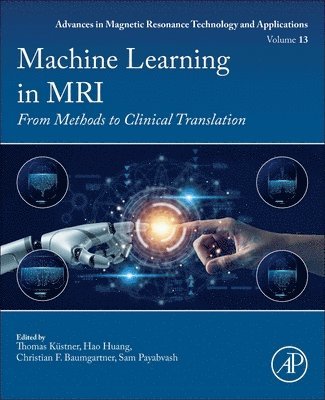
    Machine Learning in MRI

    From Methods to Clinical Translation

    AvThomas Kuestner,Hao Huang

    Häftad, Engelska, 2025

    Del 13 i serien Advances in Magnetic Resonance Technology and Applications

    1 479 kr

    Beställningsvara. Skickas inom 10-15 vardagar. Fri frakt över 249 kr.

    Beskrivning

    Machine Learning in MRI: From Methods to Clinical Translation, Volume Thirteen in the
    Advances in Magnetic Resonance Technology and Applications series presents state-of-the-art machine learning methods in magnetic resonance imaging that can shape and impact the future of patient treatment and planning. Common methods and strategies along the processing chain of data acquisition, image reconstruction, image post-processing, and image analysis of these imaging modalities are presented and illustrated. The book focuses on applications and anatomies for which machine learning methods can bring, or have already brought. Ideas and concepts on how processing could be harmonized and used to provide deployable frameworks that integrate into the clinical workflows are also considered.

    Pitfalls and current limitations are discussed in the context of how they could be overcome to cater for clinical needs, making this an ideal reference for medical imaging researchers, industry scientists and engineers, advanced undergraduate and graduate students, and clinicians. By giving an interdisciplinary presentation and discussion on the obstacles and possible solutions for the clinical translation of machine learning methods, this book enables the evolution of machine learning in medical imaging for the next decade.


    • Brings together applied researchers, clinicians, and computer scientists to give an interdisciplinary perspective on the methods of machine learning in MRI and their potential clinical translation
    • Gives a clear presentation of the key concepts of machine learning
    • Shows how machine learning methods can be applied to MR image acquisition, MR image reconstruction, MR motion correction, MR image post-processing, and MR image analysis
    • Includes application chapters that show how the methods can translate into medical practice

    Produktinformation

    • Utgivningsdatum:2025-12-19
    • Mått:191 x 235 x undefined mm
    • Vikt:1 470 g
    • Format:Häftad
    • Språk:Engelska
    • Serie:Advances in Magnetic Resonance Technology and Applications
    • Antal sidor:742
    • Förlag:Elsevier Science
    • ISBN:9780443141096

    Utforska kategorier

    • Biokemisk teknik inom Naturvetenskap och teknik
    • Biomedicinsk teknik inom Medicin
    • Medicinsk bildbehandling inom Medicin

    Mer om författaren

    Prof. Dr.-Ing. Thomas Küstner (Member, IEEE; Junior Fellow, ISMRM) is the chair of medical imaging and data analysis (MIDAS.lab) at the University Hospital of Tübingen, Germany. He received his PhD from the University of Stuttgart, Germany, in 2017. From 2018 to 2020 he was with the School of Biomedical Engineering and Imaging Sciences at King’s College London, United Kingdom. Since 2020 he co-leads the MIDAS.lab and in 2022 got appointed a professorship at the University Hospital of Tübingen, Germany about data engineering and advanced processing for medical imaging modalities. He is the spokesperson of the cross-section area for artificial intelligence-based infrastructure, data and methods in the clinic. His research group is working on artificial intelligence-enabled multi-parametric and multi-modality medical imaging methods in acquisition and reconstruction, and the automated analysis of clinical and epidemiological studies. He is particularly focused on MR-based motion imaging, correction and reconstruction, and the advents of artificial intelligence in MRI. Dr. Hao Huang is a Professor of Radiology in the Perelman School of Medicine at the University of Pennsylvania and Faculty Director of Small Animal Imaging Facility at Children’s Hospital of Philadelphia. He obtained his PhD in Biomedical Engineering from Johns Hopkins University School of Medicine in 2005. By pushing technical boundaries in advanced neural MRI acquisition and analysis, his works provide new knowledge on understanding circuits and functions of brain in health and disease. He has published more than 150 peer-reviewed articles and is one of the top scientists in neuroimaging and neurobiological sciences with cutting-edge techniques in diffusion, perfusion and functional MRI as well as artificial intelligence algorithms. He is on the Editorial Board of NeuroImage. He has served in a number of leadership positions in international committees. He has been recognized as the Distinguished Investigator of the Academy for Radiology and Biomedical Imaging Research in 2019. He has been elected as the Fellow of American Institute of Medical and Biological Engineering (AIMBE) in 2021. He has been elected as the Fellow of International Society of Magnetic Resonance in Medicine (ISMRM) in 2022. Dr. Christian Baumgartner is currently heading the Machine Learning for Medical Image Analysis Group which is part of the Cluster of Excellence: Machine Learning - New Perspectives for Science, at the University of Tübingen. Before joining the University of Tübingen, Christian was working in a senior research engineering role at PTC Vuforia, where he focused on research and development of machine learning technology for augmented reality applications. Prior to this, he was a Post-doc at the Biomedical Image Computing Group at ETH Zürich, and before in the Biomedical Image Analysis Lab at Imperial College London. Christian completed his PhD in 2016 under the joint supervision of Prof. Andy King and Prof. Daniel Rueckert at King’s College London in the School of Biomedical Engineering & Imaging Sciences. He obtained his Master’s degree in Biomedical Engineering and my Bachelor’s degree in Information Technology and Electrical Engineering from ETH Zürich. Dr. Sam Payabvash, MD is an assistant professor of radiology at Yale University. He joined Yale in 2018 after completing fellowship and working as clinical instructor at UCSF. As a neuroimaging clinician scientist and neuroradiologist Dr. Payabvash and his lab apply advanced neuroimaging techniques and analysis to drive innovation and improve the lives of patients. His research is focused on the translation of novel neuroimaging modalities, quantitative analysis, and machine intelligence to clinical practice for informed treatment planning, personalized patient care, and clinical trial design. Through multidisciplinary collaboration with clinicians, scientists, and patient advocates, his team aims to translate emerging technologies into day-to-day clinical practice with focus on brain, head, and neck tumors.

    Innehållsförteckning

    • Part One: Basics of Machine Learning and Magnetic Resonance Imaging1. The statistics behind Machine Learning2. The Ingredients for Machine Learning3. Introduction to the Physics behind MRPart Two: MR Image Acquisition4. Adjust to your imaging scenario: learning and optimizing MR sampling5. MR Imaging in the low field: Leveraging the power of machine learning6. The Smart spin: Machine learning for magnetic resonance spectroscopyPart Three: MR Image Reconstruction7. Get the Image: Machine Learning for MR image reconstruction8. Enhance the Image: Super resolution in MRI9. Freeze the motion: Machine Learning for motion correction10. Map the Image: Machine learning for quantitative MR Mapping11. Am (A)I hallucinating: Robustness of MR Image reconstructionPart Four: MR image Post-Processing12. Cut it here: Image Segmentation for MRI13. Quality Matters: Automated MR Image Quality control14. What is beyond the image? Machine Learning for MR Image Analysis15. Give me that other image: machine learning for image-to-image translationPart Five: Generalization and Fairness16. The cause and effect of an MR image: Robustness and generalizability17. Scale it up: Large-scale MR data processing18. Human in the loop: integration of experts to MR Data ProcessingPart Six: Clinical Application19. Clinical Applications of machine learning in brain, neck and spine MRI20. Clinical Applications of machine learning in cardiac MRI21. Clinical Applications of machine learning in body MRI22. Clinical Applications of machine learning in breast MRI23. Clinical Applications of Machine Learning in musculoskeletal MRIPart Seven: Reproducibility24. Let’s share: Open-Source frameworks and public databases25. System under test: challenges for algorithm benchmarkingPart Eight: Conclusion26. Future Challenges and Directions