• Fri frakt över 249 kr
  • •
  • Snabba leveranser
  • •
  • Billiga böcker
Kundservice

Du är på sajten för privatpersoner.

Företag, bibliotek eller offentlig verksamhet?

Du handlar på classic.bokus.com, där alla dina funktioner finns intakta.
Till classic.bokus.com
Bokus logotyp. Gå till startsidan.
  • Erbjudanden
  • Nyheter
  • Student
  • Topplistor
  • Barn & ungdom
  • Bokus Play
  • E-böcker
  • Pocketböcker
  • Spel & pussel

10% rabatt på allt med kod: NYSTART10 →

Sidfot

Mina sidor

    Hjälp

    • Kundservice
    • Vanliga frågor och svar
    • Frakt och leverans
    • Retur vid ångerrätt
    • Reklamera vara
    • Betalning
    • Köpvillkor
    • Allmänna villkor
    • Information om webbplatsens tillgänglighet

    Om Bokus

    • Om oss
    • Pressrum
    • För studenter
    • För företag
    • För bibliotek och offentlig verksamhet
    • För leverantörer
    • Hållbarhet

    Populärt

    • Aktuella erbjudanden
    • Presentkort
    • Studentlitteratur
    • Nya böcker
    • Topplistor
    • Signerade böcker
    • Engelska böcker

    Inspiration

    • Boktips
    • BookTok
    • Populära bokserier
    • Barnbokskaraktärer
    • Populära författare
    Logotyp för Bokus
    Följ oss på Facebook (extern länk)Följ oss på Instagram (extern länk)Följ oss på YouTube (extern länk)Följ oss på TikTok (extern länk)
    bokus @ CookiesAnpassa cookiesIntegritetspolicyKöpvillkor
    Till Citymail hemsida (extern länk)Till Budbee hemsida (extern länk)Till Postnord hemsida (extern länk)Till Schenker hemsida (extern länk)Till Early Bird hemsida (extern länk)Till Walleys hemsida (extern länk)
    1. Psykologi och pedagogik
    2. Psykologi
    3. Arbetspsykologi

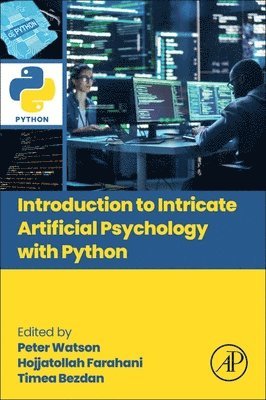
    Introduction to Intricate Artificial Psychology with Python

    AvPeter Watson,Hojjatollah Farahani

    Häftad, Engelska, 2025

    1 625 kr

    Beställningsvara. Skickas inom 10-15 vardagar. Fri frakt över 249 kr.

    Beskrivning

    Introduction to Intricate Artificial Psychology with Python unlocks the mysteries of Intricate Artificial Psychology (iAp). This comprehensive guide takes readers through advanced cognitive frameworks and the complex landscape of artificial psychology using Python. Starting with an introduction to iAp, the book explores degrees of prediction and applies Fuzzy Cognitive Maps (IAP). Special focus is given to detecting implicit bias through a combination of Fuzzy Cognitive Maps and SHAP values, offering a unique perspective on artificial intelligence and psychological phenomena. The book covers forecasting in iAp, complex network analysis, and psychological graph analysis (Pga).

    It delves into the intersection of deep learning and neuroimaging, as well as machine learning techniques in neuroimaging. It includes practical case studies, allowing readers to apply cutting-edge techniques to real-world psychological scenarios.

    • Examines how to utilize and analyze predictive models and psychological graphs
    • Illustrates how to apply machine learning and deep learning techniques in neuroimaging
    • Includes specific code examples in Python

    Produktinformation

    • Utgivningsdatum:2025-11-27
    • Mått:152 x 229 x undefined mm
    • Vikt:450 g
    • Format:Häftad
    • Språk:Engelska
    • Antal sidor:344
    • Förlag:Elsevier Science
    • ISBN:9780443302480

    Utforska kategorier

    • Arbetspsykologi inom Psykologi och pedagogik
    • Programspråk inom Data och IT
    • Artificiell intelligens inom Data och IT

    Mer om författaren

    Peter Watson holds three degrees in Mathematical Statistics including a Ph.D. (Manchester). He has been providing statistical support in various ways to the research at CBSU, the Cognition and Brain Sciences Unit in Cambridge (and its predecessor, the Applied Psychology Unit) since 1994 (and prior to that fulfilling a similar role at the MRC Age and Cognitive Performance Research Centre in Manchester). He is the co-author of over 100 papers and lectures at the University of Cambridge. He is a statistical referee for several journals including BMJ Open and the Journal of Affective Disorders. He has also been a major contributor of articles to the on-line CBSU statswiki web pages which receive upwards of 100,000 visits annually. He has also been secretary, since 1996, of the Cambridge Statistics Discussion Group and chair and meetings organiser for the SPSS users’ group (ASSESS) since 2001 and has also been a member of the Clinical Trials Advisory Panel for Alzheimer’s Research UK. Hojjatollah Farahani is an Assistant Professor at the Tarbiat Modares University (TMU), Iran. He received his Ph.D. from Isfahan University in 2009, and he was a postdoctoral researcher in Fuzzy inference at the Victoria University in Australia (2014-2015), where he started working on Fuzzy Cognitive Maps (FCMs) under supervision of professor Yuan Miao. He is the author or co-author of more than 150 research papers and a reviewer in numerous scientific journals. He has supervised and advised many theses and dissertations in psychological sciences. His new book is “Introduction to artificial Psychology using R “which was published by Springer in 2023. His research interests and directions include psychometrics, fuzzy psychology, artificial intelligence, machine learning algorithms in psychology theoretical neuroscience, neurological pain, and trauma. Timea Bezdan is a Ph.D. candidate at the University Singidunum in Belgrade, Serbia, pursuing a doctoral degree in Computer Science. She works as a Teaching Assistant at the Technical Faculty and Faculty of Informatics and Computing within the same institution. Her principal research pursuits encompass optimization, swarm intelligence, machine learning, and artificial intelligence. Her scholarly contributions comprise over 40 published scientific papers, featured in esteemed journals and international conferences, all of which delve into these aforementioned domains.

    Innehållsförteckning

    • 1. Introduction to intricate artificial psychology2. Intricate mind: perception, cognition, and emotion are integrated in a new paradigm for a cognitive model3. Toward intricate thinking4. Prediction in intricate artificial psychology5. Detecting implicit bias using fuzzy cognitive maps6. Forecasting in complex artificial psychology7. Explaining neural networks in natural language8. Complex network analysis9. Network approach in psychology10. Deep learning techniques in neuroimaging11. Machine learning techniques in neuroimaging12. Becoming a PsychoPythonista