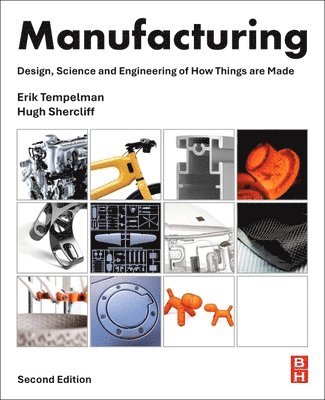
Häftad, Engelska, 2026
Manufacturing
Av Erik Tempelman, Hugh Shercliff
733 kr
Skickas torsdag 22/10. Fri frakt över 249 kr.
Beskrivning
Manufacturing: Design, Science and Engineering of How Things are Made, Second Edition presents a fresh view on the world of industrial production, in terms of both abstraction levels and trade-offs. The book invites its readers to distinguish between what is possible in principle for a certain process (as determined by physical law); what is possible in practice (the production method as determined by industrial state-of-the-art); and what is possible for a certain supplier (as determined by its production equipment). Specific processes considered include metal forging, extrusion, and casting; plastic injection molding and thermoforming; additive manufacturing; joining; recycling, and more.
By tackling the field of manufacturing processes from this new angle, the book makes the most out of a reader's limited time. It gives the knowledge needed to not only create well-producible designs, but also to understand supplier needs in order to find the optimal compromise. Apart from improving design for production, this publication raises the standards of thinking about producibility.
By tackling the field of manufacturing processes from this new angle, the book makes the most out of a reader's limited time. It gives the knowledge needed to not only create well-producible designs, but also to understand supplier needs in order to find the optimal compromise. Apart from improving design for production, this publication raises the standards of thinking about producibility.
- Emphasises the strong links between product design, materials and their properties, and the choice and operation of manufacturing processes
- Introduces the concept of a “manufacturing triangle” as a structured approach to considering the trade-offs between function, cost, and quality, for any conventional or emerging manufacturing process
- Coverage of contemporary manufacturing technology - notably Additive Manufacturing, Industry 4.0, Remanufacturing and Recycling, and Design for Manufacture and Assembly (DFMA)
- Includes a solutions manual and image bank for instructors
Produktinformation
- Utgivningsdatum: 2026-08-27
- Mått: 191 x 235 x 24 mm
- Vikt: 780 g
- Format: Häftad
- Språk: Engelska
- Antal sidor: 480
- Upplaga: 2
- Förlag: Elsevier Science
- ISBN: 9780443332036
Utforska kategorier
Betyg & recensioner
0 recensioner
Inga recensioner tillgängliga.