• Fri frakt över 249 kr
  • •
  • Snabba leveranser
  • •
  • Billiga böcker
Kundservice

Du är på sajten för privatpersoner.

Företag, bibliotek eller offentlig verksamhet?

Du handlar på classic.bokus.com, där alla dina funktioner finns intakta.
Till classic.bokus.com
Bokus logotyp. Gå till startsidan.
  • Erbjudanden
  • Nyheter
  • Student
  • Topplistor
  • Barn & ungdom
  • Bokus Play
  • E-böcker
  • Pocketböcker
  • Spel & pussel

10% rabatt på allt med kod NYSTART10 →

Sidfot

Mina sidor

    Hjälp

    • Kundservice
    • Vanliga frågor och svar
    • Frakt och leverans
    • Retur vid ångerrätt
    • Reklamera vara
    • Betalning
    • Köpvillkor
    • Allmänna villkor
    • Information om webbplatsens tillgänglighet

    Om Bokus

    • Om oss
    • Pressrum
    • För studenter
    • För företag
    • För bibliotek och offentlig verksamhet
    • För leverantörer
    • Hållbarhet

    Populärt

    • Aktuella erbjudanden
    • Presentkort
    • Studentlitteratur
    • Nya böcker
    • Topplistor
    • Signerade böcker
    • Engelska böcker

    Inspiration

    • Boktips
    • BookTok
    • Populära bokserier
    • Barnbokskaraktärer
    • Populära författare
    Logotyp för Bokus
    Följ oss på Facebook (extern länk)Följ oss på Instagram (extern länk)Följ oss på YouTube (extern länk)Följ oss på TikTok (extern länk)
    bokus @ CookiesAnpassa cookiesIntegritetspolicyKöpvillkor
    Till Citymail hemsida (extern länk)Till Budbee hemsida (extern länk)Till Postnord hemsida (extern länk)Till Schenker hemsida (extern länk)Till Early Bird hemsida (extern länk)Till Walleys hemsida (extern länk)
    1. Medicin
    2. Andra medicinska specialiteter
    3. Patologi

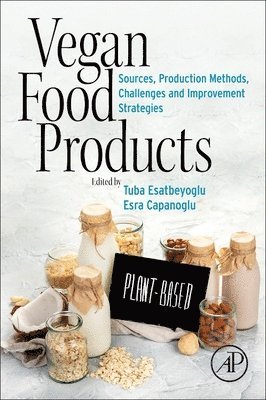
    Vegan Food Products

    Sources, Production Methods, Challenges and Improvement Strategies

    AvTuba Esatbeyoglu,Esra Capanoglu guven

    Häftad, Engelska, 2026

    1 517 kr

    Kommande

    Beskrivning

    Vegan Food Products: Sources, Production Methods, Challenges and Improvement Strategies assembles the science related to different vegan foods in a comprehensive reference that discusses the benefits and challenges of vegan food products. Comprised of 11 chapters, the book covers the vegan alternatives of different food groups, including meat, fish, egg, and dairy. It also presents a variety of vegan protein sources, such as plant-based proteins, macro- and microalgae and single-cell proteins. Sections explore production methods and technologies, including extrusion, dry-fractionation methods for enriching proteins, 3D printing, and in vitro methods.

    In addition, the health aspects of vegan foods, with a specific chapter devoted to the fortification studies, are covered, as well as the vegan food market, the consumer perception, and the sensory and nutritional quality of vegan products. Edited by well-known global researchers in the field, this book provides readers with a broad review of the most recent research on the opportunities and challenges of vegan ingredients and foods.

    • Covers vegan alternatives of different food groups including meat, fish, egg, and dairy
    • Presents vegan protein sources of plant-based and microbial origins
    • Explores health aspects of vegan foods, consumer perception, and legislation aspects
    • Discusses production methods and technology of vegan foods

    Produktinformation

    • Utgivningsdatum:2026-11-01
    • Mått:152 x 229 x undefined mm
    • Vikt:450 g
    • Format:Häftad
    • Språk:Engelska
    • Antal sidor:440
    • Förlag:Elsevier Science
    • ISBN:9780443335501

    Utforska kategorier

    • Patologi inom Medicin
    • Tillverkningsteknik inom Naturvetenskap och teknik

    Mer om författaren

    Tuba Esatbeyoglu, since 2023, Full Professor (W3) for Molecular Food Chemistry and Food Development, Department of Molecular Food Chemistry and Food Development, Institute of Food and One Health. She published more than 150 international/national scientific papers and chapters and has authored/edited books. She is and has been a guest Editor of Journals special issues (e.g. Dietary change strategies for sustainable diets and their impact on human health, Vol. II), Editorial Board member of international Journals. She is a Member of the Scientific Advisory Board of the Research Circle of the Food Industry (FEI) for the term of office 2023-2025. Award of the Association for the Promotion of Food Chemistry in Braunschweig e.v. for outstanding academic achievements in the subject of food chemistry. Esra Çapanoğlu Güven, a full professor at the Department of Food Engineering, and leading international food chemist, is known for her expertise in processing and food matrix effects on the content and bioavailability of bioactives. She has also made important contributions to investigating methods to improve the bioavailability of bioactive compounds, as well as waste valorization. She has published three books, 30 chapters and more than 300 international/national scientific papers. She was selected as a Highly Cited Researcher in 2019, 2022, and 2023 by Clarivate, Web of Science Group. She has also been indicated as the top 2% of scientists of the main subfield discipline according to the list created by Stanford University for the last 4 years (2020-2023). She also received Georg Forster Prize from Alexander von Humboldt Foundation in July 2022. She has been selected as an Associate Member for the Turkish Academy of Sciences starting from 2023. She is an Assoc. Editor in ACS Omega and Editorial Advisory Board Member of Journal of Agricultural and Food Chemistry (JAFC), Food Frontiers, Journal of Berry Research, Turkish Journal of Agriculture and Forestry, and several others.

    Innehållsförteckning

    • 1. Veganism concept overview, definitions and descriptions2. Production methods and technology of vegan foods (extrusion, dry-fractionation method for enriching proteins, 3D printing, in vitro methods)3. Meat and Seafood alternatives (red meat, chicken, pork, seafood, etc.)4. Egg alternatives5. Dairy product alternatives (mil, cheese, yoghurt, kefir, etc.)6. Vegan protein sources: Plant-based proteins (Legumes, cereals, aquafaba, nuts, novel plant-based proteins i.e. Moringa)7. Vegan protein sources: Microbial proteins (single cells, macro- and microalgae)8. Vegan food fortification (vitamins, minerals, etc.) and Health aspects9.Vegan food market and Consumer Perception10. Strategies for the Improvement of Vegan Product Quality (Sensory and Nutritional Quality)