• Fri frakt över 249 kr
  • •
  • Snabba leveranser
  • •
  • Billiga böcker
Kundservice

Du är på sajten för privatpersoner.

Företag, bibliotek eller offentlig verksamhet?

Du handlar på classic.bokus.com, där alla dina funktioner finns intakta.
Till classic.bokus.com
Bokus logotyp. Gå till startsidan.
  • Erbjudanden
  • Nyheter
  • Student
  • Topplistor
  • Barn & ungdom
  • Bokus Play
  • E-böcker
  • Pocketböcker
  • Spel & pussel

10% rabatt på allt med kod: NYSTART10 →

Sidfot

Mina sidor

    Hjälp

    • Kundservice
    • Vanliga frågor och svar
    • Frakt och leverans
    • Retur vid ångerrätt
    • Reklamera vara
    • Betalning
    • Köpvillkor
    • Allmänna villkor
    • Information om webbplatsens tillgänglighet

    Om Bokus

    • Om oss
    • Pressrum
    • För studenter
    • För företag
    • För bibliotek och offentlig verksamhet
    • För leverantörer
    • Hållbarhet

    Populärt

    • Aktuella erbjudanden
    • Presentkort
    • Studentlitteratur
    • Nya böcker
    • Topplistor
    • Signerade böcker
    • Engelska böcker

    Inspiration

    • Boktips
    • BookTok
    • Populära bokserier
    • Barnbokskaraktärer
    • Populära författare
    Logotyp för Bokus
    Följ oss på Facebook (extern länk)Följ oss på Instagram (extern länk)Följ oss på YouTube (extern länk)Följ oss på TikTok (extern länk)
    bokus @ CookiesAnpassa cookiesIntegritetspolicyKöpvillkor
    Till Citymail hemsida (extern länk)Till Budbee hemsida (extern länk)Till Postnord hemsida (extern länk)Till Schenker hemsida (extern länk)Till Early Bird hemsida (extern länk)Till Walleys hemsida (extern länk)
    1. Medicin
    2. Omvårdnad och medicinska stödfunktioner
    3. Biomedicinsk teknik

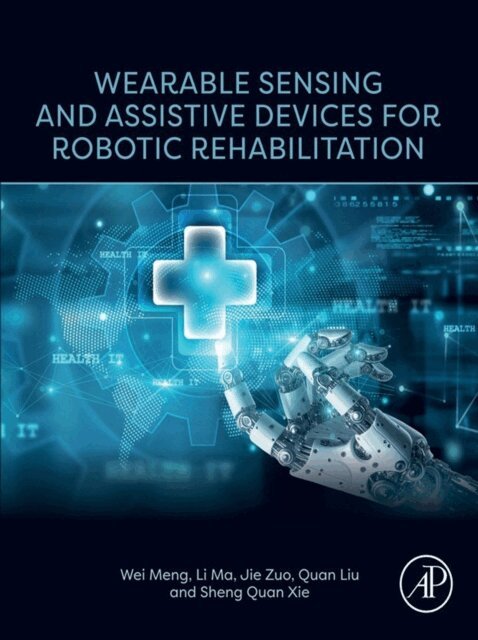
    Wearable Sensing and Assistive Devices for Robotic Rehabilitation

    AvWei Meng,Li Ma

    Häftad, Engelska, 2026

    1 829 kr

    Beställningsvara. Skickas inom 10-15 vardagar. Fri frakt över 249 kr.

    Beskrivning

    Wearable Sensing and Assistive Devices for Robotic Rehabilitation provides an overview of current research and developments in the field of innovative technologies for advanced wearable sensing and assistive devices in medical rehabilitation. The book presents a systematic investigation into the wearable acquisition and deep learning-based processing of biological signals and applications with wearable robotic devices. It provides fundamental bio-mechatronics engineering knowledge to analyze and design new wearable sensing and assistive devices.

    In addition, the book includes human wearable sensors design and development, biological signals acquisition and processing, brain-computer interface and neuromuscular interfaces, wearable exoskeleton and soft robotic devices, and human-centered interactive robot control.

    • Presents expertise from an authoring team with more than 20 years of experience working in neurological and robotic systems, bio-mechatronics, and rehabilitation engineering
    • Contains insights into emerging technologies and developments that are being, or will be, utilized in biological systems and mechatronics for rehabilitative purpose
    • Provides an all-in-one, comprehensive background on human wearable sensing and assistive devices, detailing new advances in the field
    • Addresses challenges for robotic rehabilitation applications in bio-signal sensing and processing, brain and muscular interfaces, and wearable robotic devices and control

    Produktinformation

    • Utgivningsdatum:2026-04-09
    • Mått:191 x 235 x 20 mm
    • Vikt:450 g
    • Format:Häftad
    • Språk:Engelska
    • Antal sidor:446
    • Förlag:Elsevier Science
    • ISBN:9780443404634

    Utforska kategorier

    • Biomedicinsk teknik inom Medicin
    • Biokemisk teknik inom Naturvetenskap och teknik
    • Elektronik och kommunikationer inom Naturvetenskap och teknik

    Mer om författaren

    Wei Meng is currently a lecturer at the School of Information Engineering, Wuhan University of Technology. His research interests include robot-assisted rehabilitation, human–robot interaction, and iterative learning control. He has co-authored five books, published more than 80 academic journal and conference papers, and holds 22 patents. Li Ma is an associate professor at Wuhan University of Technology, China. From 2015 to 2016, he was a PhD exchange student in National Taiwan University, Taiwan and a joint training PhD student at UCLA, US, from 2016 to 2018. After that, he carried on one-year postdoctoral research fellow at University of Michigan, US. His research interest includes the biomedical signal processing, especially in brain monitoring during anaesthesia, brain modelling and brain-computer interfaces, and is now focusing on the brain inspired intelligence. Quan Liu is currently chair professor at the School of Information Engineering at Wuhan University of Technology. In the past five years, she authored more than 100 technical publications, proceedings, editorials, and books. She has directed more than 20 research projects. Her research interests include signal processing, embedded systems, and robots and electronics. Prof. Liu received two national awards and three provincial and ministerial awards. She was awarded as the “National Excellent Teacher” in 2007. She is a Council Member of the Chinese Association of Electromagnetic Compatibility and the Hubei Institute of Electronics. Sheng Quan Xie is currently chair professor in robotics and autonomous systems at the Faculty of Engineering, University of Leeds. He has published seven books, 15 book chapters, and more than 300 international journal and conference papers. His current research interests include medical and rehabilitation robots and advanced robot control. Professor Xie was elected a Fellow of The Institution of Professional Engineers New Zealand in 2016. He has also served as a Technical Editor of the IEEE/ASME TRANSACTIONS ON MECHATRONICS. Jie Zuo received the Ph.D. degree in information engineering from Wuhan University of Technology, Wuhan, China, in 2022. She is currently working as a Lecturer at Wuhan University of Technology. From 2022 to 2024, she was a postdoctoral researcher in the School of Artificial Intelligence and Automation at Huazhong University of Science and Technology. Her research interests include robotic design, modelling and control strategies, rehabilitation bio-mechatronics.

    Innehållsförteckning

    • 1. Introduction2. State of the Art3. Wearable Optical Fibre Sensors and Signal Acquisition4. Neuro-Muscular Interfaces for Motion Recognition5. Brain-Computer Interface with Invasive Caps6. Wearable Ankle-Foot Exoskeletons7. Knee Exoskeletons for Walking Assistance8. Human-Centred Interactive Control Systems9. Applications and Validations of Wearable Devices10. Conclusion