• Fri frakt över 249 kr
  • •
  • Snabba leveranser
  • •
  • Billiga böcker
Kundservice

Du är på sajten för privatpersoner.

Företag, bibliotek eller offentlig verksamhet?

Du handlar på classic.bokus.com, där alla dina funktioner finns intakta.
Till classic.bokus.com
Bokus logotyp. Gå till startsidan.
  • Erbjudanden
  • Nyheter
  • Student
  • Topplistor
  • Barn & ungdom
  • Bokus Play
  • E-böcker
  • Pocketböcker
  • Spel & pussel

10% rabatt på allt med kod: NYSTART10 →

Sidfot

Mina sidor

    Hjälp

    • Kundservice
    • Vanliga frågor och svar
    • Frakt och leverans
    • Retur vid ångerrätt
    • Reklamera vara
    • Betalning
    • Köpvillkor
    • Allmänna villkor
    • Information om webbplatsens tillgänglighet

    Om Bokus

    • Om oss
    • Pressrum
    • För studenter
    • För företag
    • För bibliotek och offentlig verksamhet
    • För leverantörer
    • Hållbarhet

    Populärt

    • Aktuella erbjudanden
    • Presentkort
    • Studentlitteratur
    • Nya böcker
    • Topplistor
    • Signerade böcker
    • Engelska böcker

    Inspiration

    • Boktips
    • BookTok
    • Populära bokserier
    • Barnbokskaraktärer
    • Populära författare
    Logotyp för Bokus
    Följ oss på Facebook (extern länk)Följ oss på Instagram (extern länk)Följ oss på YouTube (extern länk)Följ oss på TikTok (extern länk)
    bokus @ CookiesAnpassa cookiesIntegritetspolicyKöpvillkor
    Till Citymail hemsida (extern länk)Till Budbee hemsida (extern länk)Till Postnord hemsida (extern länk)Till Schenker hemsida (extern länk)Till Early Bird hemsida (extern länk)Till Walleys hemsida (extern länk)
    1. Naturvetenskap och teknik
    2. Matematik och naturvetenskap
    3. Matematik
    4. Beräkning och matematisk analys
    • Nyhet

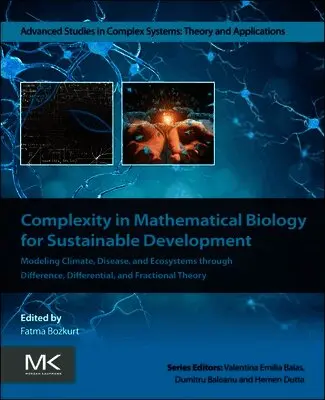
    Complexity in Mathematical Biology for Sustainable Development

    Modeling Climate, Disease, and Ecosystems through Difference, Differential, and Fractional Theory

    AvFatma Bozkurt

    Häftad, Engelska, 2026

    Del i serien Advanced Studies in Complex Systems

    1 771 kr

    Beställningsvara. Skickas inom 10-15 vardagar. Fri frakt över 249 kr.

    Fler format och utgåvor

    E-bok

    2 308 kr

    Beskrivning

    Complexity in Mathematical Biology for Sustainable Development: Modeling Climate, Disease, and Ecosystems through Difference, Differential, and Fractional Theory introduces new mathematical methods to derive complex modeling solutions for a wide range of engineering and scientific research applications. The book strikes a balance between high-level mathematical theory and technical derivations, offering step-by-step explanations, real-world case studies, and clear introductions to advanced mathematical models. Solutions include modeling and quantifying complexity, with emphasis placed on the growing need for interdisciplinary collaboration, the integration of real-time data into models, and the development of adaptive frameworks challenges such as pandemics, biodiversity loss, and climate uncertainty.

    The book is designed to meet the needs of a diverse primary audience, from graduate students to professionals in fields such as computer science, public health, environmental policy, applied mathematics, and biotechnology. By providing both theoretical foundations and practical applications, the book equips readers with the skills and knowledge to tackle pressing global challenges through mathematical models, making it a valuable resource for both academic and professional development.

    • Presents clear, accessible introductions to advanced mathematical models
    • Includes step-by-step guides for solving difference, differential, and fractional-order equations, with applications in climate, health, and biodiversity
    • Provides extensive case studies that demonstrate the power of mathematical modeling in solving pressing global problems, including climate change and disease control

    Produktinformation

    • Utgivningsdatum:2026-07-15
    • Mått:216 x 276 x 33 mm
    • Vikt:450 g
    • Format:Häftad
    • Språk:Engelska
    • Serie:Advanced Studies in Complex Systems
    • Antal sidor:620
    • Förlag:Elsevier Science
    • ISBN:9780443452963

    Utforska kategorier

    • Beräkning och matematisk analys inom Naturvetenskap och teknik
    • Tillämpad matematik inom Naturvetenskap och teknik
    • Biovetenskap inom Naturvetenskap och teknik

    Mer om författaren

    Prof. Dr. Fatma Bozkurt is a Professor in the Department of Mathematics Education at Erciyes University, Türkiye. She holds a PhD in Applied Mathematics (2010) and completed her postdoctoral research at United Arab Emirates University. With over 20 years of international teaching and research experience across Europe and the Middle East, she has developed a strong interdisciplinary profile at the intersection of applied mathematics, sustainability, and education.Her research focuses on mathematical modeling of complex biological and socio-ecological systems, including disease dynamics, cancer treatment modeling, and climate-related processes. She has published extensively in leading Q1 journals and has led multiple research projects supported by TÜBİTAK.Prof. Dr. Bozkurt is a member of UNESCO’s Greening Education Partnership and a co-author of the Greening Communities Guidance. Her work extends to policy-oriented educational design, integrating Sustainable Development Goals (SDGs), climate literacy, and green skills into teacher education and lifelong learning systems. She also has extensive experience in international curriculum development and interdisciplinary STEAM education aligned with the Fourth Industrial Revolution.

    Innehållsförteckning

    • 1. Introduction to Mathematical Biology2. Difference Equations3. Ordinary Differential Equations (ODEs)4. Fractional-Order Differential Equations5. Weighted Graphs, Networks, and Statistical Models6. Mathematical Models in Ecosystems and Natural Systems7. Human Health and Sustainable Development8. Climate Change Models9. Applications to Sustainable Development Goals (SDGs)10. Applications and Future Perspectives of Mathematical Biology11. Conclusion