• Fri frakt över 249 kr
  • •
  • Snabba leveranser
  • •
  • Billiga böcker
Kundservice

Du är på sajten för privatpersoner.

Företag, bibliotek eller offentlig verksamhet?

Du handlar på classic.bokus.com, där alla dina funktioner finns intakta.
Till classic.bokus.com
Bokus logotyp. Gå till startsidan.
  • Erbjudanden
  • Nyheter
  • Student
  • Topplistor
  • Barn & ungdom
  • Bokus Play
  • E-böcker
  • Pocketböcker
  • Spel & pussel

10% rabatt på allt med kod NYSTART10 →

Sidfot

Mina sidor

    Hjälp

    • Kundservice
    • Vanliga frågor och svar
    • Frakt och leverans
    • Retur vid ångerrätt
    • Reklamera vara
    • Betalning
    • Köpvillkor
    • Allmänna villkor
    • Information om webbplatsens tillgänglighet

    Om Bokus

    • Om oss
    • Pressrum
    • För studenter
    • För företag
    • För bibliotek och offentlig verksamhet
    • För leverantörer
    • Hållbarhet

    Populärt

    • Aktuella erbjudanden
    • Presentkort
    • Studentlitteratur
    • Nya böcker
    • Topplistor
    • Signerade böcker
    • Engelska böcker

    Inspiration

    • Boktips
    • BookTok
    • Populära bokserier
    • Barnbokskaraktärer
    • Populära författare
    Logotyp för Bokus
    Följ oss på Facebook (extern länk)Följ oss på Instagram (extern länk)Följ oss på YouTube (extern länk)Följ oss på TikTok (extern länk)
    bokus @ CookiesAnpassa cookiesIntegritetspolicyKöpvillkor
    Till Citymail hemsida (extern länk)Till Budbee hemsida (extern länk)Till Postnord hemsida (extern länk)Till Schenker hemsida (extern länk)Till Early Bird hemsida (extern länk)Till Walleys hemsida (extern länk)
    1. Naturvetenskap och teknik
    2. Matematik och naturvetenskap
    3. Kemi

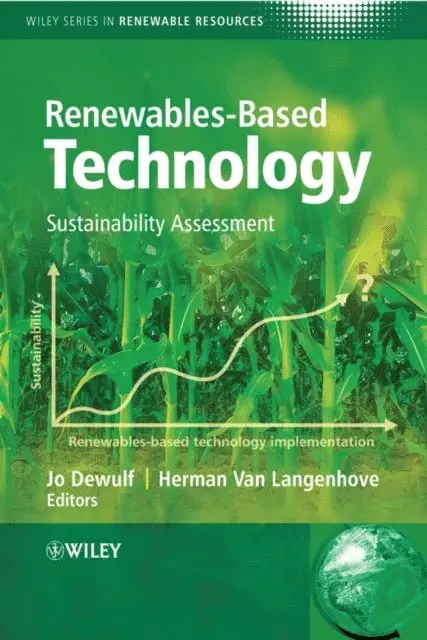
    Renewables-Based Technology

    Sustainability Assessment

    AvJo Dewulf,Herman Van Langenhove

    Inbunden, Engelska, 2006

    Del 2 i serien Wiley Series in Renewable Resource

    1 891 kr

    Beställningsvara. Skickas inom 5-8 vardagar. Fri frakt över 249 kr.

    Beskrivning

    Renewables-Based Technology: Sustainability AssessmentSustainability is a key driving force for industries in the chemical, food, packaging, agricultural and pharmaceutical sectors, and quantitative sustainability indicators are being incorporated into company reports. This is driving the uptake of renewable resources and the adoption of renewables.Renewables' can either be the substituted raw materials that are used in a given industry, (e.g. the use of biomass for fuel); the use and/or modification of a crop for use in a new industry (e.g. plant cellulose), or the reuse of a waste product (e.g. organic waste for energy production).This is the first book in the Wiley Renewable Resources series that brings together the range of sustainability assessment methods and their uses. Ensuing books in the series will look at individual renewable materials and applications.

    Produktinformation

    • Utgivningsdatum:2006-03-24
    • Mått:175 x 252 x 28 mm
    • Vikt:798 g
    • Format:Inbunden
    • Språk:Engelska
    • Serie:Wiley Series in Renewable Resource
    • Antal sidor:384
    • Förlag:John Wiley & Sons Inc
    • ISBN:9780470022412

    Utforska kategorier

    • Kemi inom Naturvetenskap och teknik
    • Biologi inom Naturvetenskap och teknik
    • Energiteknik inom Naturvetenskap och teknik

    Mer om författaren

    Editors: Prof Dr Jo Dewulf, Prof Dr Herman van Langenhove, both of Ghent University, Belgium. Both experienced researchers in environmental chemistry and clean technology.

    Innehållsförteckning

    • Contributors xvForeword xviiSeries Preface xixPreface xxiList of Abbreviations xxiiiPart I Renewables as a Resource and Sustainability Performance Indicators 11 The Contribution of Renewables to Society 3Göran Berndes1.1 Introduction 31.2 Historic and Present Biomass Uses for Food, Energy and Materials in the World 61.3 Potential Availability of Agricultural Residues and Land for Non-Food Crop Production 81.4 Drivers Behind Increasing Demand for Biomass for Energy and Materials 101.5 Land Use Competition 121.6 Multifunctional Biomass Production Systems 141.7 Summary 162 The Potential of Renewables as a Feedstock for Chemistry and Energy 19Wilfried G. J. H. M. van Sark, Martin K. Patel, André P. C. Faaij and Monique M. Hoogwijk2.1 Introduction 192.2 Supply of Energy and Materials Using Renewables 212.3 Demand for Energy and Materials 312.4 Summary 343 Sustainability Performance Indicators 39Alexei Lapkin3.1 Introduction 393.2 The Hierarchy of Sustainability Metrics 403.3 Aspects of Methodology 423.4 Examples of Sustainability Metrics for Technology Assessment 463.5 Summary 51Part II Relevant Assessment Tools 554 Life Cycle Inventory Analysis Applied to Renewable Resources 57Niels Jungbluth and Rolf Frischknecht4.1 Introduction 574.2 Conceptual Background to LCA in ISO 14040ff 584.3 Goal and Scope Definition 594.4 Inventory Analysis 594.5 LCI Data Documentation and Exchange Format 684.6 Consequential versus Attributional LCI 694.7 Summary 705 Net Energy Balancing and Fuel-Cycle Analysis 73Hosein Shapouri, Michael Wang and James A. Duffield5.1 Introduction 735.2 Methodology 755.3 Energy Balance of Fossil Fuel versus Biofuel 795.4 Greenhouse Gas Emissions from Corn Ethanol Production 835.5 Summary 846 Life Cycle Assessment as an Environmental Sustainability Tool 87Adisa Azapagic6.1 Introduction 876.2 The LCA Methodology: A Brief Overview 886.3 LCIA Impact Categories as Indicators of Environmental Sustainability 936.4 Using LCA to Assess Environmental Sustainability 1056.5 Summary 1087 Exergy 111Jo Dewulf and Herman Van Langenhove7.1 Introduction 1117.2 Assessment of Sustainability of Technology: Developing Metrics 1137.3 A Thermodynamic Basis for Developing Sustainability Assessment Metrics: Exergy 1147.4 Technology Assessment by Exergy Analysis 1167.5 Exergy-Based Indicators: How to Assess the Role of Renewables 1177.6 Exergy-based Indicators: Integrating the Role of Renewables in an Overall Physical Chemical Sustainability Assessment 1227.7 Summary 1238 Material Flow Analysis and the Use of Renewables from a Systems Perspective 127Stefan Bringezu8.1 Introduction 1278.2 Overview of the Methodology 1288.3 Examples of MFA Studies in the Context of Renewables 1308.4 Summary 1399 Ecological Footprints and Biocapacity: Essential Elements in Sustainability Assessment 143William E. Rees9.1 Introduction 1439.2 Eco-Footprint Analysis 1449.3 Inherent Strengths in EFA 1509.5 Summary 15510 The Sustainable Process Index (SPI) 159Michael Narodoslawsky and Anneliese Niederl10.1 Introduction 15910.2 Computation of the SPI 16210.3 Case Study: Biodiesel from Used Vegetable Oil 16810.4 Summary 170Part III Case Studies 17311 Assessment of Sustainable Land Use in Producing Biomass 175Helmut Haberl and Karl-Heinz Erb11.1 Introduction 17511.2 Sustainability Issues Involved in Promoting Biomass Energy 17711.3 Recommendations 18611.4 Summary 18712 Assessment of the Forest Products Industries 193Klaus Richter, Frank Werner and Hans-Jörg Althaus12.1 Introduction 19312.2 Metrics and Criteria to Assess the Sustainability of Forestry 19512.3 Metrics and Criteria for Assessing the Sustainability of the Wood Industry 19812.4 Scope for Action 20512.5 Summary 20513 Assessment of the Energy Production Industry: Modern Options for Producing Secondary EnergyCarriers from Biomass 209André Faaij13.1 Introduction 20913.2 Technology Overview 21013.3 Economics of Biomass Energy Systems 22413.4 Heat, Power and Fuels from Biomass: Key Markets 22513.5 Summary 22714 Assessment of Biofuels 231James A. Duffield, Hosein Shapouri and Michael Wang14.1 Introduction 23114.2 Background 23114.3 Biofuel Feedstocks 23214.4 Bio-Transportation Fuels and Fuel Additives 23414.5 Current Supply of Biofuels 23514.6 Future Supply of Biofuels 23614.7 Measuring the Sustainability of Biofuels 23814.8 Summary 24315 Assessment of Organic Waste Treatment 247Jan-Olov Sundqvist15.1 Introduction 24715.2 General Description of Options for Organic Waste Treatment 24715.3 Environmental Characteristics of Organic Waste Treatment 24915.4 Results of a Life Cycle Assessment of Organic Waste 25015.5 Discussion 26215.6 Summary 26216 Oleochemical and Petrochemical Surfactants: An Overall Assessment 265Erwan Saouter, Gert Van Hoof, Mark Stalmans and Alan Brunskill16.1 Introduction 26516.2 Main Chemical and Structural Differences 26716.3 Resource and Usage 26816.4 Environmental Profile 27016.5 Sustainability Aspects of Oleochemical Production 27616.6 Summary 27817 Assessment of Bio-Based Packaging Materials 281Andreas Detzel, Martina Krüger and Axel Ostermayer17.1 Introduction 28117.2 Environmental Aspects of Polymer Production 28317.3 Environmental Aspects of Packaging Disposal 28717.4 Summary 29518 Assessment of Biotechnology-Based Chemicals 299Peter Saling and Andreas Kicherer18.1 Introduction 29918.2 Explanation: What is Eco-Efficiency Analysis? 30018.3 Evaluation of Decision-making Processes with Eco-Efficiency Analysis 30718.4 Case Studies 30818.5 Summary 31119 Assessment of Bio-Based Pharmaceuticals: The Cephalexin Case 315Alle Bruggink and Peter Nossin19.1 Introduction 31519.2 Assessment Methods During Process Development and Technology Transfers 31619.3 Assessment of Bio-Based Routes to Cephalexin 32219.4 Summary 328Part IV Conclusions 33120 Conclusions 333Jo Dewulf and Herman Van Langenhove20.1 Introduction 33320.2 The Available Sustainability Metrics 33420.3 Where Are We Going in Assessing Renewables-Based Technology? 336Reference 337Index 339