• Fri frakt över 249 kr
  • •
  • Snabba leveranser
  • •
  • Billiga böcker
Kundservice

Du är på sajten för privatpersoner.

Företag, bibliotek eller offentlig verksamhet?

Du handlar på classic.bokus.com, där alla dina funktioner finns intakta.
Till classic.bokus.com
Bokus logotyp. Gå till startsidan.
  • Erbjudanden
  • Nyheter
  • Student
  • Topplistor
  • Barn & ungdom
  • Bokus Play
  • E-böcker
  • Pocketböcker
  • Spel & pussel

10% rabatt på allt med kod NYSTART10 →

Sidfot

Mina sidor

    Hjälp

    • Kundservice
    • Vanliga frågor och svar
    • Frakt och leverans
    • Retur vid ångerrätt
    • Reklamera vara
    • Betalning
    • Köpvillkor
    • Allmänna villkor
    • Information om webbplatsens tillgänglighet

    Om Bokus

    • Om oss
    • Pressrum
    • För studenter
    • För företag
    • För bibliotek och offentlig verksamhet
    • För leverantörer
    • Hållbarhet

    Populärt

    • Aktuella erbjudanden
    • Presentkort
    • Studentlitteratur
    • Nya böcker
    • Topplistor
    • Signerade böcker
    • Engelska böcker

    Inspiration

    • Boktips
    • BookTok
    • Populära bokserier
    • Barnbokskaraktärer
    • Populära författare
    Logotyp för Bokus
    Följ oss på Facebook (extern länk)Följ oss på Instagram (extern länk)Följ oss på YouTube (extern länk)Följ oss på TikTok (extern länk)
    bokus @ CookiesAnpassa cookiesIntegritetspolicyKöpvillkor
    Till Citymail hemsida (extern länk)Till Budbee hemsida (extern länk)Till Postnord hemsida (extern länk)Till Schenker hemsida (extern länk)Till Early Bird hemsida (extern länk)Till Walleys hemsida (extern länk)
    1. Psykologi och pedagogik
    2. Pedagogik
    3. Skolan och förskolan

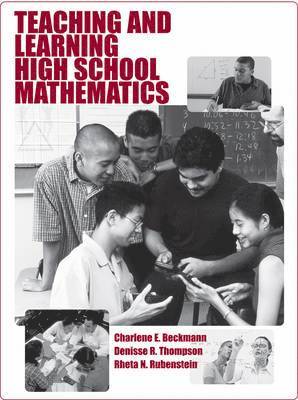
    Teaching and Learning High School Mathematics

    AvCharlene E. Beckmann,Denisse R. Thompson

    Häftad, Engelska, 2009

    2 190 kr

    Beställningsvara. Skickas inom 5-8 vardagar. Fri frakt över 249 kr.

    Beskrivning

    Too many high school students, faced with mathematics in courses at the level of algebra and beyond, find themselves struggling with abstract concepts and unwilling to pursue further study of mathematics. When students curtail their course taking in mathematics, they may be impacting their college and career options. Thus, high school mathematics teachers have the responsibility to help students recognize the value and importance of mathematics while also designing instruction that makes mathematics accessible to all students. Ball and Bass (2000), as well as other mathematics educators, have recognized that mathematics teachers not only need to know mathematics content and mathematics pedagogy (i.e., teaching strategies) but they also need to know how these ideas are integrated. This mathematical knowledge for teaching is the knowledge that teachers of mathematics need and it differs from the knowledge that research or applied mathematicians must know. This text is designed to provide teachers with insights into this mathematical knowledge for teaching.Teaching and Learning High School Mathematics is likely different from many other texts that you have used. It integrates both content and pedagogy to help you develop and build your own understanding of teaching. The text is designed to help you develop “deep conceptual understanding of fundamental mathematics” (Ma 1999) so that you are able to approach mathematics from multiple perspectives with many tools. Such flexibility in teaching is essential if teachers are to help all students become mathematically proficient.Throughout this book, you are encouraged to work in cooperative teams. This strategy is designed to help you develop a mathematics learning community and build a professional network that will be a valuable resource during your professional career. Hopefully, you will experience the benefits of engaging in rich mathematical discussions with peers and consider how to encourage such learning environments in your own classrooms.Lesson planning is another element pervasive throughout this text. To help teachers plan for effective student-centered lessons, the Question Response Support (QRS) Guide is introduced in Lesson 1.1 and used throughout the remainder of the lessons. The QRS Guide is a tool on which teachers may record tasks or questions (Q) for students, expected and observed student responses (R), and teacher support (S) in the form of additional “just enough” questions to support students in their progress on the task. In each unit, teachers expand their repertoire of teaching and learning elements and strategies and incorporate these elements as they plan additional lesson segments. In Unit 4 lesson planning is formally introduced as teachers put together elements from previous units into complete, cohesive lesson plans.

    Produktinformation

    • Utgivningsdatum:2009-12-11
    • Mått:213 x 277 x 18 mm
    • Vikt:1 021 g
    • Format:Häftad
    • Språk:Engelska
    • Antal sidor:560
    • Förlag:John Wiley & Sons Inc
    • ISBN:9780470454503

    Utforska kategorier

    • Skolan och förskolan inom Psykologi och pedagogik
    • Undervisning i specifika ämnen inom Psykologi och pedagogik

    Mer om författaren

    Dr. Charlene Beckmann is a professor of Mathematics at Grand Valley State University. Her research interests include: assessment, cooperative learning, real life uses of mathematics, functions, games, literature and mathematics, technology, how conceptual understanding builds their ability to understand and write proofs.

    Innehållsförteckning

    • Course Introduction Mathematics Education: Where Do I Stand?Unit One. Encouraging Communication in Mathematics Classrooms(Mathematics Strand: Logic and Reasoning)Unit One Team-Builder: Carpet Square MazePreparing to Observe Mathematics Classrooms: Focus on EquityListening to Students Reason About Mathematics1.1 Developing Questioning Strategies: Conjecturing and Reasoning1.2 Exploring Mathematical Concepts Cooperatively: Reasoning with Conditional Statements1.3 Using Representations to Investigate Mathematics: Reasoning with Conjunctions, Disjunctions, and Negations1.4 Learning from Students: Valid and Invalid Arguments1.5  Summarizing Classroom Observations and Listening to Students: Focus on Equity Synthesizing Unit One Unit One Investigation: Carpet Square MazesUnit Two. High School Students and How They Learn            (Mathematics Strands: Geometry and Measurement)Unit Two Team-Builder: Transformed Snowflakes                Preparing to Observe Mathematics Classrooms: Focus on Learning            Listening to Students Reason About Geometry                     Understanding Geometry Learning: Coordinate Geometry         2.2 Building Conceptual Understanding: Congruence and Similarity2.3 Learning Mathematics through Multiple Perspectives: Quadrilaterals and Constructions2.4 Using Physical Tools and Technology: Circles2.5 Tasks with High Cognitive Demand: Measurement in the Plane and in Space2.6 Doing Mathematics: Axiomatic Systems2.7 Summarizing Classroom Observations and Listening to Students Synthesizing Unit TwoUnit Two Investigation: TransformationsUnit Three. Planning for Instruction(Mathematics Strands: Algebra and Functions)Unit Three Team-Builder: Find Your Function FamilyPreparing to Observe Mathematics Classrooms: Focus on Curriculum and Technology          Listening to Students Reason about Functions3.1 Building on Students' Knowledge and Experiences: Understanding Variables and Linear Functions  3.2 Thinking about Learning Outcomes: Exponential Functions                  3.3 Active Learning: Modeling Data Through Experiments   3.4 Teaching with Technology: Geometry of Functions3.5 Increasing Challenge or Accessibility of Problems: Polynomial Functions3.6 Accommodating Different Learning Styles: Rational Functions3.7 Summarizing Observations and Listening to Students                          Synthesizing Unit  Three                                                                                Unit Three Investigation: Families of FunctionsUnit Four. Lesson Planning(Mathematics Strands: Data Analysis and Probability)Unit Four Team-Builder: A Dream Team in HockeyPreparing to Observe Mathematics Classrooms: Focus on TeachingListening to Students Reason about Data Analysis and Probability4.1 Planning a Lesson Launch and Explore: Data Analysis4.2 Planning a Lesson Share and Summarize: Probability4.3 Blending Direct Instruction into a Lesson: Variability and Distributions4.4 Planning for Alternative Schedules: Statistical Decision Making4.5 Summarizing Observations and Listening to Students               Synthesizing Unit Four                 Unit Four Investigation: Build Your Own Dream TeamUnit Five. Assessment of Students' Learning  (Mathematics Strand: Precalculus)Unit Five Team-Builder: Conic ConundrumPreparing to Observe Mathematics Classrooms:Focus on Assessment          Listening to Students Reason about Precalculus5.1 Daily Assessments: Limits                                                     5.2 Rubrics: Rates of Change5.3 Designing and Aligning Tests with Instruction5.4 Alternative Assessments: Accumulations5.5 Summarizing Observations and Listening to Students Synthesizing Unit FiveUnit Five Investigation: Conic SectionsUnit Six. Collaborating with Educational PartnersListening to Educational Partners about Issues in Mathematics Education6.1 Evaluating Curriculum Materials6.2 Coordinating Curricula Beyond the Classroom6.3 Continued Professional Development        6.4 Summarizing Interviews on Educational IssuesSynthesizing Unit Six