• Fri frakt över 249 kr
  • •
  • Snabba leveranser
  • •
  • Billiga böcker
Kundservice

Du är på sajten för privatpersoner.

Företag, bibliotek eller offentlig verksamhet?

Du handlar på classic.bokus.com, där alla dina funktioner finns intakta.
Till classic.bokus.com
Bokus logotyp. Gå till startsidan.
  • Erbjudanden
  • Student
  • Topplistor
  • Barn & ungdom
  • Bokus Play
  • E-böcker
  • Ljudböcker
  • Pocketböcker
  • Spel & pussel

10% rabatt på allt med kod NYSTART10 →

Sidfot

Mina sidor

    Hjälp

    • Kundservice
    • Vanliga frågor och svar
    • Frakt och leverans
    • Retur vid ångerrätt
    • Reklamera vara
    • Betalning
    • Köpvillkor
    • Allmänna villkor
    • Information om webbplatsens tillgänglighet

    Om Bokus

    • Om oss
    • Pressrum
    • För studenter
    • För företag
    • För bibliotek och offentlig verksamhet
    • För leverantörer
    • Hållbarhet

    Populärt

    • Aktuella erbjudanden
    • Presentkort
    • Studentlitteratur
    • Nya böcker
    • Topplistor
    • Signerade böcker
    • Engelska böcker

    Inspiration

    • Boktips
    • BookTok
    • Populära bokserier
    • Barnbokskaraktärer
    • Populära författare
    Logotyp för Bokus
    Följ oss på Facebook (extern länk)Följ oss på Instagram (extern länk)Följ oss på YouTube (extern länk)Följ oss på TikTok (extern länk)
    bokus @ CookiesAnpassa cookiesIntegritetspolicyKöpvillkor
    Till Citymail hemsida (extern länk)Till Budbee hemsida (extern länk)Till Postnord hemsida (extern länk)Till Schenker hemsida (extern länk)Till Early Bird hemsida (extern länk)Till Walleys hemsida (extern länk)
    1. Samhälle och politik
    2. Samhälle och kultur
    3. Kultur och medier
    4. Referensverk och tvärvetenskap

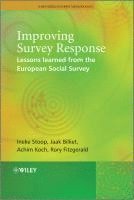
    Improving Survey Response

    Lessons Learned from the European Social Survey

    AvIneke A. L. Stoop,Jaak Billiet

    Inbunden, Engelska, 2010

    Del i serien Wiley Series in Survey Methodology

    837 kr

    Tillfälligt slut

    Beskrivning

    High response rates have traditionally been considered as one of the main indicators of survey quality. Obtaining high response rates is sometimes difficult and expensive, but clearly plays a beneficial role in terms of improving data quality. It is becoming increasingly clear, however, that simply boosting response to achieve a higher response rate will not in itself eradicate nonresponse bias. In this book the authors argue that high response rates should not be seen as a goal in themselves, but rather as part of an overall survey quality strategy based on random probability sampling and aimed at minimising nonresponse bias. Key features of Improving Survey Response: A detailed coverage of nonresponse issues, including a unique examination of cross-national survey nonresponse processes and outcomes.A discussion of the potential causes of nonresponse and practical strategies to combat it.A detailed examination of the impact of nonresponse and of techniques for adjusting for it once it has occurred.Examples of best practices and experiments drawn from 25 European countries.Supplemented by the European Social Survey (ESS) websites, containing materials for the measurement and analysis of nonresponse based on detailed country-level response process datasets.The book is designed to help survey researchers and those commissioning surveys by explaining how to prioritise the reduction of nonresponse bias rather than focusing on increasing the overall response rate. It shows substantive researchers how nonresponse can impact on substantive outcomes.

    Produktinformation

    • Utgivningsdatum:2010-03-26
    • Mått:158 x 234 x 25 mm
    • Vikt:626 g
    • Format:Inbunden
    • Språk:Engelska
    • Serie:Wiley Series in Survey Methodology
    • Antal sidor:340
    • Förlag:John Wiley & Sons Inc
    • ISBN:9780470516690

    Utforska kategorier

    • Referensverk och tvärvetenskap inom Samhälle och politik
    • Matematisk statistik inom Naturvetenskap och teknik

    Mer om författaren

    Ineke Stoop, Social and Cultural Planning Office of the NetherlandsHead of the Department of Data Services and IT, Dr Stoop has worked in survey research and data quality for almost 30 years. She's a member of the advisory board for both Eurostat and the ISI. Her main research interest is nonresponse. Jaak Billiet, Centre for Sociological Research, K.U. Leuven, BelgiumProfessor Billiet is head of the Centre of Sociological Research and a member of the central co-ordination team of the European Social Survey. Achim Koch, Centre for Survey Research and Methodology, GermanySenior Researcher Achim Koch has been working in this area for 20 years. He was Director of the German General Social Survey between 1995 and 2004. Rory Fitzgerald, Centre for Comparative Social Surveys, City University, UKSenior Research Fellow Rory Fitzgerald has had many years experience working in surveying. Before moving to his current post he was Research Director at the National Centre for Social Research (NatCen) for 5 years.All four authors have published numerous articles in this area.

    Innehållsförteckning

    • 1. Backgrounds of nonresponse 1.1. Introduction1.2. Declining response rates1.3. Total survey quality and nonresponse1.4. Optimising comparability2. Survey response in cross-national studies2.1. Introduction2.2. Harmonisation models2.3. Contactability2.4. Ability to cooperate2.5. Willingness to cooperate2.6. Nonresponse bias2.7. Ethics and humans3. The European Social Survey3.1. Introduction3.2. What is the European Social Survey?3.3. ESS design and methodology3.4. Nonresponse targets, strategies and documentation3.5. Conclusions4. Implementation of the European Social Survey4.1. Introduction4.2. Basic survey features4.3. Practical fieldwork issues4.4. Summary and conclusions5. Response and nonresponse rates in the European Social Survey5.1. Data and definitions5.2. Response and nonresponse rates in ESS 35.3. Response rate differences and fieldwork efforts6. Response enhancement through extended interviewer efforts6.1. Introduction6.2. Previous research on contactability6.3. Previous research on cooperation6.4. Sample type and recruitment mode in the European Social Survey6.5. Establishing contact in the European Social Survey6.6. Obtaining cooperation in the European Social Survey6.7. Effects of enhanced field efforts in the European Social Survey6.8. Conclusion7. Refusal conversion7.1. Introduction7.2. Previous research7.3. Refusal conversion in the ESS7.4. Refusal conversion and data quality7.5. Discussion and conclusions8. Designs for detecting nonresponse bias and adjustment8.1. What is nonresponse bias?8.2. Methods for assessing nonresponse bias8.4. Final conclusions9. Lessons learned9.1. Introduction9.2. Standardisation, tailoring and control9.3. Achieving high response rates9.4. Refusal conversion9.5. Nonresponse bias9.6. Contact forms and fieldwork monitoring9.7. Into the future