• Fri frakt över 249 kr
  • •
  • Snabba leveranser
  • •
  • Billiga böcker
Kundservice

Du är på sajten för privatpersoner.

Företag, bibliotek eller offentlig verksamhet?

Du handlar på classic.bokus.com, där alla dina funktioner finns intakta.
Till classic.bokus.com
Bokus logotyp. Gå till startsidan.
  • Erbjudanden
  • Nyheter
  • Student
  • Topplistor
  • Barn & ungdom
  • Bokus Play
  • E-böcker
  • Pocketböcker
  • Spel & pussel

Må bättre, för mindre! Upp till 50% rabatt på hälsoböcker

Sidfot

Mina sidor

    Hjälp

    • Kundservice
    • Vanliga frågor och svar
    • Frakt och leverans
    • Retur vid ångerrätt
    • Reklamera vara
    • Betalning
    • Köpvillkor
    • Allmänna villkor
    • Information om webbplatsens tillgänglighet

    Om Bokus

    • Om oss
    • Pressrum
    • För studenter
    • För företag
    • För bibliotek och offentlig verksamhet
    • För leverantörer
    • Hållbarhet

    Populärt

    • Aktuella erbjudanden
    • Presentkort
    • Studentlitteratur
    • Nya böcker
    • Topplistor
    • Signerade böcker
    • Engelska böcker

    Inspiration

    • Boktips
    • BookTok
    • Populära bokserier
    • Barnbokskaraktärer
    • Populära författare
    Logotyp för Bokus
    Följ oss på Facebook (extern länk)Följ oss på Instagram (extern länk)Följ oss på YouTube (extern länk)Följ oss på TikTok (extern länk)
    bokus @ CookiesAnpassa cookiesIntegritetspolicyKöpvillkor
    Till Citymail hemsida (extern länk)Till Budbee hemsida (extern länk)Till Postnord hemsida (extern länk)Till Schenker hemsida (extern länk)Till Early Bird hemsida (extern länk)Till Walleys hemsida (extern länk)
    1. Naturvetenskap och teknik
    2. Matematik och naturvetenskap
    3. Kemi
    4. Analytisk kemi

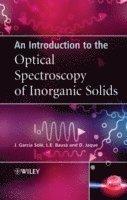
    Introduction to the Optical Spectroscopy of Inorganic Solids

    AvJose Solé,Luisa Bausa

    Häftad, Engelska, 2005

    1 091 kr

    Beställningsvara. Skickas inom 5-8 vardagar. Fri frakt över 249 kr.

    Beskrivning

    This practical guide to spectroscopy and inorganic materials meets the demand from academia and the science community for an introductory text that introduces the different optical spectroscopic techniques, used in many laboratories, for material characterisation. Treats the most basic aspects to be introduced into the field of optical spectroscopy of inorganic materials, enabling a student to interpret simple optical (absorption, reflectivity, emission and scattering) spectraContains simple, illustrative examples and solved exercisesCovers the theory, instrumentation and applications of spectroscopy for the characterisation of inorganic materials, including lasers, phosphors and optical materials such as photonicsThis is an ideal beginner’s guide for students with some previous knowledge in quantum mechanics and optics, as well as a reference source for professionals or researchers in materials science, especially the growing field of optical materials.

    Produktinformation

    • Utgivningsdatum:2005-02-18
    • Mått:154 x 231 x 17 mm
    • Vikt:454 g
    • Format:Häftad
    • Språk:Engelska
    • Antal sidor:304
    • Förlag:John Wiley & Sons Inc
    • ISBN:9780470868867

    Utforska kategorier

    • Analytisk kemi inom Naturvetenskap och teknik
    • Maskinteknik och material inom Naturvetenskap och teknik
    • Tillverkningsteknik inom Naturvetenskap och teknik

    Mer om författaren

    Jose Solé, Department of Material Science, University of Madrid, Spain.Luis Bausa, Department of Material Science, University of Madrid, Spain.Daniel Jaque, Department of Material Science, University of Madrid, Spain.

    Recensioner i media

    "This is a useful book for an undergraduate or an early-stage postgraduate course in spectroscopy." (Reviews, June 2008) "[allows] students with a background in quantum physics and solid state physics, to interpret simple optical spectra…and obtain knowledge of the main instrumentation used in this field." (Chimie Nouvelle, March 2007)

    Innehållsförteckning

    • PREFACE. ACKNOWLEDGEMENTS.SOME PHYSICAL CONSTANTS OF INTEREST IN SPECTROSCOPY.I FUNDAMENTALS.I.1 Origin of the Spectroscopy.I.2 Electromagnetic Spectrum. Optical Spectroscopy.I.3 Absorption. The Spectrophotometer.I.4 Luminescence. The Spectrofluorimeter. Time resolved luminescence.I.5 Scattering. The Raman effect.I.6 Advanced topic: The Fourier Transform Spectrophotometer.Exercises.II LIGHT SOURCES.II.1 Introduction.II.2 Lamps.II.3 The Laser. Basic principles.II.4 Types of Lasers.II.5 Tunability of laser radiation. The Optical Parametric Oscillator.II.6 Advanced Topic:1) Site Selective Spectroscopy. 2) Excited State Absorption.Exercises.III MONOCHROMATORS AND DETECTORS.III.1 Introduction.III.2 Monochromators.III.3 Types of detectors. Basic parameters.III.4 The Photomultiplier.III.5 Signal/noise ratio optimisation.III.6 Detection of pulses.III.7 Advanced Topic: Detection of very fast pulses; The Streak Camera; The Correlator.Exercises.IV. OPTICAL TRANSPARENCY OF SOLIDS.IV.1 Introduction.IV.2 Optical magnitudes and the dielectric constant.IV.3The Lorentz oscillator.IV.4 Metals.IV.5 Semiconductors and insulators.IV.6 Spectral shape of the fundamental absorption edge.IV.7 Excitons.IV.8 Advanced topic: The colour of metals.Exercises.V. OPTICALLY ACTIVE CENTRES.V.1 Introduction.V.2 Static interaction. The crystalline field.V.3 Band intensities. The oscillator strength.V.4 Dynamic interaction. The coordinate configuration diagram.V.5 Band shape. The Huang-Rhys factor.V.6 Non radiative transitions. Energy transfer.V.7 Advanced topic: Determination of quantum efficiencies.Exercises.VI. APPLICATIONS: RARE EARTH AND TRANSITION METAL IONS, COLOUR CENTERS.VI.1 Introduction.VI.2 Trivalent rare earth ions. Diagram of Dieke.VI.3 Non radiative transitions in rare earth ions; The "energy gap" law.VI.4 Transition metal ions. Tanabe- Sugano diagrams.VI.5 Colour centres.VI.6 Advanced topic: 1) The Judd and Ofelt method. 2) Optical cooling of solids.Exercises.VII. GROUP THEORY AND SPECTROSCOPY.VII.1 Introduction.VII.2 Symmetry operations and classes.VII.3 Representations. The character table.VII.4 Reduction in symmetry and splitting of energy levels.VII.5 Selection rules for optical transitions.VII.6 Illustrative examples.VII.7 Advanced topic: Applications to optical transitions of Kramers ions.Exercises.APPENDICES.APPENDIX A1.- The joint density of states.APPENDIX A2.- Effect of an octahedral field on a valence electron d1.APPENDIX A3.- Calculation of the spontaneous emission probability by the Einstein thermodynamic treatment.APPENDIX A4.- Determination of the Smakula´s formula.INDEX.