• Fri frakt över 249 kr
  • •
  • Snabba leveranser
  • •
  • Billiga böcker
Kundservice

Du är på sajten för privatpersoner.

Företag, bibliotek eller offentlig verksamhet?

Du handlar på classic.bokus.com, där alla dina funktioner finns intakta.
Till classic.bokus.com
Bokus logotyp. Gå till startsidan.
  • Erbjudanden
  • Nyheter
  • Student
  • Topplistor
  • Barn & ungdom
  • Bokus Play
  • E-böcker
  • Pocketböcker
  • Spel & pussel

10% rabatt på allt med kod NYSTART10 →

Sidfot

Mina sidor

    Hjälp

    • Kundservice
    • Vanliga frågor och svar
    • Frakt och leverans
    • Retur vid ångerrätt
    • Reklamera vara
    • Betalning
    • Köpvillkor
    • Allmänna villkor
    • Information om webbplatsens tillgänglighet

    Om Bokus

    • Om oss
    • Pressrum
    • För studenter
    • För företag
    • För bibliotek och offentlig verksamhet
    • För leverantörer
    • Hållbarhet

    Populärt

    • Aktuella erbjudanden
    • Presentkort
    • Studentlitteratur
    • Nya böcker
    • Topplistor
    • Signerade böcker
    • Engelska böcker

    Inspiration

    • Boktips
    • BookTok
    • Populära bokserier
    • Barnbokskaraktärer
    • Populära författare
    Logotyp för Bokus
    Följ oss på Facebook (extern länk)Följ oss på Instagram (extern länk)Följ oss på YouTube (extern länk)Följ oss på TikTok (extern länk)
    bokus @ CookiesAnpassa cookiesIntegritetspolicyKöpvillkor
    Till Citymail hemsida (extern länk)Till Budbee hemsida (extern länk)Till Postnord hemsida (extern länk)Till Schenker hemsida (extern länk)Till Early Bird hemsida (extern länk)Till Walleys hemsida (extern länk)
    1. Naturvetenskap och teknik
    2. Matematik och naturvetenskap
    3. Matematik
    4. Matematisk statistik

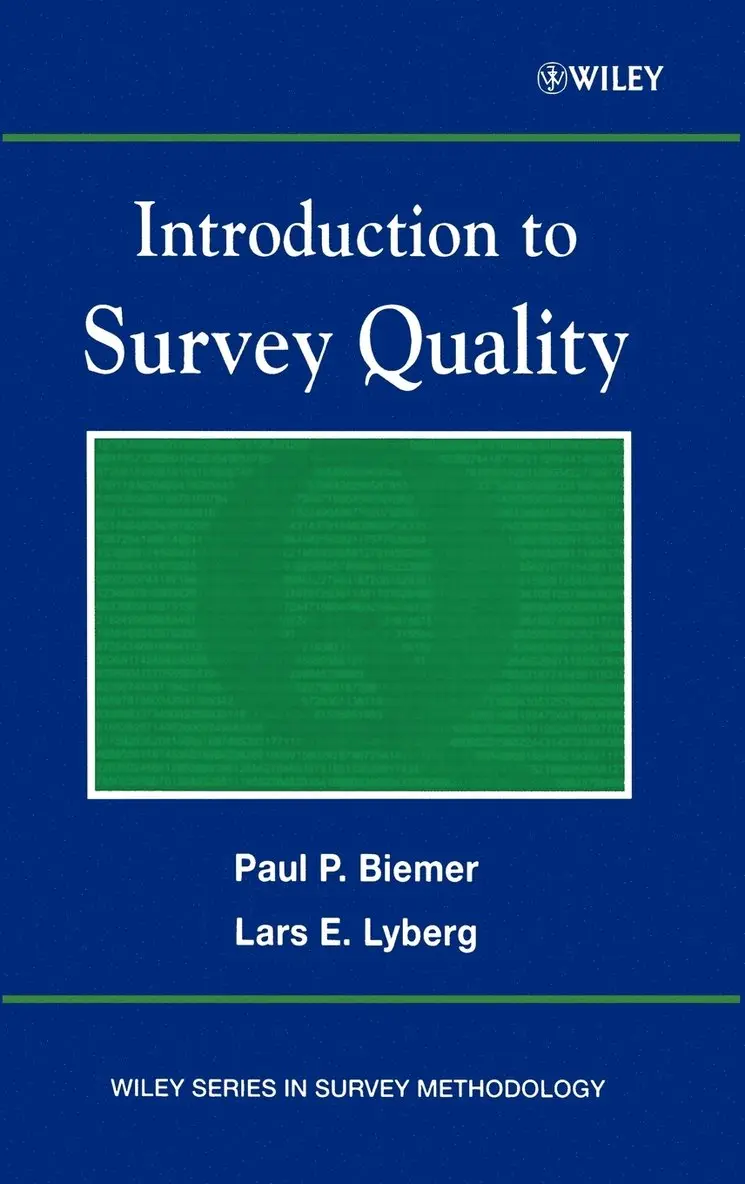
    Introduction to Survey Quality

    AvPaul P. Biemer,Lars E. Lyberg

    Inbunden, Engelska, 2003

    Del 329 i serien Wiley Series in Survey Methodology

    1 961 kr

    Beställningsvara. Skickas inom 5-8 vardagar. Fri frakt över 249 kr.

    Beskrivning

    Peruse the history of survey research and the essential conceptsfor data quality. With an emphasis on total survey error, theauthors review principles and concepts in the field and examineimportant unresolved issues in survey methods. Spanning a range oftopics dealing with the quality of data collected through thesurvey process, they focus on such key issues as:* Major sources of survey error, examining the origins of eacherror source most successful methods for reducing errors from thosesources* Methods most often used in practice for evaluating the effectsof the source on total survey error* Implications of improving survey quality for organizationalmanagement and costs

    Produktinformation

    • Utgivningsdatum:2003-03-11
    • Mått:162 x 246 x 27 mm
    • Vikt:715 g
    • Format:Inbunden
    • Språk:Engelska
    • Serie:Wiley Series in Survey Methodology
    • Antal sidor:424
    • Förlag:John Wiley & Sons Inc
    • ISBN:9780471193753

    Utforska kategorier

    • Matematisk statistik inom Naturvetenskap och teknik

    Mer om författaren

    PAUL P. BIEMER, PhD, is a distinguished Fellow at RTIInternational, and Assistant Director for Survey Research at theOdum Institute for Research in Social Science at the University ofNorth Carolina at Chapel Hill. LARS E. LYBERG, PhD, is Chief Scientist at StatisticsSweden. They both have co-edited, with others, Measurement Errorsin Surveys, Survey Measurement and Process Quality, and TelephoneSurvey Methodology (all published by Wiley).

    Recensioner i media

    "...a very nice place to begin for anyone who might have an interest in the quality of surveys." (Technometrics, Vol. 45, No. 3, August 2003)

    Innehållsförteckning

    • Preface. Chapter 1. The Evolution of Survey Process Quality. 1.1 The Concept of a Survey. 1.2 Types of Surveys. 1.3 Brief History of Survey Methodology. 1.4 The Quality Revolution. 1.5 Definitions of Quality and Quality in StatisticalOrganizations. 1.6 Measuring Quality. 1.7 Improving Quality. 1.8 Quality in a Nutshell. Chapter 2. The Survey Process and Data Quality. 2.1 Overview of the Survey Process. 2.2 Data Quality and Total Survey Error. 2.3 Decomposing Nonsampling Error into Its Component Parts. 2.4 Gauging the Magnitude of Total Survey Error. 2.5 Mean Squared Error. 2.6 An Illustration of the Concepts. Chapter 3. Coverage and Nonresponse Error. 3.1 Coverage Error. 3.2 Measures of Coverage Bias. 3.3 Reducing Coverage Bias. 3.4 Unit Nonresponse Error. 3.5 Calculating Response Rates. 3.6 Reducing Nonresponse Bias. Chapter 4. The Measurement Process and Its Implications forQuestionnaire Design. 4.1Components of Measurement Error. 4.2 Errors Arising from the Questionnaire Design. 4.3 Understanding the Response Process. Chapter 5. Errors Due to Interviewers and Interviewing. 5.1 Role of the Interviewer. 5.2 Interviewer Variability. 5.3 Design Factors that Influence Interviewer Effects. 5.4 Evaluation of Interviewer Performance. Chapter 6. Data Collection Modes and Associated Errors. 6.1 Modes of Data Collection. 6.2 Decision Regarding Mode. 6.3 Some Examples of Mode Effects. Chapter 7. Data Processing: Errors and Their Control. 7.1 Overview of Data Processing Steps. 7.2 Nature of Data Processing Error. 7.3 Data Capture Errors. 7.4 Post-Data Capture Editing. 7.5 Coding. 7.6 File Preparation. 7.7 Applications of Continuous Quality Improvement: The Case ofCoding. 7.8 Integration Activities. Chapter 8. Overview of Survey Error Evaluation Methods. 8.1 Purposes of Survey Error Evaluation. 8.2 Evaluation Methods for Designing and Pretesting Surveys. 8.3 Methods for Monitoring and Controlling Data Quality. 8.4 Postsurvey Evaluations. 8.5 Summary of Evaluation Methods. Chapter 9. Sampling Error. 9.1 Brief History of Sampling. 9.2 Nonrandom Sampling Methods. 9.3 Simple Random Sampling. 9.4 Statistical Inference in the Presence of NonsamplingErrors. 9.5 Other Methods of Random Sampling. 9.6 Concluding Remarks. Chapter 10.1 Practical Survey Design for Minimizing Total SurveyError. 10.1 Balance Between Cost, Survey Error, and Other QualityFeatures. 10.2 Planning a Survey for Optimal Quality. 10.3 Documenting Survey Quality. 10.4 Organizational Issues Related to Survey Quality. References. Index.