• Fri frakt över 249 kr
  • •
  • Snabba leveranser
  • •
  • Billiga böcker
Kundservice

Du är på sajten för privatpersoner.

Företag, bibliotek eller offentlig verksamhet?

Du handlar på classic.bokus.com, där alla dina funktioner finns intakta.
Till classic.bokus.com
Bokus logotyp. Gå till startsidan.
  • Erbjudanden
  • Nyheter
  • Student
  • Topplistor
  • Barn & ungdom
  • Bokus Play
  • E-böcker
  • Pocketböcker
  • Spel & pussel

10% rabatt på allt med kod NYSTART10 →

Sidfot

Mina sidor

    Hjälp

    • Kundservice
    • Vanliga frågor och svar
    • Frakt och leverans
    • Retur vid ångerrätt
    • Reklamera vara
    • Betalning
    • Köpvillkor
    • Allmänna villkor
    • Information om webbplatsens tillgänglighet

    Om Bokus

    • Om oss
    • Pressrum
    • För studenter
    • För företag
    • För bibliotek och offentlig verksamhet
    • För leverantörer
    • Hållbarhet

    Populärt

    • Aktuella erbjudanden
    • Presentkort
    • Studentlitteratur
    • Nya böcker
    • Topplistor
    • Signerade böcker
    • Engelska böcker

    Inspiration

    • Boktips
    • BookTok
    • Populära bokserier
    • Barnbokskaraktärer
    • Populära författare
    Logotyp för Bokus
    Följ oss på Facebook (extern länk)Följ oss på Instagram (extern länk)Följ oss på YouTube (extern länk)Följ oss på TikTok (extern länk)
    bokus @ CookiesAnpassa cookiesIntegritetspolicyKöpvillkor
    Till Citymail hemsida (extern länk)Till Budbee hemsida (extern länk)Till Postnord hemsida (extern länk)Till Schenker hemsida (extern länk)Till Early Bird hemsida (extern länk)Till Walleys hemsida (extern länk)
    1. Naturvetenskap och teknik
    2. Matematik och naturvetenskap
    3. Naturvetenskap:allmänt
    4. Naturvetenskapens historia

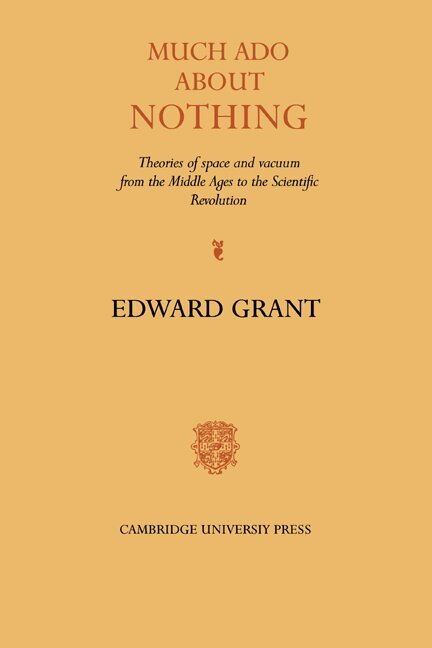
    Much Ado about Nothing

    Theories of Space and Vacuum from the Middle Ages to the Scientific Revolution

    AvEdward Grant,Edward Grant

    Häftad, Engelska, 2008

    463 kr

    Beställningsvara. Skickas inom 10-15 vardagar. Fri frakt över 249 kr.

    Fler format och utgåvor

    Inbunden

    2 193 kr

    Beskrivning

    The primary objective of this study is to provide a description of the major ideas about void space within and beyond the world that were formulated between the fourteenth and early eighteenth centuries. The second part of the book - on infinite, extracosmic void space - is of special significance. The significance of Professor Grant's account is twofold: it provides a comprehensive and detailed description of the scholastic Aristotelian arguments for and against the existence of void space; and it presents (again for the first time) an analysis of the possible influence of scholastic ideas and arguments on the interpretations of space proposed by the nonscholastic authors who made the Scientific Revolution possible. The concluding chapter of the book is unique in not only describing the conceptualizations of space proposed by the makers of the Scientific Revolution, but in assessing the role of readily available scholastic ideas on the conception of space adopted for the Newtonian world.

    Produktinformation

    • Utgivningsdatum:2008-05-15
    • Mått:152 x 229 x 24 mm
    • Vikt:660 g
    • Format:Häftad
    • Språk:Engelska
    • Antal sidor:472
    • Förlag:Cambridge University Press
    • ISBN:9780521061926

    Utforska kategorier

    • Naturvetenskapens historia inom Naturvetenskap och teknik

    Innehållsförteckning

    • Preface; Part I. Intracosmic Space: Scope of study; 1. Aristotle on void space; 2. Medieval conceptions of the nature and properties of void space; 3. The possibility of motion in void space; 4. Nature's abhorrence of a vacuum; Part II. Infinite Void Space Beyond the World: Largely a theological problem; 5. The historical roots of the medieval concept of an infinite, extracosmic void space; 6. Late medieval conceptions of extracosmic ('imaginary') void space; 7. Extracosmic, infinite void space in sixteenth- and seventeenth-century scholastic thought; 8. Infinite space in nonscholastic thought during the sixteenth and seventeenth centuries; Part III. Summary and Reflections: 9. Summary and reflections; Notes; Bibliography; Index.