• Fri frakt över 249 kr
  • •
  • Snabba leveranser
  • •
  • Billiga böcker
Kundservice

Du är på sajten för privatpersoner.

Företag, bibliotek eller offentlig verksamhet?

Du handlar på classic.bokus.com, där alla dina funktioner finns intakta.
Till classic.bokus.com
Bokus logotyp. Gå till startsidan.
  • Erbjudanden
  • Student
  • Topplistor
  • Barn & ungdom
  • Bokus Play
  • E-böcker
  • Ljudböcker
  • Pocketböcker
  • Spel och pussel

5% studentrabatt – använd koden KURSBOK27 →

Sidfot

Mina sidor

    Hjälp

    • Kundservice
    • Vanliga frågor och svar
    • Frakt och leverans
    • Retur vid ångerrätt
    • Reklamera vara
    • Betalning
    • Köpvillkor
    • Allmänna villkor
    • Information om webbplatsens tillgänglighet

    Om Bokus

    • Om oss
    • Pressrum
    • För studenter
    • För företag
    • För bibliotek och offentlig verksamhet
    • För leverantörer
    • Hållbarhet

    Populärt

    • Aktuella erbjudanden
    • Presentkort
    • Studentlitteratur
    • Nya böcker
    • Topplistor
    • Signerade böcker
    • Engelska böcker

    Inspiration

    • Boktips
    • BookTok
    • Barnbokskaraktärer
    • Populära författare
    Logotyp för Bokus
    Följ oss på Facebook (extern länk)Följ oss på Instagram (extern länk)Följ oss på YouTube (extern länk)Följ oss på TikTok (extern länk)
    bokus @ CookiesAnpassa cookiesIntegritetspolicyKöpvillkor
    Till Citymail hemsida (extern länk)Till Budbee hemsida (extern länk)Till Postnord hemsida (extern länk)Till Schenker hemsida (extern länk)Till Early Bird hemsida (extern länk)Till Walleys hemsida (extern länk)
    1. Naturvetenskap och teknik
    2. Matematik och naturvetenskap
    3. Matematik
    4. Matematisk statistik

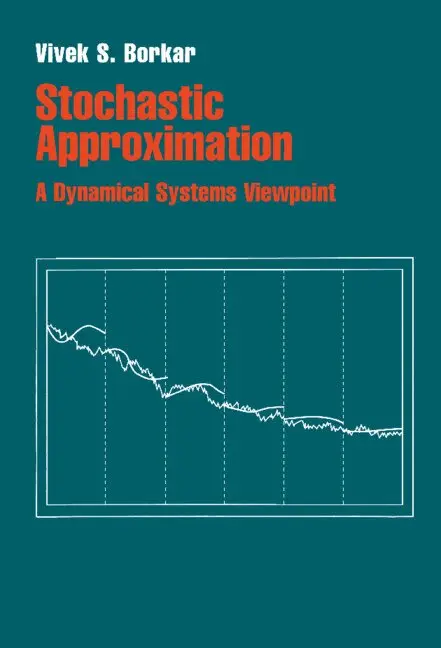
    Stochastic Approximation

    A Dynamical Systems Viewpoint

    AvVivek S. Borkar

    Inbunden, Engelska, 2008

    852 kr

    Beställningsvara. Skickas inom 7-10 vardagar. Fri frakt över 249 kr.

    Beskrivning

    This simple, compact toolkit for designing and analyzing stochastic approximation algorithms requires only basic literacy in probability and differential equations. Yet these algorithms have powerful applications in control and communications engineering, artificial intelligence and economic modelling. The dynamical systems viewpoint treats an algorithm as a noisy discretization of a limiting differential equation and argues that, under reasonable hypotheses, it tracks the asymptotic behaviour of the differential equation with probability one. The differential equation, which can usually be obtained by inspection, is easier to analyze. Novel topics include finite-time behaviour, multiple timescales and asynchronous implementation. There is a useful taxonomy of applications, with concrete examples from engineering and economics. Notably it covers variants of stochastic gradient-based optimization schemes, fixed-point solvers, which are commonplace in learning algorithms for approximate dynamic programming, and some models of collective behaviour. Three appendices give background on differential equations and probability.

    Produktinformation

    • Utgivningsdatum:2008-09-01
    • Mått:157 x 233 x 17 mm
    • Vikt:380 g
    • Format:Inbunden
    • Språk:Engelska
    • Antal sidor:176
    • Förlag:Cambridge University Press
    • ISBN:9780521515924

    Utforska kategorier

    • Matematisk statistik inom Naturvetenskap och teknik
    • Tillämpad matematik inom Naturvetenskap och teknik

    Mer om författaren

    Vivek S. Borkar is dean of the School of Technology and Computer Science at the Tata Institute of Fundamental Research. A distinguished researcher in stochastic and adaptive control, he distils his deep knowledge and broad experience in this motivating book.

    Recensioner i media

    'I highly recommend [this book] to all readers interested in the theory of recursive algorithms and its applications in practice.' Mathematical Reviews

    Innehållsförteckning

    • Preface; 1. Introduction; 2. Basic convergence analysis; 3. Stability criteria; 4. Lock-in probability; 5. Stochastic recursive inclusions; 6. Multiple timescales; 7. Asynchronous schemes; 8. A limit theorem for fluctuations; 9. Constant stepsize algorithms; 10. Applications; 11. Appendices; References; Index.