• Fri frakt över 249 kr
  • •
  • Snabba leveranser
  • •
  • Billiga böcker
Kundservice

Du är på sajten för privatpersoner.

Företag, bibliotek eller offentlig verksamhet?

Du handlar på classic.bokus.com, där alla dina funktioner finns intakta.
Till classic.bokus.com
Bokus logotyp. Gå till startsidan.
  • Erbjudanden
  • Nyheter
  • Student
  • Topplistor
  • Barn & ungdom
  • Bokus Play
  • E-böcker
  • Pocketböcker
  • Spel & pussel

10% rabatt på allt med kod: NYSTART10 →

Sidfot

Mina sidor

    Hjälp

    • Kundservice
    • Vanliga frågor och svar
    • Frakt och leverans
    • Retur vid ångerrätt
    • Reklamera vara
    • Betalning
    • Köpvillkor
    • Allmänna villkor
    • Information om webbplatsens tillgänglighet

    Om Bokus

    • Om oss
    • Pressrum
    • För studenter
    • För företag
    • För bibliotek och offentlig verksamhet
    • För leverantörer
    • Hållbarhet

    Populärt

    • Aktuella erbjudanden
    • Presentkort
    • Studentlitteratur
    • Nya böcker
    • Topplistor
    • Signerade böcker
    • Engelska böcker

    Inspiration

    • Boktips
    • BookTok
    • Populära bokserier
    • Barnbokskaraktärer
    • Populära författare
    Logotyp för Bokus
    Följ oss på Facebook (extern länk)Följ oss på Instagram (extern länk)Följ oss på YouTube (extern länk)Följ oss på TikTok (extern länk)
    bokus @ CookiesAnpassa cookiesIntegritetspolicyKöpvillkor
    Till Citymail hemsida (extern länk)Till Budbee hemsida (extern länk)Till Postnord hemsida (extern länk)Till Schenker hemsida (extern länk)Till Early Bird hemsida (extern länk)Till Walleys hemsida (extern länk)
    1. Filosofi och religion
    2. Filosofi
    3. Filosofiska discipliner

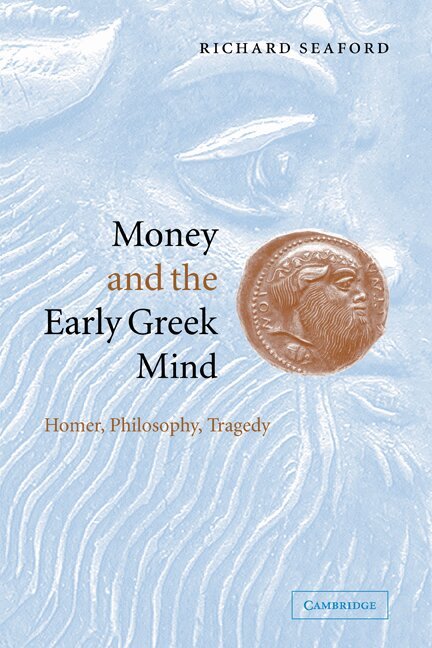
    Money and the Early Greek Mind

    Homer, Philosophy, Tragedy

    AvRichard Seaford

    Häftad, Engelska, 2004

    666 kr

    Beställningsvara. Skickas inom 10-15 vardagar. Fri frakt över 249 kr.

    Fler format och utgåvor

    Inbunden

    1 536 kr

    Beskrivning

    How were the Greeks of the sixth century BC able to invent philosophy and tragedy? In this book Richard Seaford argues that a large part of the answer can be found in another momentous development, the invention and rapid spread of coinage which produced the first ever thoroughly monetised society. By transforming social relations, monetisation contributed to the ideas of the universe as an impersonal system (presocratic philosophy) and of the individual alienated from his own kin and from the gods (in tragedy). Seaford argues that an important precondition for this monetisation was the Greek practice of animal sacrifice, as represented in Homeric Epic, which describes a premonetary world on the point of producing money. This book combines social history, economic anthropology, numismatics and the close reading of literary, inscriptional, and philosophical texts. Questioning the origins and shaping force of Greek philosophy, this is a major book with wide appeal.

    Produktinformation

    • Utgivningsdatum:2004-03-11
    • Mått:152 x 228 x 26 mm
    • Vikt:609 g
    • Format:Häftad
    • Språk:Engelska
    • Antal sidor:384
    • Förlag:Cambridge University Press
    • ISBN:9780521539920

    Utforska kategorier

    • Filosofiska discipliner inom Filosofi och religion

    Mer om författaren

    Richard Seaford is Professor of Greek Literature at the University of Exeter. He is the author of commentaries on Euripides' 'Cyclops' (1984) and 'Bacchae' (1996) and of 'Reciprocity and Ritual: Homer and Tragedy in the Developing City-State' (1994).

    Recensioner i media

    'This book is of wider relevance than just to teachers and students of classics, for whom it affords an invaluable resource. It relates to all of us who, as Seaford says, 'live in a world in which the monetisation first observable in the Greek polis has had several centuries to develop …' The Lecturer

    Innehållsförteckning

    • 1. Introduction; Part I. The Genesis of Coined Money: 2. Homeric transactions; 3. Sacrifice and distribution; 4. Greece and the ancient near East; 5. Greek money; 6. The preconditions of coinage; 7. The earliest coins; 8. The features of money; Part II. The Making of Metaphysics: 9. Did politics produce philosophy?; 10. Anaximander and Xenophanes; 11. The many and the one; 12. Heraclitus and Parmenides; 13. Pythagoreanism and Protagoras; 14. Individualisation; 15. Appendix: was money used in the early near East?