• Fri frakt över 249 kr
  • •
  • Snabba leveranser
  • •
  • Billiga böcker
Kundservice

Du är på sajten för privatpersoner.

Företag, bibliotek eller offentlig verksamhet?

Du handlar på classic.bokus.com, där alla dina funktioner finns intakta.
Till classic.bokus.com
Bokus logotyp. Gå till startsidan.
  • Erbjudanden
  • Nyheter
  • Student
  • Topplistor
  • Barn & ungdom
  • Bokus Play
  • E-böcker
  • Pocketböcker
  • Spel & pussel

10% rabatt på allt med kod NYSTART10 →

Sidfot

Mina sidor

    Hjälp

    • Kundservice
    • Vanliga frågor och svar
    • Frakt och leverans
    • Retur vid ångerrätt
    • Reklamera vara
    • Betalning
    • Köpvillkor
    • Allmänna villkor
    • Information om webbplatsens tillgänglighet

    Om Bokus

    • Om oss
    • Pressrum
    • För studenter
    • För företag
    • För bibliotek och offentlig verksamhet
    • För leverantörer
    • Hållbarhet

    Populärt

    • Aktuella erbjudanden
    • Presentkort
    • Studentlitteratur
    • Nya böcker
    • Topplistor
    • Signerade böcker
    • Engelska böcker

    Inspiration

    • Boktips
    • BookTok
    • Populära bokserier
    • Barnbokskaraktärer
    • Populära författare
    Logotyp för Bokus
    Följ oss på Facebook (extern länk)Följ oss på Instagram (extern länk)Följ oss på YouTube (extern länk)Följ oss på TikTok (extern länk)
    bokus @ CookiesAnpassa cookiesIntegritetspolicyKöpvillkor
    Till Citymail hemsida (extern länk)Till Budbee hemsida (extern länk)Till Postnord hemsida (extern länk)Till Schenker hemsida (extern länk)Till Early Bird hemsida (extern länk)Till Walleys hemsida (extern länk)
    1. Samhälle och politik
    2. Politik och statsskick
    3. Statsskick och politiska processer
    4. Statsskick: demokrati

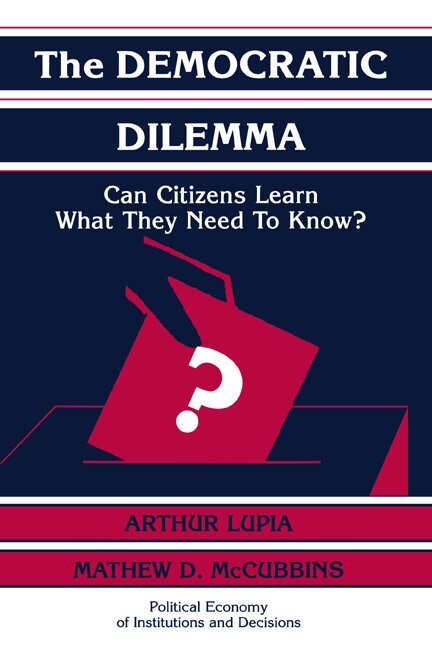
    The Democratic Dilemma

    Can Citizens Learn What They Need to Know?

    AvArthur Lupia,Mathew D. McCubbins

    Häftad, Engelska, 1998

    Del i serien Political Economy of Institutions and Decisions

    379 kr

    Beställningsvara. Skickas inom 10-15 vardagar. Fri frakt över 249 kr.

    Fler format och utgåvor

    Inbunden

    1 335 kr

    Beskrivning

    Voters cannot answer simple survey questions about politics. Legislators cannot recall the details of legislation. Jurors cannot comprehend legal arguments. Observations such as these are plentiful and several generations of pundits and scholars have used these observations to claim that voters, legislators, and jurors are incompetent. Are these claims correct? Do voters, jurors, and legislators who lack political information make bad decisions? In The Democratic Dilemma, Professors Arthur Lupia and Mathew McCubbins explain how citizens make decisions about complex issues. Combining insights from economics, political science, and the cognitive sciences, they seek to develop theories and experiments about learning and choice. They use these tools to identify the requirements for reasoned choice - the choice that a citizen would make if she possessed a certain (perhaps, greater) level of knowledge. The results clarify debates about voter, juror, and legislator competence and also reveal how the design of political institutions affects citizens' abilities to govern themselves effectively.

    Produktinformation

    • Utgivningsdatum:1998-03-13
    • Mått:152 x 228 x 24 mm
    • Vikt:405 g
    • Format:Häftad
    • Språk:Engelska
    • Serie:Political Economy of Institutions and Decisions
    • Antal sidor:300
    • Förlag:Cambridge University Press
    • ISBN:9780521585934

    Utforska kategorier

    • Statsskick: demokrati inom Samhälle och politik

    Recensioner i media

    'Lupia and McCubbins competently and clearly shed light on the foundations of how citizens learn.' Political Studies

    Innehållsförteckning

    • List of tables and figures; Series editors' preface; Acknowledgements; 1. Knowledge and the foundation of democracy; Part I. Theory: 2. How people learn; 3. How people learn from others; 4. What people learn from others; 5. Delegation and democracy; Part II. Experiments: 6. Theory, predictions and the scientific method; 7. Laboratory experiments on information, persuasion and choice; 8. Laboratory experiments on delegation; 9. A survey on the conditions for persuasion; Part III. Implications for Institutional Design: 10. The institutions of knowledge; Afterword; Appendices; References; Author index; Subject index.