• Fri frakt över 249 kr
  • •
  • Snabba leveranser
  • •
  • Billiga böcker
Kundservice

Du är på sajten för privatpersoner.

Företag, bibliotek eller offentlig verksamhet?

Du handlar på classic.bokus.com, där alla dina funktioner finns intakta.
Till classic.bokus.com
Bokus logotyp. Gå till startsidan.
  • Erbjudanden
  • Nyheter
  • Student
  • Topplistor
  • Barn & ungdom
  • Bokus Play
  • E-böcker
  • Pocketböcker
  • Spel & pussel

10% rabatt på allt med kod NYSTART10 →

Sidfot

Mina sidor

    Hjälp

    • Kundservice
    • Vanliga frågor och svar
    • Frakt och leverans
    • Retur vid ångerrätt
    • Reklamera vara
    • Betalning
    • Köpvillkor
    • Allmänna villkor
    • Information om webbplatsens tillgänglighet

    Om Bokus

    • Om oss
    • Pressrum
    • För studenter
    • För företag
    • För bibliotek och offentlig verksamhet
    • För leverantörer
    • Hållbarhet

    Populärt

    • Aktuella erbjudanden
    • Presentkort
    • Studentlitteratur
    • Nya böcker
    • Topplistor
    • Signerade böcker
    • Engelska böcker

    Inspiration

    • Boktips
    • BookTok
    • Populära bokserier
    • Barnbokskaraktärer
    • Populära författare
    Logotyp för Bokus
    Följ oss på Facebook (extern länk)Följ oss på Instagram (extern länk)Följ oss på YouTube (extern länk)Följ oss på TikTok (extern länk)
    bokus @ CookiesAnpassa cookiesIntegritetspolicyKöpvillkor
    Till Citymail hemsida (extern länk)Till Budbee hemsida (extern länk)Till Postnord hemsida (extern länk)Till Schenker hemsida (extern länk)Till Early Bird hemsida (extern länk)Till Walleys hemsida (extern länk)
    1. Samhälle och politik
    2. Politik och statsskick
    3. Statsskick och politiska processer

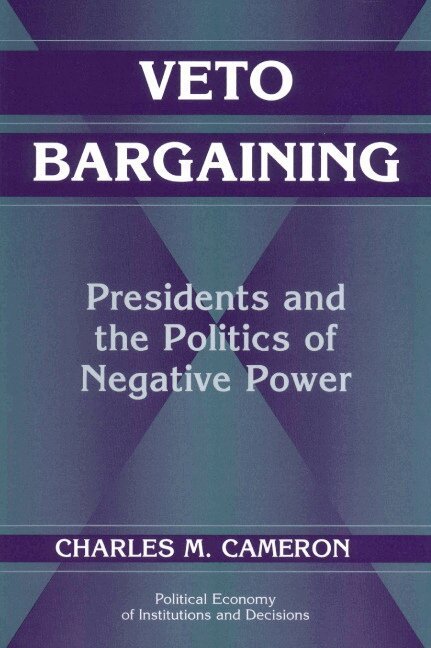
    Veto Bargaining

    Presidents and the Politics of Negative Power

    AvCharles M. Cameron,Randall Calvert

    Häftad, Engelska, 2000

    Del i serien Political Economy of Institutions and Decisions

    379 kr

    Beställningsvara. Skickas inom 10-15 vardagar. Fri frakt över 249 kr.

    Beskrivning

    The late-twentieth century has given rise to the most concentrated period of divided party government in American history. With one party controlling the presidency and the opposing party controlling Congress, the veto has inevitably become a critical tool of presidential power. Combining sophisticated game theory with unprecedented data, this book analyzes how divided party presidents use threats and vetoes to wrest policy concessions from a hostile Congress. Case studies of the most important vetoes in recent history add texture to the analysis, detailing how President Clinton altered the course of Newt Gingrich's Republican Revolution. Offering the first book-length analysis to bring rational choice theory to bear on the presidency, Veto Bargaining offers a major contribution to our understanding of American politics in an age of divided party government.

    Produktinformation

    • Utgivningsdatum:2000-06-19
    • Mått:152 x 228 x 21 mm
    • Vikt:430 g
    • Format:Häftad
    • Språk:Engelska
    • Serie:Political Economy of Institutions and Decisions
    • Antal sidor:312
    • Förlag:Cambridge University Press
    • ISBN:9780521625500

    Utforska kategorier

    • Statsskick och politiska processer inom Samhälle och politik

    Recensioner i media

    'Cameron's is at once the most extensive theoretical and empirical study of vetoes in the US federal system ever undertaken. The range of predictions generated from a quite spare and economical family of models is truly impressive, as are the author's ingenuity and persistence in testing them. This will be a landmark, not just in the study of veto bargaining in the United States, but also in the study of vetoes in other separation-of-powers systems and in the study of executive-legislative relations more broadly conceived.' Gary Cox, University of California at San Diego

    Innehållsförteckning

    • 1. Divided government and interbranch bargaining; 2. A natural history of veto bargaining, 1945–1992; 3. Rational choice and the presidency; 4. Models of veto bargaining; 5. Explaining the patterns; 6. Testing the models; 7. Veto threats; 8. Interpreting history; 9. Conclusions.