• Fri frakt över 249 kr
  • •
  • Snabba leveranser
  • •
  • Billiga böcker
Kundservice

Du är på sajten för privatpersoner.

Företag, bibliotek eller offentlig verksamhet?

Du handlar på classic.bokus.com, där alla dina funktioner finns intakta.
Till classic.bokus.com
Bokus logotyp. Gå till startsidan.
  • Erbjudanden
  • Student
  • Topplistor
  • Barn & ungdom
  • Bokus Play
  • E-böcker
  • Ljudböcker
  • Pocketböcker
  • Spel & pussel

Upp till 25% på utvalda nyheter →

Sidfot

Mina sidor

    Hjälp

    • Kundservice
    • Vanliga frågor och svar
    • Frakt och leverans
    • Retur vid ångerrätt
    • Reklamera vara
    • Betalning
    • Köpvillkor
    • Allmänna villkor
    • Information om webbplatsens tillgänglighet

    Om Bokus

    • Om oss
    • Pressrum
    • För studenter
    • För företag
    • För bibliotek och offentlig verksamhet
    • För leverantörer
    • Hållbarhet

    Populärt

    • Aktuella erbjudanden
    • Presentkort
    • Studentlitteratur
    • Nya böcker
    • Topplistor
    • Signerade böcker
    • Engelska böcker

    Inspiration

    • Boktips
    • BookTok
    • Populära bokserier
    • Barnbokskaraktärer
    • Populära författare
    Logotyp för Bokus
    Följ oss på Facebook (extern länk)Följ oss på Instagram (extern länk)Följ oss på YouTube (extern länk)Följ oss på TikTok (extern länk)
    bokus @ CookiesAnpassa cookiesIntegritetspolicyKöpvillkor
    Till Citymail hemsida (extern länk)Till Budbee hemsida (extern länk)Till Postnord hemsida (extern länk)Till Schenker hemsida (extern länk)Till Early Bird hemsida (extern länk)Till Walleys hemsida (extern länk)
    1. Psykologi och pedagogik
    2. Psykologi
    3. Barnpsykologi och utvecklingspsykologi

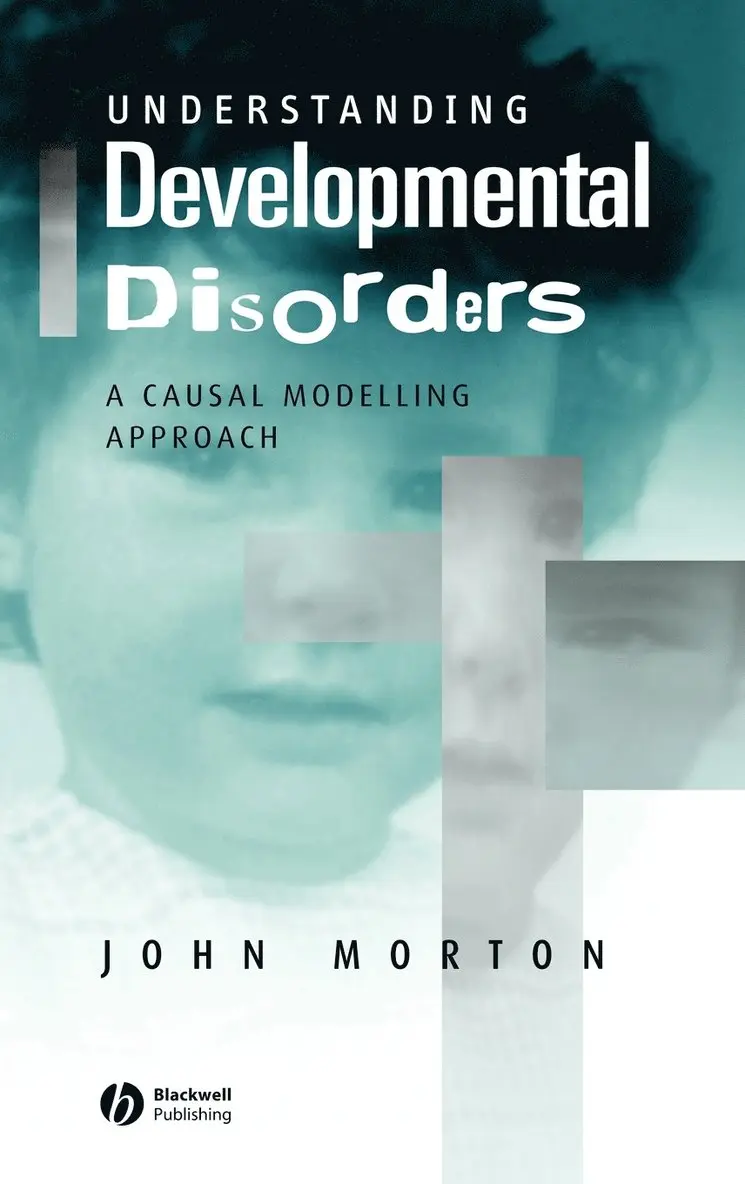
    Understanding Developmental Disorders

    A Causal Modelling Approach

    AvJohn Morton

    Inbunden, Engelska, 2004

    1 593 kr

    Beställningsvara. Skickas inom 5-8 vardagar. Fri frakt över 249 kr.

    Fler format och utgåvor

    E-bok

    1 748 kr

    Häftad

    655 kr

    Beskrivning

    A long-awaited book from developmental disorders expert John Morton, Understanding Developmental Disorders: A Causal Modelling Approach makes sense of the many competing theories about what can go wrong with early brain development, causing a child to develop outside the normal range. Based on the idea that understanding developmental disorders requires us to talk about biological, cognitive, behavioral and environmental factors, and to talk about causal relationships among these elements.Explains what causal modelling is and how to do it.Compares different theories about particular developmental disorders using causal modelling.Will have a profound impact on research in the fields of psychology, neuroscience and medicine.

    Produktinformation

    • Utgivningsdatum:2004-12-08
    • Mått:159 x 237 x 29 mm
    • Vikt:567 g
    • Format:Inbunden
    • Språk:Engelska
    • Antal sidor:320
    • Förlag:John Wiley and Sons Ltd
    • ISBN:9780631187578

    Utforska kategorier

    • Barnpsykologi och utvecklingspsykologi inom Psykologi och pedagogik
    • Beteendeteori inom Psykologi och pedagogik
    • Pediatrik inom Medicin

    Mer om författaren

    John Morton is the former Director of the Medical Research Council’s Cognitive Development Unit. He is now Visiting Professor in the Department of Psychology and Honorary Fellow of the Institute of Cognitive Neuroscience, University College London.

    Recensioner i media

    "What causes disorders of development? How can they be meaningfully defined? These questions have resulted in deeply entangled controversies. John Morton has provided a razor-sharp tool that cuts the Gordian knot. This tool uses a simple pictorial notation that leaves aside ambiguous and divisive words. It resolves entrenched but illusory oppositions between cognition and brain and between nature and nurture. It makes the confusing facts about autism, dyslexia, and other disorders fall into a new coherent pattern and invigorates the comparison of different points of view. This book is indispensable for anyone trying to understand cognitive development and its disorders." Uta Frith, Professor of Cognitive Development, University College London Institute of Cognitive Neuroscience"In his compelling book, Understanding Developmental Disorders, John Morton applies a causal modeling approach to understanding the influences that biological, cognitive, behavioral, and environmental factors exert on the emergence of developmental disorders. Morton eloquently conveys a way of conceptualizing various theories of developmental disorders. This volume will provide an invaluable tool for students, practitioners, and those in academia. I highly recommend it as a must for all professionals striving to understand the origins and course of developmental disorders." Dante Cicchetti, Ph.D., Director, Mt. Hope Family Center "Causal modelling of cognition is a new and original tool not only for thinking with precision about cognitive development and the ways in which it can go amiss; I can see this book having a revolutionary impact on developmental psychology. The causal-modelling framework is also valuable for exposing the kind of sloppy thinking about the causes of developmental difficulties that one sees so often in statements by journalists and politicians (the book contains many such examples). Simply and cogently written, this book is of great importance both for scientists in developmental psychology and for public-health professionals concerned with disorders such as autism, ADHD and dyslexia." Prof Max Coltheart, Scientific Director, Macquarie Centre for Cognitive Science, Australia "John Morton's deep and wonderful book should be required reading for any serious student of cognitive development, as well as for any researcher concerned with developmental disabilities. In giving us a tool for thinking about the causal history of developmental disabilities, he offers profound insights into the nature of causality, the relations among different levels of analysis, and the causes of four developmental syndromes, including autism and dyslexia." Susan Carey, Professor, Harvard University "Morton's lucid and highly readable book offers an excellent tool to clarify the field of developmental disorders as it stands and to point the way to the future." Trends in Cognitive Sciences, August 2005 "Morton writes from first principles but then, as the book progresses, assumes some psychological sophistication. He has a comfortable and conversational...style that has become unusual in scientific writing. It invites reflection, questioning and discussion and I found it well suited to putting across concepts." Tom Berney, Journal of Child Psychology and Psychiatry, May 2006 “Morton’s causal modeling approach seems an innovative and insightful advance in examining and understanding the causes and diagnosis of pathologic conditions.” Psychological Record

    Innehållsförteckning

    • Preface and Acknowledgements viiiChapter 1 Introducing Cause 1Cause and public issues 1Cause and individual events: ‘Why did Romeo die?’ 6Some more reasons for not looking at individual cases 9The need for a framework for thinking in 10Creating a tool: the problem of notation 14An example of the limits of language 15An invitation to consider diagrams as a tool 18A tool for representing causal relationships 18Chapter 2 Introducing Cognition 20One thing I do want you to believe 20Reductionism 22Can we rely on behaviour? 24The IQ example: a note of caution 27Why cause needs cognition 29Chapter 3 Representing Causal Relationships: Technical and Formal Considerations 34Categorizing facts 34The causal notation 38Starting a causal model for autism 41Complications 46Some easy stuff on cause and correlation 51Other notations 54Chapter 4 Autism: How Causal Modelling Started 67The biological origin of autism 74The role of cognition in defining autism 81What is mentalizing? 86The non-social features of autism: how to diagram ideas on weak central coherence in autism 89Summary 92Chapter 5 The What and the How 98Ground rules of causal modelling 99Chapter 6 Competing Causal Accounts of Autism 106Representing the effects of environmental factors 107Cognitive theories of autism 112Chapter 7 The Problem of Diagnosis 133Diagnosis and cause: relying on behaviour 134The Spanish Inquisition example: the dangers of labelling 135Problems of diagnostic practice 140Variability 148Changes over time: improvement and deterioration 152The variability of the phenotype 153On co-morbidity and the question of residual normality 158To summarize 160Chapter 8 A Causal Analysis of Dyslexia 161The dyslexia debate: Is there such a thing as dyslexia? 161The discrepancy definition of specific reading disability 164Towards a cognitive definition 166An X-type causal model of dyslexia 168Competing theories of dyslexia 176Non-biological causes 195Other biological causes of reading failure 199How do we sort among the options? 200The relationship between acquired and developmental dyslexia 204A theoretical update 204Chapter 9 The Hyperkinetic Confusions 208Drugs as diagnostic refinement 212Types of theory 216The problem of co-morbidity: conduct disorder and ADHD 218The cognitive level 219Sonuga-Barke’s dual pathway model 223Summary 226Chapter 10 Theories of Conduct Disorder 227The violence inhibition mechanism (VIM) model 228The social information processing model for aggressive children 231The coercive parenting model of Patterson 235The theory of life-course persistent antisocial behaviour 236What does the application of the framework tell us about the theories? 244Chapter 11 Tying in Biology 247Relations between the cognitive and biological levels 247Equivalence: brain to cognition 251Causal influences from cognition to brain 253Genes and cause: the end of behaviour genetics 255Endophenotypes 264Mouse (and other) models for human disorders 266Chapter 12 To Conclude 270References 273Name Index 292Subject Index 296