• Fri frakt över 249 kr
  • •
  • Snabba leveranser
  • •
  • Billiga böcker
Kundservice

Du är på sajten för privatpersoner.

Företag, bibliotek eller offentlig verksamhet?

Du handlar på classic.bokus.com, där alla dina funktioner finns intakta.
Till classic.bokus.com
Bokus logotyp. Gå till startsidan.
  • Erbjudanden
  • Nyheter
  • Student
  • Topplistor
  • Barn & ungdom
  • Bokus Play
  • E-böcker
  • Pocketböcker
  • Spel & pussel

10% rabatt på allt med kod NYSTART10 →

Sidfot

Mina sidor

    Hjälp

    • Kundservice
    • Vanliga frågor och svar
    • Frakt och leverans
    • Retur vid ångerrätt
    • Reklamera vara
    • Betalning
    • Köpvillkor
    • Allmänna villkor
    • Information om webbplatsens tillgänglighet

    Om Bokus

    • Om oss
    • Pressrum
    • För studenter
    • För företag
    • För bibliotek och offentlig verksamhet
    • För leverantörer
    • Hållbarhet

    Populärt

    • Aktuella erbjudanden
    • Presentkort
    • Studentlitteratur
    • Nya böcker
    • Topplistor
    • Signerade böcker
    • Engelska böcker

    Inspiration

    • Boktips
    • BookTok
    • Populära bokserier
    • Barnbokskaraktärer
    • Populära författare
    Logotyp för Bokus
    Följ oss på Facebook (extern länk)Följ oss på Instagram (extern länk)Följ oss på YouTube (extern länk)Följ oss på TikTok (extern länk)
    bokus @ CookiesAnpassa cookiesIntegritetspolicyKöpvillkor
    Till Citymail hemsida (extern länk)Till Budbee hemsida (extern länk)Till Postnord hemsida (extern länk)Till Schenker hemsida (extern länk)Till Early Bird hemsida (extern länk)Till Walleys hemsida (extern länk)
    1. Historia och arkeologi
    2. Historia
    3. Historia: särskilda händelser och ämnen
    4. Historia: pesten, sjukdomar, svält

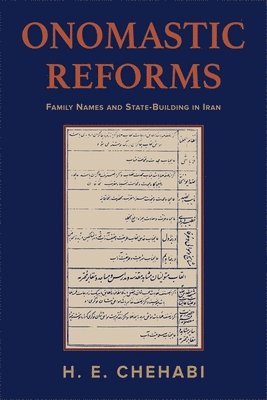
    Onomastic Reforms

    Family Names and State Building in Iran

    AvH. E. Chehabi

    Häftad, Engelska, 2020

    Del 23 i serien Ilex Series

    158 kr

    Beställningsvara. Skickas inom 5-8 vardagar. Fri frakt över 249 kr.

    Beskrivning

    In the mid-1920s, the Iranian state legislated a wide-ranging reform of the citizenry’s naming practices. Honorary titles and honorifics were abolished, family names were made obligatory, and an office for registering names and citizens’ life events (birth, marriage, divorce, and death) was established. The main motivation for this onomastic reform was conscription, which necessitated knowledge of young men’s ages, identities, and whereabouts. The introduction of conscription was itself part of the state-building efforts that followed the weakening of the central government induced by the First World War.In Onomastic Reforms, H. E. Chehabi explains the traditional naming practices of Iranians before the reform, describes the public debates surrounding their obsolescence, traces the legislative measures and decrees that constituted the reform, and explores the ways Iranians chose or invented surnames for themselves.

    Produktinformation

    • Utgivningsdatum:2020-12-07
    • Mått:152 x 229 x 8 mm
    • Vikt:299 g
    • Format:Häftad
    • Språk:Engelska
    • Serie:Ilex Series
    • Antal sidor:120
    • Förlag:Harvard University Press
    • ISBN:9780674248199

    Utforska kategorier

    • Historia: pesten, sjukdomar, svält inom Historia och arkeologi
    • Mellanösterns historia inom Historia och arkeologi

    Mer om författaren

    H. E. Chehabi is Professor Emeritus of International Relations and History at Boston University. He is the author of Iranian Politics and Religious Modernism and Onomastic Reform, and editor or co-editor of a dozen volumes, most recently, with David Motadel, Unconquered States.

    Recensioner i media

    In this concise and stimulating study of personal names in modern Iran, Chehabi provides an excellent manual of contemporary Persian onomastics while also shedding light on the complex relations between individuals and political society. Through reforms of their personal names, citizens became clearly identified as taxpayers, voters, and soldiers. Anthropologists and historians will find here a wealth of examples to help them understand how, thanks to their new civil status, Iranians looked at themselves, wishing to be perceived as part of the ‘civilized’ (i.e. Westernized) world.