• Fri frakt över 249 kr
  • •
  • Snabba leveranser
  • •
  • Billiga böcker
Kundservice

Du är på sajten för privatpersoner.

Företag, bibliotek eller offentlig verksamhet?

Du handlar på classic.bokus.com, där alla dina funktioner finns intakta.
Till classic.bokus.com
Bokus logotyp. Gå till startsidan.
  • Erbjudanden
  • Nyheter
  • Student
  • Topplistor
  • Barn & ungdom
  • Bokus Play
  • E-böcker
  • Pocketböcker
  • Spel & pussel

10% studentrabatt med kod TERM26

Sidfot

Mina sidor

    Hjälp

    • Kundservice
    • Vanliga frågor och svar
    • Frakt och leverans
    • Retur vid ångerrätt
    • Reklamera vara
    • Betalning
    • Köpvillkor
    • Allmänna villkor
    • Information om webbplatsens tillgänglighet

    Om Bokus

    • Om oss
    • Pressrum
    • För studenter
    • För företag
    • För bibliotek och offentlig verksamhet
    • För leverantörer
    • Hållbarhet

    Populärt

    • Aktuella erbjudanden
    • Presentkort
    • Studentlitteratur
    • Nya böcker
    • Topplistor
    • Signerade böcker
    • Engelska böcker

    Inspiration

    • Boktips
    • BookTok
    • Populära bokserier
    • Barnbokskaraktärer
    • Populära författare
    Logotyp för Bokus
    Följ oss på Facebook (extern länk)Följ oss på Instagram (extern länk)Följ oss på YouTube (extern länk)Följ oss på TikTok (extern länk)
    bokus @ CookiesAnpassa cookiesIntegritetspolicyKöpvillkor
    Till Citymail hemsida (extern länk)Till Budbee hemsida (extern länk)Till Postnord hemsida (extern länk)Till Schenker hemsida (extern länk)Till Early Bird hemsida (extern länk)Till Walleys hemsida (extern länk)
    1. Naturvetenskap och teknik
    2. Geovetenskap
    3. Miljövetenskap och miljöpolitik

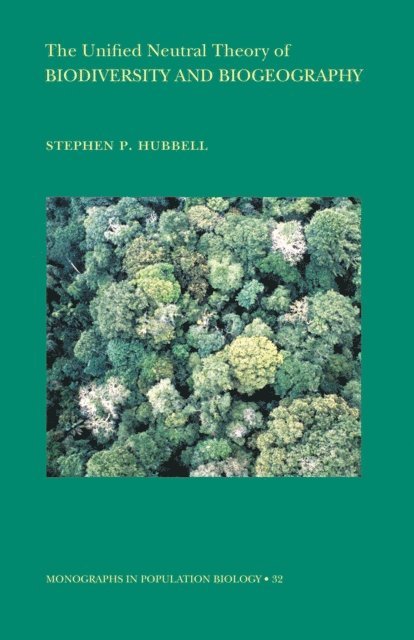
    Unified Neutral Theory of Biodiversity and Biogeography

    AvStephen P. Hubbell

    Häftad, Engelska, 2001

    Del i serien Monographs in Population Biology

    905 kr

    Beställningsvara. Skickas inom 5-8 vardagar. Fri frakt över 249 kr.

    Fler format och utgåvor

    E-bok

    1 274 kr

    Beskrivning

    Despite its supreme importance and the threat of its global crash, biodiversity remains poorly understood both empirically and theoretically. This ambitious book presents a new, general neutral theory to explain the origin, maintenance, and loss of biodiversity in a biogeographic context. Until now biogeography (the study of the geographic distribution of species) and biodiversity (the study of species richness and relative species abundance) have had largely disjunct intellectual histories. In this book, Stephen Hubbell develops a formal mathematical theory that unifies these two fields. When a speciation process is incorporated into Robert H. MacArthur and Edward O. Wilson's now classical theory of island biogeography, the generalized theory predicts the existence of a universal, dimensionless biodiversity number. In the theory, this fundamental biodiversity number, together with the migration or dispersal rate, completely determines the steady-state distribution of species richness and relative species abundance on local to large geographic spatial scales and short-term to evolutionary time scales.Although neutral, Hubbell's theory is nevertheless able to generate many nonobvious, testable, and remarkably accurate quantitative predictions about biodiversity and biogeography. In many ways Hubbell's theory is the ecological analog to the neutral theory of genetic drift in genetics. The unified neutral theory of biogeography and biodiversity should stimulate research in new theoretical and empirical directions by ecologists, evolutionary biologists, and biogeographers.

    Produktinformation

    • Utgivningsdatum:2001-04-29
    • Mått:140 x 216 x 23 mm
    • Vikt:440 g
    • Format:Häftad
    • Språk:Engelska
    • Serie:Monographs in Population Biology
    • Antal sidor:392
    • Förlag:Princeton University Press
    • ISBN:9780691021287

    Utforska kategorier

    • Miljövetenskap och miljöpolitik inom Naturvetenskap och teknik
    • Biologi inom Naturvetenskap och teknik
    • Geografi inom Naturvetenskap och teknik

    Mer om författaren

    Stephen P.Hubbell is Professor of Plant Biology at the University of Georgia and Staff Scientist at the Smithsonian Tropical Research Institute in Panama. He is the author of more than one hundred papers in tropical plant ecology, theoretical ecology, and plant-animal interactions. He has been awarded a Guggenheim Fellowship and the Pew Scholar Award in Conservation and the Environment. He is Chairman of the National Council for Science and the Environment (formerly the Committee for the National Institute for the Encironment) and the inventor of Extinction: The Game of Ecology.

    Recensioner i media

    Highly innovative and insightful... Ideas are conveyed clearly and the addition of summary points at the end of each chapter facilitates assimilation."--Richard T. Busing, Ecological Engineering "Hubbell's book is a very exciting one, deeply original, based on extensive field data, and convincing in its 'simple' explanations of many broad-scale patterns in biodiversity and biogeography. It will probably cause controversies, but primarily stimulate further research."--Gottfried Jetschke, Ecology "[This] is a rich book about an idea that has the power to re-produce generic patterns and that will be in the back of your mind when you, again, try to make sense of the plethora of articles on species diversity, abundance and distribution."--Carsten F. Dormann, Basic and Applied Ecology "A rich book about an idea that has the power to re-produce generic patterns and that will be in the back of your mind when you, again, try to make sense of the plethora of articles on species diversity, abundance and distribution... Once you start reading it, you will find it not a page too long."--Carsten F. Dormann, Basic Applied Ecology "This is an important contribution to the development of a much sought-after explanation of pattern and process in an increasingly threatened global resource."--Michael E. Meadows, Environmental Conservation "Hubbell has produced a book for all those who think about how communities are put together, even the not so mathematically minded... [It] is sure to influence how community ecology is done for years to come."--Sandra Knapp, Biological Conservation

    Innehållsförteckning

    • Preface ix 1.MacArthur and Wilson's Radical Theory 3 2.On Current Theories of Relative Species Abundance 30 3.Dynamical Models of the Relative Abundance of Species 48 4.Local Community Dynamics under Ecological Drift 76 5.Metacommunity Dynamics and the Unified Theory 113 6.The Unified Theory and Dynamical Species-Area Relationships 152 7.Metapopulations and Biodiversity on the Metacommunity Landscape 202 8.Speciation, Phylogeny, and the Evolution of Metacommunity Biodiversity 231 9.Sampling, Parameter Estimation, and the Generality of the Unified Theory 281 10.Reconciling Dispersal-Assembly and Niche-Assembly Theories 319 Literature Cited 347 Index 371