• Fri frakt över 249 kr
  • •
  • Snabba leveranser
  • •
  • Billiga böcker
Kundservice

Du är på sajten för privatpersoner.

Företag, bibliotek eller offentlig verksamhet?

Du handlar på classic.bokus.com, där alla dina funktioner finns intakta.
Till classic.bokus.com
Bokus logotyp. Gå till startsidan.
  • Erbjudanden
  • Nyheter
  • Student
  • Topplistor
  • Barn & ungdom
  • Bokus Play
  • E-böcker
  • Pocketböcker
  • Spel & pussel

10% rabatt på allt med kod NYSTART10 →

Sidfot

Mina sidor

    Hjälp

    • Kundservice
    • Vanliga frågor och svar
    • Frakt och leverans
    • Retur vid ångerrätt
    • Reklamera vara
    • Betalning
    • Köpvillkor
    • Allmänna villkor
    • Information om webbplatsens tillgänglighet

    Om Bokus

    • Om oss
    • Pressrum
    • För studenter
    • För företag
    • För bibliotek och offentlig verksamhet
    • För leverantörer
    • Hållbarhet

    Populärt

    • Aktuella erbjudanden
    • Presentkort
    • Studentlitteratur
    • Nya böcker
    • Topplistor
    • Signerade böcker
    • Engelska böcker

    Inspiration

    • Boktips
    • BookTok
    • Populära bokserier
    • Barnbokskaraktärer
    • Populära författare
    Logotyp för Bokus
    Följ oss på Facebook (extern länk)Följ oss på Instagram (extern länk)Följ oss på YouTube (extern länk)Följ oss på TikTok (extern länk)
    bokus @ CookiesAnpassa cookiesIntegritetspolicyKöpvillkor
    Till Citymail hemsida (extern länk)Till Budbee hemsida (extern länk)Till Postnord hemsida (extern länk)Till Schenker hemsida (extern länk)Till Early Bird hemsida (extern länk)Till Walleys hemsida (extern länk)
    1. Ekonomi och Ledarskap
    2. Nationalekonomi
    3. Mikroekonomi

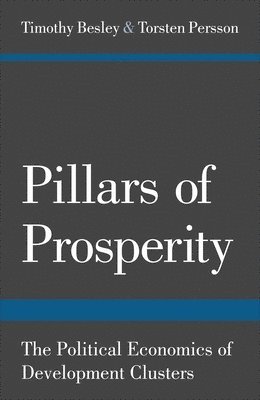
    Pillars of Prosperity

    The Political Economics of Development Clusters

    AvTimothy Besley,Torsten Persson

    Inbunden, Engelska, 2011

    Del i serien Yrjö Jahnsson Lectures

    862 kr

    Beställningsvara. Skickas inom 5-8 vardagar. Fri frakt över 249 kr.

    Fler format och utgåvor

    Häftad

    455 kr

    Beskrivning

    "Little else is required to carry a state to the highest degree of opulence from the lowest barbarism, but peace, easy taxes, and a tolerable administration of justice; all the rest being brought about by the natural course of things." So wrote Adam Smith a quarter of a millennium ago. Using the tools of modern political economics and combining economic theory with a bird's-eye view of the data, this book reinterprets Smith's pillars of prosperity to explain the existence of development clusters - places that tend to combine effective state institutions, the absence of political violence, and high per-capita incomes. To achieve peace, the authors stress the avoidance of repressive government and civil conflict. Easy taxes, they argue, refers not to low taxes, but a tax system with widespread compliance that collects taxes at a reasonable cost from a broad base, like income. And a tolerable administration of justice is about legal infrastructure that can support the enforcement of contracts and property rights in line with the rule of law.The authors show that countries tend to enjoy all three pillars of prosperity when they have evolved cohesive political institutions that promote common interests, guaranteeing the provision of public goods. In line with much historical research, international conflict has also been an important force behind effective states by fostering common interests. The absence of common interests and/or cohesive political institutions can explain the existence of very different development clusters in fragile states that are plagued by poverty, violence, and weak state capacity.

    Produktinformation

    • Utgivningsdatum:2011-08-28
    • Mått:152 x 235 x undefined mm
    • Vikt:680 g
    • Format:Inbunden
    • Språk:Engelska
    • Serie:Yrjö Jahnsson Lectures
    • Antal sidor:432
    • Förlag:Princeton University Press
    • ISBN:9780691152684
    • Utmärkelser:Commended for PROSE Awards: Economics 2011

    Utforska kategorier

    • Mikroekonomi inom Ekonomi och Ledarskap
    • Nationalekonomi inom Ekonomi och Ledarskap
    • Internationell ekonomi inom Ekonomi och Ledarskap

    Mer om författaren

    Timothy Besley is the School Professor of Economics and Political Science at the London School of Economics and Political Science. Torsten Persson is the Torsten and Ragnar Soderberg Chair in Economic Sciences and professor of economics at the Institute for International Economic Studies, Stockholm University.

    Recensioner i media

    Honorable Mention for the 2011 PROSE Award in Economics,s, Association of American Publishers "This is a fascinating set of questions, and Pillars of Prosperity will be essential reading for other researchers in this area."--Diane Coyle, Enlightened Economist "Besley and Persson have written a book that seeks to bring weak and fragile states into mainstream economic analysis... [I]f you wish to model the fiscal capacity of various nations, or their legal capacity, or political violence ... this is an ideal place to start... This is a marvelous book."--Daniel Bromley, American Journal of Agricultural Economics

    Innehållsförteckning

    • Series Foreword ix Preface xi CHAPTER 1: Development Clusters 1 1.1 Salient Correlations 6 1.2 The Main Questions 10 1.3 Fiscal Capacity 11 1.4 Legal Capacity 14 1.5 Political Violence 22 1.6 State Spaces 27 1.7 Development Assistance 31 1.8 Political Reform 32 1.9 Main Themes 34 1.10 Final Remarks 37 1.11 Notes on the Literature 38 CHAPTER 2: Fiscal Capacity 40 2.1 The Core Model 45 2.1.1 Basic Structure 46 2.1.2 Politically Optimal Policy 50 2.1.3 Fiscal-Capacity Investments 52 2.1.4 Normative Benchmark: A Pigouvian Planner 54 2.1.5 Three Types of States 56 2.1.6 Taking Stock 63 2.2 Developing the Model 64 2.2.1 Microfoundations for Fiscal Capacity 64 2.2.2 More General Models for Public Goods 67 2.2.3 Polarization/Heterogeneity 70 2.2.4 Income Inequality 73 2.2.5 Differences in Group Size 78 2.2.6 Tax Distortions 79 2.2.7 From Trade to Income Taxes 83 2.2.8 An Infinite-Horizon Model 86 2.3 Empirical Implications and Data 91 2.4 Final Remarks 99 2.5 Notes on the Literature 99 CHAPTER 3: Legal Capacity 103 3.1 The Core Model with Legal Capacity 108 3.1.1 Politically Optimal Policy 109 3.1.2 Investments in State Capacity 110 3.1.3 Comparative Statics 113 3.1.4 Taking Stock 117 3.2 Developing the Model 118 3.2.1 Microeconomic Foundations 118 3.2.2 The Genius of Taxation 131 3.2.3 Private Capital Accumulation 138 3.2.4 Predation and Corruption 144 3.3 Empirical Implications and Data 156 3.4 Final Comments 164 3.5 Notes on the Literature 165 CHAPTER 4: Political Violence 169 4.1 The Core Model with Political Violence 175 4.1.1 Model Modifications 175 4.1.2 Policy 177 4.1.3 Investments in Political Violence 179 4.1.4 Empirical Implications 185 4.2 Developing the Model 189 4.2.1 Asymmetries 189 4.2.2 Polarization, Greed, and Grievance 190 4.2.3 Anarchy 191 4.2.4 Conflict in a Predatory State 192 4.2.5 Investing in Coercive Capacity 193 4.3 From Theory to Empirical Testing 194 4.4 Data and Results 198 4.4.1 Data 198 4.4.2 Cross-Sectional Correlations 201 4.4.3 Econometric Estimates 202 4.5 Final Remarks 211 4.6 Notes on the Literature 213 CHAPTER 5: State Spaces 215 5.1 State Capacity in the Comprehensive Core Model 216 5.1.1 Equilibrium Political Turnover 216 5.1.2 Investments in State Capacity Revisited 219 5.2 Developing the Model 223 5.3 Empirical Implications 227 5.4 Putting the Pieces Together 231 5.5 Final Remarks 234 5.6 Notes on the Literature 235 CHAPTER 6: Development Assistance 237 6.1 The Core Model with Aid 242 6.1.1 Cash Aid 243 6.1.2 Technical Assistance 250 6.1.3 Military Assistance 253 6.1.4 Postconflict Assistance 254 6.2 Final Remarks 256 6.3 Notes on the Literature 257 CHAPTER 7: Political Reform 259 7.1 The Core Model and Political Reform 264 7.1.1 Political Reform under a Veil of Ignorance 265 7.1.2 Strategic Political Reform 267 7.2 Developing the Model 271 7.2.1 Micropolitical Foundations for ? 271 7.2.2 Micropolitical Foundations for ? 275 7.2.3 Constitutional Rules 280 7.2.4 Political Violence 282 7.2.5 Trust 287 7.2.6 Governance 290 7.3 Political Reform in Practice 293 7.4 Final Remarks 298 7.5 Notes on the Literature 299 CHAPTER 8: Lessons Learned 302 8.1 What We Have Learned 303 8.1.1 Answers to the Three Main Questions 303 8.1.2 Our Analysis and Traditional Development Research 307 8.2 The Pillars of Prosperity Index 310 8.2.1 Defining the Index 310 8.2.2 Predicting the Index 319 8.3 Where Next? 325 8.4 Concluding Remarks 332 References 333 Name Index 357 Subject Index 363