• Fri frakt över 249 kr
  • •
  • Snabba leveranser
  • •
  • Billiga böcker
Kundservice

Du är på sajten för privatpersoner.

Företag, bibliotek eller offentlig verksamhet?

Du handlar på classic.bokus.com, där alla dina funktioner finns intakta.
Till classic.bokus.com
Bokus logotyp. Gå till startsidan.
  • Erbjudanden
  • Nyheter
  • Student
  • Topplistor
  • Barn & ungdom
  • Bokus Play
  • E-böcker
  • Pocketböcker
  • Spel & pussel

10% rabatt på allt med kod NYSTART10 →

Sidfot

Mina sidor

    Hjälp

    • Kundservice
    • Vanliga frågor och svar
    • Frakt och leverans
    • Retur vid ångerrätt
    • Reklamera vara
    • Betalning
    • Köpvillkor
    • Allmänna villkor
    • Information om webbplatsens tillgänglighet

    Om Bokus

    • Om oss
    • Pressrum
    • För studenter
    • För företag
    • För bibliotek och offentlig verksamhet
    • För leverantörer
    • Hållbarhet

    Populärt

    • Aktuella erbjudanden
    • Presentkort
    • Studentlitteratur
    • Nya böcker
    • Topplistor
    • Signerade böcker
    • Engelska böcker

    Inspiration

    • Boktips
    • BookTok
    • Populära bokserier
    • Barnbokskaraktärer
    • Populära författare
    Logotyp för Bokus
    Följ oss på Facebook (extern länk)Följ oss på Instagram (extern länk)Följ oss på YouTube (extern länk)Följ oss på TikTok (extern länk)
    bokus @ CookiesAnpassa cookiesIntegritetspolicyKöpvillkor
    Till Citymail hemsida (extern länk)Till Budbee hemsida (extern länk)Till Postnord hemsida (extern länk)Till Schenker hemsida (extern länk)Till Early Bird hemsida (extern länk)Till Walleys hemsida (extern länk)
    1. Historia och arkeologi
    2. Historia
    3. Historia: särskilda händelser och ämnen
    4. Socialhistoria och kulturhistoria

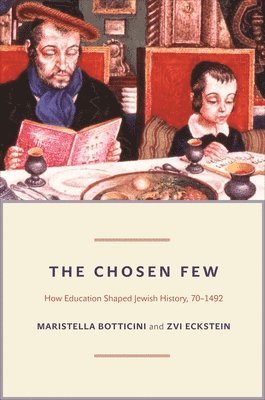
    Chosen Few

    How Education Shaped Jewish History, 70-1492

    AvMaristella Botticini,Zvi Eckstein

    Häftad, Engelska, 2014

    Del i serien Princeton Economic History of the Western World

    226 kr

    Beställningsvara. Skickas inom 5-8 vardagar. Fri frakt över 249 kr.

    Fler format och utgåvor

    Inbunden

    634 kr

    Beskrivning

    In 70 CE, the Jews were an agrarian and illiterate people living mostly in the Land of Israel and Mesopotamia. By 1492 the Jewish people had become a small group of literate urbanites specializing in crafts, trade, moneylending, and medicine in hundreds of places across the Old World, from Seville to Mangalore. What caused this radical change? The Chosen Few presents a new answer to this question by applying the lens of economic analysis to the key facts of fifteen formative centuries of Jewish history. Maristella Botticini and Zvi Eckstein offer a powerful new explanation of one of the most significant transformations in Jewish history while also providing fresh insights into the growing debate about the social and economic impact of religion.

    Produktinformation

    • Utgivningsdatum:2014-10-12
    • Mått:152 x 231 x 23 mm
    • Vikt:477 g
    • Format:Häftad
    • Språk:Engelska
    • Serie:Princeton Economic History of the Western World
    • Antal sidor:344
    • Förlag:Princeton University Press
    • ISBN:9780691163512
    • Utmärkelser:Short-listed for National Jewish Book Award for Scholarship 2012

    Utforska kategorier

    • Socialhistoria och kulturhistoria inom Historia och arkeologi
    • Sociala grupper och identitet inom Samhälle och politik
    • Judendom inom Filosofi och religion

    Mer om författaren

    Maristella Botticini is professor of economics, as well as director and fellow of the Innocenzo Gasparini Institute for Economic Research (IGIER), at Bocconi University in Milan. Zvi Eckstein is dean of the Arison School of Business and of the School of Economics at IDC Herzliya in Herzliya, Israel; Judith C. and William G. Bollinger visiting professor in the Finance Department at the Wharton School of the University of Pennsylvania; and emeritus professor in the Eitan Berglas School of Economics at Tel Aviv University.

    Recensioner i media

    Winner of the 2012 National Jewish Book Award in Scholarship One of Jewish Ideas Daily.com's 40 Best Jewish Books of 2012 "[A]mbitious ... systematically dismantle much of the conventional wisdom about medieval Jewish history."--Jonathan B. Krasner, Forward "[W]here so many have simply taken as a given universal literacy among Jews, [Botticini and Eckstein] find that a majority of Jews actually weren't willing to invest in Jewish education, with the shocking result that more than two-thirds of the Jewish community disappeared toward the end of the first millennium... The astonishing theory presented here has great implications for both the Jewish community and the broader world today."--Steven Weiss, Slate "[E]ventually, The Chosen Few will have changed the course of history in the Middle East ... as part of a broad reinterpretation of the history of the peopling of the world, underway for a century and a half, that has begun gathering force since the 1990s... This may be the first you have heard about The Chosen Few, but I pretty much guarantee you that it will not be the last."--David Warsh, Economic Principals "[P]rovocative."--Choice "Botticini and Eckstein's simple yet sophisticated human capital analysis provides new insights into Jewish history for the fourteen centuries covered in this book... [Their] methodology yields a very convincing Cliometric analysis that we can expect to inform all future economic histories of the Jews between 70 and 1492."--Carmel U. Chiswick, EH.net "I found The Chosen Few, a book on Jewish economic history by Maristella Botticini and Zvi Eckstein, enormously enlightening and relevant to the draft-the-Haredim debate."--Shlomo Maital, Jerusalem Report "If you've ever wondered how the Chosen People survived the vagaries of history, reading The Chosen Few will give you answers you cannot find anywhere else."--Huffington Post "This is a trailblazing, original, illuminating and horizon-broadening book."--Manuel Trajtenberg, Haaretz

    Innehållsförteckning

    • List of Illustrations xi List of Tables xiii Preface xv Introduction 1 Chapter 1 70 CE-1492: How Many Jews Were There, and Where and How Did They Live? 11 From Jesus to Muhammad (1 CE-622): A World of Farmers 15 From Muhammad to Hulagu Khan (622-1258): Farmers to Merchants 31 From Hulagu Khan to Tomas de Torquemada (1258-1492): The End of the Golden Age 44 Jewish History, 70 CE-1492: Puzzles 51 Chapter 2 Were the Jews a Persecuted Minority? 52 Restrictions on Jewish Economic Activities 52 Taxation Discrimination 58 Physical versus Portable Human Capital 59 Self-Segregated Religious Minority 61 The Economics of Small Minorities 62 Summary 65 Chapter 3 The People of the Book, 200 BCE-200 CE 66 The Two Pillars of Judaism from Ezra to Hillel (500-50 BCE): The Temple and the Torah 66 The Lever of Judaism: Education as a Religious Norm 69 The Destruction of the Second Temple: From Ritual Sacrifices to Torah Reading and Study 73 The Legacy of Rabbinic Judaism: The Mishna and Universal Primary Education, 10 CE-200 74 Judaism and Education: The Unique Link in the World of the Mishna 78 Chapter 4 The Economics of Hebrew Literacy in a World of Farmers 80 Heterogeneity and the Choices Facing Jewish Farmers circa 200 82 The Economic Theory: Basic Setup 84 The Economic Theory: Predictions 87 Life in a Village in the Galilee circa 200 through the Lens of the Theory 88 Annex 4.A: Formal Model of Education and Conversion of Farmers 89 Chapter 5 Jews in the Talmud Era, 200-650: The Chosen Few 95 An Increasingly Literate Farming Society 96 Conversions of Jewish Farmers 111 Summary 122 Chapter 6 From Farmers to Merchants, 750-1150 124 The Economics of Hebrew Literacy in a World of Merchants 125 The Golden Age of Literate Jews in the Muslim Caliphates 130 Summary 150 Annex 6.A: Formal Model of Education and Conversion of Merchants 150 Chapter 7 Educated Wandering Jews, 800-1250 153 Wandering Jews before Marco Polo 154 Jewish Migration within the Muslim Caliphates 163 Migration of Byzantine Jewry 172 Jewish Migration to and within Christian Europe 173 Migration of the Jewish Religious Center 195 Summary 200 Chapter 8 Segregation or Choice? From Merchants to Moneylenders, 1000-1500 201 The Economics of Money and Credit in Medieval Europe 202 Jewish Prominence in Moneylending: Hypotheses 209 The Dynamics of Jewish Moneylending in Medieval Europe 212 Jewish Moneylending in Medieval Italy: A Detailed Analysis 219 Attitudes toward Moneylending 232 Facts and Competing Hypotheses 237 From Merchants to Moneylenders: Comparative Advantage in Complex Intermediation 241 Annex 8.A: The Charter to the Jews of Vienna 244 Chapter 9 The Mongol Shock: Can Judaism Survive When Trade and Urban Economies Collapse? 248 The Mongol Conquest of the Muslim Middle East 249 Socioeconomic Conditions in the Middle East under the Mongols 252 Jewish Demography under Mongol and Mamluk Rule: An Experiment 254 Why Judaism Cannot Survive When Trade and Urban Economies Collapse 258 Summary 259 Chapter 10 1492 to Today: Open Questions 261 Portrait of World Jewry circa 1492 261 Jewish History, 70 CE-1492: Epilogue 264 Trajectory of the Jewish People over the Past 500 Years 266 Persistence of Jewish Occupational Structure 268 Appendix 274 Bibliography 287 Index 317