• Fri frakt över 249 kr
  • •
  • Snabba leveranser
  • •
  • Billiga böcker
Kundservice

Du är på sajten för privatpersoner.

Företag, bibliotek eller offentlig verksamhet?

Du handlar på classic.bokus.com, där alla dina funktioner finns intakta.
Till classic.bokus.com
Bokus logotyp. Gå till startsidan.
  • Erbjudanden
  • Nyheter
  • Student
  • Topplistor
  • Barn & ungdom
  • Bokus Play
  • E-böcker
  • Pocketböcker
  • Spel & pussel

10% rabatt på allt med kod: NYSTART10 →

Sidfot

Mina sidor

    Hjälp

    • Kundservice
    • Vanliga frågor och svar
    • Frakt och leverans
    • Retur vid ångerrätt
    • Reklamera vara
    • Betalning
    • Köpvillkor
    • Allmänna villkor
    • Information om webbplatsens tillgänglighet

    Om Bokus

    • Om oss
    • Pressrum
    • För studenter
    • För företag
    • För bibliotek och offentlig verksamhet
    • För leverantörer
    • Hållbarhet

    Populärt

    • Aktuella erbjudanden
    • Presentkort
    • Studentlitteratur
    • Nya böcker
    • Topplistor
    • Signerade böcker
    • Engelska böcker

    Inspiration

    • Boktips
    • BookTok
    • Populära bokserier
    • Barnbokskaraktärer
    • Populära författare
    Logotyp för Bokus
    Följ oss på Facebook (extern länk)Följ oss på Instagram (extern länk)Följ oss på YouTube (extern länk)Följ oss på TikTok (extern länk)
    bokus @ CookiesAnpassa cookiesIntegritetspolicyKöpvillkor
    Till Citymail hemsida (extern länk)Till Budbee hemsida (extern länk)Till Postnord hemsida (extern länk)Till Schenker hemsida (extern länk)Till Early Bird hemsida (extern länk)Till Walleys hemsida (extern länk)
    1. Psykologi och pedagogik
    2. Pedagogik
    3. Högskola och universitet

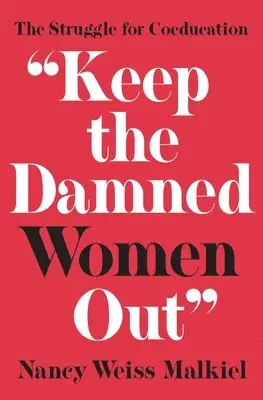
    "Keep the Damned Women Out"

    The Struggle for Coeducation

    AvNancy Weiss Malkiel

    Inbunden, Engelska, 2016

    Del i serien William G. Bowen Series

    284 kr

    Beställningsvara. Skickas inom 5-8 vardagar. Fri frakt över 249 kr.

    Fler format och utgåvor

    Häftad

    276 kr

    Beskrivning

    As the tumultuous decade of the 1960s ended, a number of very traditional, very conservative, highly prestigious colleges and universities in the United States and the United Kingdom decided to go coed, seemingly all at once, in a remarkably brief span of time. Coeducation met with fierce resistance. As one alumnus put it in a letter to his alma mater, "Keep the damned women out." Focusing on the complexities of institutional decision making, this book tells the story of this momentous era in higher education--revealing how coeducation was achieved not by organized efforts of women activists, but through strategic decisions made by powerful men. In America, Ivy League schools like Harvard, Yale, Princeton, and Dartmouth began to admit women; in Britain, several of the men's colleges at Cambridge and Oxford did the same. What prompted such fundamental change? How was coeducation accomplished in the face of such strong opposition? How well was it implemented? Nancy Weiss Malkiel explains that elite institutions embarked on coeducation not as a moral imperative but as a self-interested means of maintaining a first-rate applicant pool.She explores the challenges of planning for the academic and non-academic lives of newly admitted women, and shows how, with the exception of Mary Ingraham Bunting at Radcliffe, every decision maker leading the charge for coeducation was male. Drawing on unprecedented archival research, "Keep the Damned Women Out" is a breathtaking work of scholarship that is certain to be the definitive book on the subject.

    Produktinformation

    • Utgivningsdatum:2016-10-04
    • Mått:152 x 235 x 48 mm
    • Vikt:1 106 g
    • Format:Inbunden
    • Språk:Engelska
    • Serie:William G. Bowen Series
    • Antal sidor:672
    • Förlag:Princeton University Press
    • ISBN:9780691172996

    Utforska kategorier

    • Högskola och universitet inom Psykologi och pedagogik
    • Genusvetenskap inom Samhälle och politik
    • Utbildningsstrategier och utbildningspolitik inom Psykologi och pedagogik

    Mer om författaren

    Nancy Weiss Malkiel is professor emeritus of history at Princeton University, where she was the longest-serving dean of the college, overseeing the university's undergraduate academic program for twenty-four years. Her books include Whitney M. Young, Jr., and the Struggle for Civil Rights and Farewell to the Party of Lincoln: Black Politics in the Age of FDR (both Princeton).

    Recensioner i media

    Winner of the 2017 PROSE Award in Education Practice, Association of American Publishers "A painstakingly detailed account of how coeducation came to Harvard, Yale, and Princeton, is an invaluable antidote to the amnesia that has come to envelop the subject. More than that, it is an important work of cultural history. It seems a truism to observe that so profound a change could not have occurred in a vacuum, and Malkiel takes full account of the social and political revolutions that were convulsing the country in the 1960s. But she digs deeper to show how, as the nation neared its end, the leaders of Yale and Princeton realized that the missions these institutions had long assigned themselves of producing the nation's leaders would soon be unsustainable in the absence of coeducation."--Linda Greenhouse, New York Review of Books "Malkiel presents an absorbing, richly textured landscape of the experience of thousands of women who found themselves in elite universities."--Rachel Holmes, Times Literary Supplement "In an age when student activists at campuses across the country are focused on microaggressions and safe spaces, it's a bit surreal to read Nancy Weiss Malkiel's history of gender desegregation at elite American and British colleges. Fifty years ago, same-sex schooling in higher education had ended for many public colleges and universities in the United States and Britain, but it remained the norm at most elite universities... How and why, between 1969 and 1974, these prestigious institutions decided to go coed--or not--is the fascinating story Ms. Malkiel tells. And although her narrow focus is gender admission practices, there are clues ... about the obstacles that continue to prevent the harmony between the many diverse groups of students on campus today."--Lenore Tiefer, Wall Street Journal "One of the most thorough accounts ever written of the determination of highly educated and powerful men to keep women away from the places that endorse exclusive forms of power... A superb, richly documented study."--Mary Evans, Times Higher Education "Fascinating... This hefty book offers a compelling study of institutional change that came not because it was demanded, and not because the motives of its agents were pure. More simply, it was about damned time. "--Carlos Lozada, Washington Post "A carefully researched and compelling narrative... This highly recommended history presents a major cultural change in which coeducation both reflected and stimulated a transformation in women's social and professional status in America."--Library Journal, starred "Lest we forget, a professor of history emerita at Princeton and past dean of its college delivers an authoritative history of the coeducation of elite institutions in the United States and the United Kingdom between 1969 and 1974. Invaluable history, beginning with Harvard, Yale, and Princeton, and enlivened with such vivid illustrations as Jim Berry's 1967 cartoon of two clubmen conferring from their wing chairs: 'Confused--of course, I'm confused! I have a son at Vassar and a daughter at Yale!'"---Harvard Magazine "In the late 1960s, several prestigious universities in the United States-- including Princeton--decided to admit women for the first time. The reasons it happened at this particular moment are surprising and largely unexplored. In her new book, "Keep the Damned Women Out": The Struggle for Coeducation, professor emerita of history and former Dean of the College Nancy Weiss Malkiel illuminates the forces that prompted a small group of powerful men to implement this pivotal change."--Amelia Thompson-Deveaux, Princeton Alumni Weekly "It may be hard for today's undergraduates at elite colleges and universities to imagine that many of their institutions--as recently as the 1960s and 1970s--would not admit female students. These days when coeducation is in the news, it is typically a women's college deciding to admit men. But the reality is that coeducation at elite institutions that were once all male did not happen overnight--and didn't happen without considerable backlash from alumni and others. Nancy Weiss Malkiel tells the story in "Keep the Damned Women Out": The Struggle for Coeducation."--Scott Jaschik, Inside Higher Ed "'Keep the Damned Women Out'... Or in some cases, the damned men."--Smith Alumni Quarterly "There are things you take for granted, until you learn how recently they came about or how tortuous their path. That's how I felt while reading Malkiel's history of how several elite U.S. universities--in particular, Yale, Princeton, Harvard and Dartmouth--finally offered full undergraduate education for women starting in the late 1960s and early 1970s."--Carlos Lozada, Washington Post "From enraged male alumni to topless female protesters, this book captures the tumultuous five-year period when several elite universities in the US and UK first enrolled women as undergraduates."--Jill Wrenn, Financial Times "[A] rich and compelling story"--Maggie Doherty, Chronicle Review "A magisterial history about the admission of women to the most prestigious and sheltered of men's colleges in the United States and Great Britain ... [Malkiel] is a lucid, excellent scholar."--Kate Stimpson, Public Books

    Innehållsförteckning

    • List of Illustrations xi Preface xv Acknowledgments xxiii Introduction 1 Setting the Stage: The Turbulent 1960s 3 Part I The Ivy League: Harvard, Yale, and Princeton 2 Harvard-Radcliffe:"To Be Accepted by the Old and Beloved University" 31 3 Yale: "Girls Are People, Just Like You and Me" 54 4 Princeton: "Coeducation Is Inevitable" 81 5 Princeton: "A Penetrating Analysis of Far-Reaching Significance" 110 6 Yale: "Treat Yale as You Would a Good Woman" 136 7 Princeton: "The Admission of Women Will Make Princeton a Better University" 166 8 Harvard-Radcliffe: Negotiating the "Non-Merger Merger" 195 9 Princeton: "I Felt I Was in a Foreign Country" 214 10 Harvard-Radcliffe: Playing in the "Big Yard" with the Boys 245 11 Yale: Yale Is "Not Yet Coeducational" 268 12 Princeton: "We're All Coeds Now" 288 Part II The Seven Sisters: Vassar, Smith, and Wellesley 13 Vassar: "Separate Education for Women Has No Future" 309 14 Vassar: "Vassar for Men?" 328 15 Smith: "A Looming Problem Which Is Going to Have to Be Faced" 351 16 Smith: "Recommitting to Its Original, Pioneering Purpose" 371 17 Wellesley: "Should Wellesley Jump on the Bandwagon?" 390 18 Wellesley: "Having the Courage to Remain a Women's College" 412 Part III Revisiting the Ivies: Dartmouth 19 Dartmouth: "For God's Sake, for Everyone's Sake, Keep the Damned Women Out" 441 20 Dartmouth: "Our Cohogs" 464 Part IV The United Kingdom: Cambridge and Oxford 21 Cambridge: "Like Dropping a Hydrogen Bomb in the Middle of the University" 491 22 Cambridge: "A Tragic Break with Centuries of Tradition" 517 23 Oxford: "Our Crenellations Crumble, We Cannot Keep Them Out" 540 24 Oxford: As Revolutionary as "the Abolition of Celibacy among the Dons" 570 Part V Taking Stock 25 Epilogue 595 Manuscript Collections and Oral History Transcripts: Abbreviations 611 Interviews 622 Index 623