• Fri frakt över 249 kr
  • •
  • Snabba leveranser
  • •
  • Billiga böcker
Kundservice

Du är på sajten för privatpersoner.

Företag, bibliotek eller offentlig verksamhet?

Du handlar på classic.bokus.com, där alla dina funktioner finns intakta.
Till classic.bokus.com
Bokus logotyp. Gå till startsidan.
  • Erbjudanden
  • Nyheter
  • Student
  • Topplistor
  • Barn & ungdom
  • Bokus Play
  • E-böcker
  • Pocketböcker
  • Spel & pussel

10% rabatt på allt med kod NYSTART10 →

Sidfot

Mina sidor

    Hjälp

    • Kundservice
    • Vanliga frågor och svar
    • Frakt och leverans
    • Retur vid ångerrätt
    • Reklamera vara
    • Betalning
    • Köpvillkor
    • Allmänna villkor
    • Information om webbplatsens tillgänglighet

    Om Bokus

    • Om oss
    • Pressrum
    • För studenter
    • För företag
    • För bibliotek och offentlig verksamhet
    • För leverantörer
    • Hållbarhet

    Populärt

    • Aktuella erbjudanden
    • Presentkort
    • Studentlitteratur
    • Nya böcker
    • Topplistor
    • Signerade böcker
    • Engelska böcker

    Inspiration

    • Boktips
    • BookTok
    • Populära bokserier
    • Barnbokskaraktärer
    • Populära författare
    Logotyp för Bokus
    Följ oss på Facebook (extern länk)Följ oss på Instagram (extern länk)Följ oss på YouTube (extern länk)Följ oss på TikTok (extern länk)
    bokus @ CookiesAnpassa cookiesIntegritetspolicyKöpvillkor
    Till Citymail hemsida (extern länk)Till Budbee hemsida (extern länk)Till Postnord hemsida (extern länk)Till Schenker hemsida (extern länk)Till Early Bird hemsida (extern länk)Till Walleys hemsida (extern länk)
    1. Samhälle och politik
    2. Sociologi och antropologi
    3. Sociologi

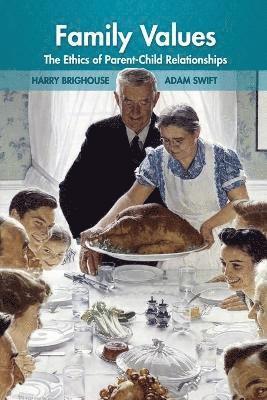
    Family Values

    The Ethics of Parent-Child Relationships

    AvHarry Brighouse,Adam Swift

    Häftad, Engelska, 2016

    292 kr

    Beställningsvara. Skickas inom 5-8 vardagar. Fri frakt över 249 kr.

    Beskrivning

    The family is hotly contested ideological terrain. Some defend the traditional two-parent heterosexual family while others welcome its demise. Opinions vary about how much control parents should have over their children's upbringing. Family Values provides a major new theoretical account of the morality and politics of the family, telling us why the family is valuable, who has the right to parent, and what rights parents should--and should not--have over their children. Harry Brighouse and Adam Swift argue that parent-child relationships produce the "familial relationship goods" that people need to flourish. Children's healthy development depends on intimate relationships with authoritative adults, while the distinctive joys and challenges of parenting are part of a fulfilling life for adults. Yet the relationships that make these goods possible have little to do with biology, and do not require the extensive rights that parents currently enjoy.Challenging some of our most commonly held beliefs about the family, Brighouse and Swift explain why a child's interest in autonomy severely limits parents' right to shape their children's values, and why parents have no fundamental right to confer wealth or advantage on their children. Family Values reaffirms the vital importance of the family as a social institution while challenging its role in the reproduction of social inequality and carefully balancing the interests of parents and children.

    Produktinformation

    • Utgivningsdatum:2016-08-02
    • Mått:152 x 235 x 18 mm
    • Vikt:372 g
    • Format:Häftad
    • Språk:Engelska
    • Antal sidor:240
    • Förlag:Princeton University Press
    • ISBN:9780691173733

    Utforska kategorier

    • Sociologi inom Samhälle och politik
    • Filosofiska discipliner inom Filosofi och religion

    Mer om författaren

    Harry Brighouse is professor of philosophy and affiliate professor of educational policy studies at the University of Wisconsin-Madison. His books include On Education and School Choice and Social Justice. Adam Swift is professor of political theory at the University of Warwick. His books include Political Philosophy: A Beginners' Guide for Students and Politicians and How Not to Be a Hypocrite: School Choice for the Morally Perplexed Parent.

    Recensioner i media

    "Brighouse and Swift raise some important issues and come to some conclusions that are bound to be controversial, which is exactly why this book is so important and so worthy of considerable thought and debate. The work is scholarly and well documented, with 30 pages of notes and bibliography accompanying the 181-page text. That's a welcome distinction over the political diatribes that often cloud family value debates... Highly recommended."--Talking Ethics "This thoughtful work addresses tensions between the liberty of parents to raise children as they see fit, parents' duty to ensure that children develop the capacity for autonomy, and the role of the family as an obstacle to fair equality of opportunity."--Choice "It presents and negotiates the issues at stake in exceptionally nuanced, elegant and meticulously-crafted ways."--Gideon Calder, European Journal of Political Theory "In their clearly written and elegantly structured book, Harry Brighouse and Adam Swift develop a normative account of child-rearing that deftly weaves together positions associated with both the political left and the right... Their principled account of the rights of parents and children is the best of which I am aware, and I expect it to set the standard for discussion of these issues for some time to come."--George Sher, Social Theory and Practice "Family Values is an original, important, and well-written book that will influence the discussion concerning the moral status of the family for years to come, and it can be recommended to any reader who is interested in this topic."--Jorg Loschke, Ethical Theory and Moral Practice

    Innehållsförteckning

    • Preface ix Acknowledgments xvii Part One Liberty, Equality, Family 1 Introduction 2 Chapter 1 Liberalism and the Family 5 Chapter 2 Equality and the Family 23 Part Two Justifying the Family 47 Introduction 48 Chapter 3 Children 57 Chapter 4 Adults 86 Part Three Parents' Rights 113 Introduction 114 Chapter 5 Conferring Advantage 123 Chapter 6 Shaping Values 149 Conclusion 175 Notes 183 Bibliography 201 Index 213