• Fri frakt över 249 kr
  • •
  • Snabba leveranser
  • •
  • Billiga böcker
Kundservice

Du är på sajten för privatpersoner.

Företag, bibliotek eller offentlig verksamhet?

Du handlar på classic.bokus.com, där alla dina funktioner finns intakta.
Till classic.bokus.com
Bokus logotyp. Gå till startsidan.
  • Erbjudanden
  • Nyheter
  • Student
  • Topplistor
  • Barn & ungdom
  • Bokus Play
  • E-böcker
  • Pocketböcker
  • Spel & pussel

10% studentrabatt med kod TERM26

Sidfot

Mina sidor

    Hjälp

    • Kundservice
    • Vanliga frågor och svar
    • Frakt och leverans
    • Retur vid ångerrätt
    • Reklamera vara
    • Betalning
    • Köpvillkor
    • Allmänna villkor
    • Information om webbplatsens tillgänglighet

    Om Bokus

    • Om oss
    • Pressrum
    • För studenter
    • För företag
    • För bibliotek och offentlig verksamhet
    • För leverantörer
    • Hållbarhet

    Populärt

    • Aktuella erbjudanden
    • Presentkort
    • Studentlitteratur
    • Nya böcker
    • Topplistor
    • Signerade böcker
    • Engelska böcker

    Inspiration

    • Boktips
    • BookTok
    • Populära bokserier
    • Barnbokskaraktärer
    • Populära författare
    Logotyp för Bokus
    Följ oss på Facebook (extern länk)Följ oss på Instagram (extern länk)Följ oss på YouTube (extern länk)Följ oss på TikTok (extern länk)
    bokus @ CookiesAnpassa cookiesIntegritetspolicyKöpvillkor
    Till Citymail hemsida (extern länk)Till Budbee hemsida (extern länk)Till Postnord hemsida (extern länk)Till Schenker hemsida (extern länk)Till Early Bird hemsida (extern länk)Till Walleys hemsida (extern länk)
    1. Ekonomi och Ledarskap
    2. Nationalekonomi
    3. Ekonomisk historia

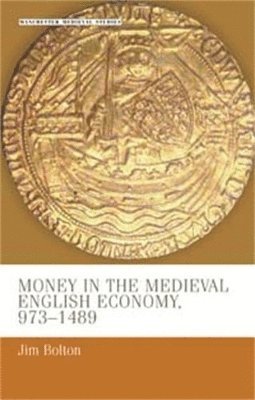
    Money in the Medieval English Economy 973–1489

    AvJ.L. Bolton

    Häftad, Engelska, 2012

    Del 15 i serien Manchester Medieval Studies

    371 kr

    Beställningsvara. Skickas inom 5-8 vardagar. Fri frakt över 249 kr.

    Fler format och utgåvor

    Inbunden

    Tillf. slut

    Beskrivning

    The importance of money as one of the key variables in the workings of the medieval economy is often overlooked. This new study first provides the reader with a background to the problems of modelling the medieval economy and the value of the Fisher equation of exchange to monetary historians, to the pratical processes of strking coins from silver and gold acquired through foreign trade and to the importance of royal control over mints and exchanges. These theories are then used to analyse how money worked within the economy if the early, central and late middle ages with fluctuations in the size of the circulating medium and the availability of credit acting as either a brake on or a stimulus to economic expansion. A full money economy did not emerge until c. 1300 but its existence and flexibility helped the economy survive the severe shocks of the late middle ages.

    Produktinformation

    • Utgivningsdatum:2012-05-07
    • Mått:138 x 216 x 18 mm
    • Vikt:390 g
    • Format:Häftad
    • Språk:Engelska
    • Serie:Manchester Medieval Studies
    • Antal sidor:336
    • Förlag:Manchester University Press
    • ISBN:9780719050404

    Utforska kategorier

    • Ekonomisk historia inom Ekonomi och Ledarskap
    • Medeltiden inom Historia och arkeologi

    Mer om författaren

    J.L. (Jim) Bolton is a Professorial Research Fellow in the School of History, Queen Mary, University of London.

    Recensioner i media

    An insightful and wide-ranging book on money and its place in the medieval English economy ... Other secondary literature is available on money and the economy in medieval England, but Professor Bolton's book offers students, researchers and general readers with a breadth of vision and analysis'Andrew Wareham, Reviews in History, 6th June 2013'"Money in the Medieval English Economy: 973-1489" is one of the most important books published in English medieval economic history during the past two decades. Indeed, I do not know of any other comparable and equally comprehensive study of English medieval monetary history.'John Munro, University of Toronto, EH.Net (June 2013)'The longest and most important sustained discussion of the economic importance of England's medieval currency now available. It should be read by all those interested in the the workings of premodern monetary economics or the medieval economy more widely .. a valuable, perceptive, and very welcome addition to the literature on medieval economic history.'Rory Naismith, University of Cambridge, Journal of Economic HistoryThere is no doubt that the new monograph by Jim Bolton can be classified as a most meaningful contribution not only to the economic but also the social and political history of medieval England....this book is a truly superb study, certainly one of the most important ones in the field of the monetary history of pre-industrialEurope. There is no doubt that this monograph will be a standard reference source for both professional academics and college/university-level students.'His approach is bold and straightforward classical scholarship and a pleasure to read. The narrative provides a step-by-step approach in which each conclusion reached points the reader towards the direction of his next move... in the final analysis, a tour de force that raises the debate to a higher level.'Svein H. Gullbekk, 'Speculum' 91/2 (April 2016)

    Innehållsförteckning

    • PART ONE: THEORIES AND PROBLEMS1. Modelling the medieval economy: the equation of exchange2. Money and the money economy3. Coinage and the bullion supplyPART TWO: THE COINAGE AND THE ECONOMY, c. 973–14894. The coinage from the late tenth century to 11585. A monetarised economy, 973–1158?6. The coinage 1158–13517. The emergence of a money economy, 1158–13518. Testing the money economy, 1351–14899. ConclusionsBibliography Index