• Fri frakt över 249 kr
  • •
  • Snabba leveranser
  • •
  • Billiga böcker
Kundservice

Du är på sajten för privatpersoner.

Företag, bibliotek eller offentlig verksamhet?

Du handlar på classic.bokus.com, där alla dina funktioner finns intakta.
Till classic.bokus.com
Bokus logotyp. Gå till startsidan.
  • Erbjudanden
  • Nyheter
  • Student
  • Topplistor
  • Barn & ungdom
  • Bokus Play
  • E-böcker
  • Pocketböcker
  • Spel & pussel

Må bättre, för mindre! Upp till 50% rabatt på hälsoböcker

Sidfot

Mina sidor

    Hjälp

    • Kundservice
    • Vanliga frågor och svar
    • Frakt och leverans
    • Retur vid ångerrätt
    • Reklamera vara
    • Betalning
    • Köpvillkor
    • Allmänna villkor
    • Information om webbplatsens tillgänglighet

    Om Bokus

    • Om oss
    • Pressrum
    • För studenter
    • För företag
    • För bibliotek och offentlig verksamhet
    • För leverantörer
    • Hållbarhet

    Populärt

    • Aktuella erbjudanden
    • Presentkort
    • Studentlitteratur
    • Nya böcker
    • Topplistor
    • Signerade böcker
    • Engelska böcker

    Inspiration

    • Boktips
    • BookTok
    • Populära bokserier
    • Barnbokskaraktärer
    • Populära författare
    Logotyp för Bokus
    Följ oss på Facebook (extern länk)Följ oss på Instagram (extern länk)Följ oss på YouTube (extern länk)Följ oss på TikTok (extern länk)
    bokus @ CookiesAnpassa cookiesIntegritetspolicyKöpvillkor
    Till Citymail hemsida (extern länk)Till Budbee hemsida (extern länk)Till Postnord hemsida (extern länk)Till Schenker hemsida (extern länk)Till Early Bird hemsida (extern länk)Till Walleys hemsida (extern länk)
    1. Djur och Natur
    2. Naturböcker
    3. Naturhistoriska böcker

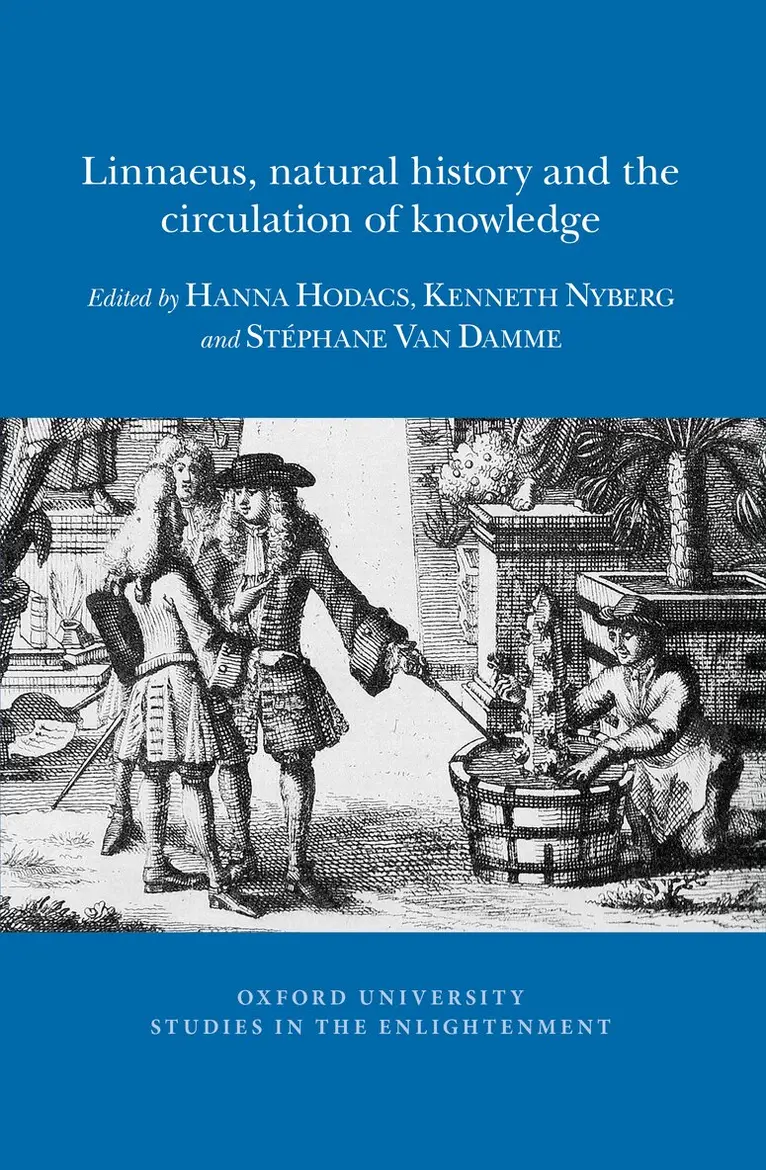
    Linnaeus, natural history and the circulation of knowledge

    AvHanna Hodacs,Kenneth Nyberg

    Häftad, Engelska, 2018

    Del i serien Oxford University Studies in the Enlightenment

    1 860 kr

    Beställningsvara. Skickas inom 5-8 vardagar. Fri frakt över 249 kr.

    Beskrivning

    The name of Carl Linnaeus (1707-1778) is inscribed in almost every flora and fauna published from the mid-eighteenth century onwards; in this respect he is virtually immortal. In this book a group of specialists argue for the need to re-centre Linnaean science and de-centre Linnaeus the man by exploring the ideas, practices and people connected to his taxonomic innovations.Contributors examine the various techniques, materials and methods that originated within the ‘Linnaean workshop’: paper technologies, publication strategies, and markets for specimens. Fresh analyses of the reception of Linnaeus’s work in Paris, Königsberg, Edinburgh and beyond offer a window on the local contexts of knowledge transfer, including new perspectives on the history of anthropology and stadial theory. The global implications and negotiated nature of these intellectual, social and material developments are further investigated in chapters tracing the experiences and encounters of Linnaean travellers in Africa, Latin America and South Asia.Through focusing on the circulation of Linnaean knowledge and placing it within the context of eighteenth-century globalization, authors provide innovative and important contributions to our understanding of the early modern history of science.

    Produktinformation

    • Utgivningsdatum:2018-01-31
    • Mått:156 x 234 x 20 mm
    • Vikt:300 g
    • Format:Häftad
    • Språk:Engelska
    • Serie:Oxford University Studies in the Enlightenment
    • Antal sidor:300
    • Förlag:Voltaire Foundation
    • ISBN:9780729412056

    Utforska kategorier

    • Naturhistoriska böcker inom Djur och Natur
    • Litteraturvetenskap inom Skönlitteratur
    • Naturvetenskapens historia inom Naturvetenskap och teknik

    Mer om författaren

    Professor of Early Modern History at the Ecole Normale Supérieure in Paris, Stéphane Van Damme has worked on the origins of early modern scientific knowledge and European Culture between 1650 and 1850 by looking at essential elements such as scientific centres (Lyons, Paris, London, Edinburgh, New York), founding fathers (Descartes, Linneaus), paradigmatic disciplines (philosophy, natural history, archaeology) and imperial projects. His last book is entitled Seconde Nature. Rematérialiser les sciences de Bacon à Tocqueville (Presses du réel, 2020). He co-edited with Hanna Hodacs and Kenneth Nyberg, Linnaeus, Natural History and the circulation of Knowledge (Oxford, Oxford University Studies in the Enlightenment, 2018).--Professeur d’histoire moderne à l’Ecole Normale Supérieure à Paris, Stéphane Van Damme travaille sur les origines des sciences modernes et la culture européenne entre 1650 et 1850 en examinant différents éléments essentiels tels que les centres de savoirs (Lyon, Paris, Londres, Edimbourg, New York), les pères fondateurs (Descartes, Linnée), les disciplines paradigmatiques (la philosophie, l’histoire naturelle ou l’archéologie), les projets impériaux. Son dernier livre est intitulé : Seconde Nature. Rematérialiser les sciences de Bacon à Tocqueville (Presses du réel, 2020). Il a co-dirigé avec Hanna Hodacs et Kenneth Nyberg, Linnaeus, Natural History and the circulation of Knowledge (Oxford, Oxford University Studies in the Enlightenment, 2018).

    Innehållsförteckning

    • List of illustrations and tablesPrefaceNotes on naming conventionsList of abbreviationsIntroduction: de-centring and re-centring Linnaeus, Hanna Hodacs, Kenneth Nyberg and Stéphane Van Damme1. Notebooks, files and slips: Carl Linnaeus and his disciples at work, Isabelle Charmantier2. What is a botanical author? Pehr Osbeck’s travelogue and the culture of collaborative publishing in Linnaean botany, Bettina Dietz3. The price of Linnaean natural history: materiality, commerce and change, Hanna Hodacs4. In the name of Linnaeus: Paris as a disputed capital of natural knowledge (1730-1789), Stéphane Van Damme5. On the use and abuse of natural history: Linnaean science in Kant’s Königsberg, Jonas Gerlings6. The Edinburgh connection: Linnaean natural history, Scottish moral philosophy and the colonial implications of Enlightenment thought, Linda Andersson Burnett and Bruce Buchan7. Negotiating people, plants and empires: the fieldwork of Johann Gerhard König in South and South East Asia (1768-1785), Niklas Thode Jensen8. Lives of useful curiosity: the global legacy of Pehr Löfling in the long eighteenth century, Kenneth Nyberg and Manuel Lucena GiraldoSummariesBibliography of works citedIndex