• Fri frakt över 249 kr
  • •
  • Snabba leveranser
  • •
  • Billiga böcker
Kundservice

Du är på sajten för privatpersoner.

Företag, bibliotek eller offentlig verksamhet?

Du handlar på classic.bokus.com, där alla dina funktioner finns intakta.
Till classic.bokus.com
Bokus logotyp. Gå till startsidan.
  • Erbjudanden
  • Nyheter
  • Student
  • Topplistor
  • Barn & ungdom
  • Bokus Play
  • E-böcker
  • Pocketböcker
  • Spel & pussel

10% rabatt på allt med kod NYSTART10 →

Sidfot

Mina sidor

    Hjälp

    • Kundservice
    • Vanliga frågor och svar
    • Frakt och leverans
    • Retur vid ångerrätt
    • Reklamera vara
    • Betalning
    • Köpvillkor
    • Allmänna villkor
    • Information om webbplatsens tillgänglighet

    Om Bokus

    • Om oss
    • Pressrum
    • För studenter
    • För företag
    • För bibliotek och offentlig verksamhet
    • För leverantörer
    • Hållbarhet

    Populärt

    • Aktuella erbjudanden
    • Presentkort
    • Studentlitteratur
    • Nya böcker
    • Topplistor
    • Signerade böcker
    • Engelska böcker

    Inspiration

    • Boktips
    • BookTok
    • Populära bokserier
    • Barnbokskaraktärer
    • Populära författare
    Logotyp för Bokus
    Följ oss på Facebook (extern länk)Följ oss på Instagram (extern länk)Följ oss på YouTube (extern länk)Följ oss på TikTok (extern länk)
    bokus @ CookiesAnpassa cookiesIntegritetspolicyKöpvillkor
    Till Citymail hemsida (extern länk)Till Budbee hemsida (extern länk)Till Postnord hemsida (extern länk)Till Schenker hemsida (extern länk)Till Early Bird hemsida (extern länk)Till Walleys hemsida (extern länk)
    1. Samhälle och politik
    2. Politik och statsskick
    3. Statsvetenskap och politisk teori

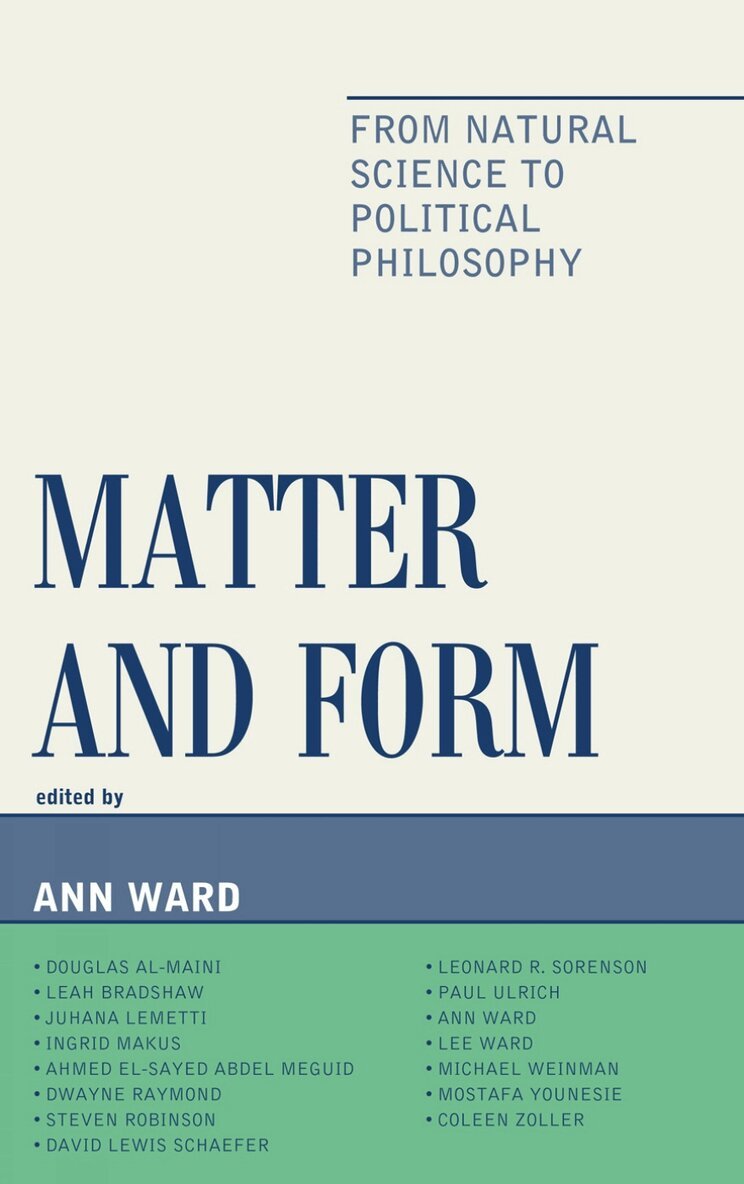
    Matter and Form

    From Natural Science to Political Philosophy

    AvAnn Ward

    Inbunden, Engelska, 2009

    1 534 kr

    Beställningsvara. Skickas inom 10-15 vardagar. Fri frakt över 249 kr.

    Beskrivning

    Matter and Form explores the relationship that has long existed between natural science and political philosophy. Plato's Socrates articulates the Ideas or Forms as an account of the ultimate source of causality in the cosmos. Aristotle's natural philosophy had a significant impact on his political philosophy: he argues that humans are by nature political animals, having their natural end in the city whose regime is hierarchically structured based on differences in moral and intellectual capacity. Medieval theorists attempt to synthesize classical natural and political philosophy with the revealed truths of scripture; they argue that divine reason structures an ordered universe, the awareness of which allows for psychic and political harmony among human beings.Enlightenment thinkers challenge the natural philosophy of classical and medieval philosophers, ushering in a more liberal political order. For example, for Hobbes, there is no rest in nature as there are no Aristotelian forms or natural places that govern matter. Hobbes applies his mechanistic understanding of material nature to his understanding of human nature: individuals are by nature locked in an endless pursuit of power until death. However, from this mechanistic understanding of humanity's natural condition, Hobbes develops a social contract theory in which civil and political society is constituted from consent. Later thinkers, such as Locke and Rousseau, modify this Hobbesian premise in their pursuit of the protection of rights and a free society. Nevertheless, materialist conceptions of the cosmos have not always given rise to liberal democratic philosophies. Historicist influence on scientific inquiry in the nineteenth century is connected to Darwin's theory of evolution; Darwin reasoned that over time the process of natural selection produces ever newer and more highly adapted species. Reflecting a form of social Darwinism, Nietzsche envisions an aristocratic order that draws its inspiration from art rather than the rationalism

    Produktinformation

    • Utgivningsdatum:2009-10-29
    • Mått:162 x 239 x 22 mm
    • Vikt:558 g
    • Format:Inbunden
    • Språk:Engelska
    • Antal sidor:256
    • Förlag:Bloomsbury Publishing Plc
    • ISBN:9780739135686

    Utforska kategorier

    • Statsvetenskap och politisk teori inom Samhälle och politik
    • Filosofiska discipliner inom Filosofi och religion

    Mer om författaren

    Ann Ward is associate professor of philosophy and classics-political studies at Campion College at the University of Regina; she is also author of Herodotus and the Philosophy of Empire, editor of Socrates: Reason or Unreason as the Foundation of European Identity, and co-editor with Lee Ward of The Ashgate Research Companion to Federalism.

    Recensioner i media

    Ward’s impressive book brings wide-ranging wisdom to a present-day intellectual crisis: the gulf between modern science and humane philosophy.

    Innehållsförteckning

    • Chapter 1 IntroductionPart 2 Part I. Ancient Science, Natural Teleology, and the Order of PoliticsChapter 3 Chapter 1. The Polis PhilosophersChapter 4 Chapter 2. The Immortality of the Soul and the Origin of the Cosmos in Plato's PhaedoChapter 5 Chapter 3. Plato's Science of Living WellChapter 6 Chapter 4. Understanding Aristotle's Politics through Form and MatterPart 7 Part II. Heavenly Perfection and Psychic HarmonyChapter 8 Chapter 5. Making "men see clearly": Physical Imperfection and Mathematical Order in Ptolemy's SyntaxisChapter 9 Chapter 6. Liberalism in the Naturalistic-Psychological Roots of Averroes' Critique of Plato's RepublicPart 10 Part III. Skepticism, Mechanism, and the New PoliticsChapter 11 Chapter 7. Skepticism, Science, and Politics in Montaigne's EssaysChapter 12 Chapter 8. Parmenidean Intuitions in Descartes's Theory of the Heart's MotionChapter 13 Chapter 9. Hobbes's Natural Condition and his Natural Science of the Mind in LeviathanChapter 14 Chapter 10. Hobbes and Aristotle: Science and PoliticsChapter 15 Chapter 11. From Metaphysics to Ethics and Beyond: Hobbes's Reaction to Aristotelian EssentialismChapter 16 Chapter 12. Hobbes and Aristotle on Biology, Reason and ReproductionPart 17 Part IV. The Scientific Roots of Liberalism and Contemporary "Biopolitics"Chapter 18 Chapter 13. Locke and the Problematic Relation between Natural Science and Moral PhilosophyChapter 19 Chapter 14. Rousseau's Botanical-Political Problem: On the Nature of Nature and Political PhilosophyChapter 20 Chapter 15. Contrasting Biological and Humanistic Approaches to the Evolution of Political MoralityChapter 21 Dialogue of the Sciences and the Humanities