• Fri frakt över 249 kr
  • •
  • Snabba leveranser
  • •
  • Billiga böcker
Kundservice

Du är på sajten för privatpersoner.

Företag, bibliotek eller offentlig verksamhet?

Du handlar på classic.bokus.com, där alla dina funktioner finns intakta.
Till classic.bokus.com
Bokus logotyp. Gå till startsidan.
  • Erbjudanden
  • Nyheter
  • Student
  • Topplistor
  • Barn & ungdom
  • Bokus Play
  • E-böcker
  • Pocketböcker
  • Spel & pussel

10% rabatt på allt med kod NYSTART10 →

Sidfot

Mina sidor

    Hjälp

    • Kundservice
    • Vanliga frågor och svar
    • Frakt och leverans
    • Retur vid ångerrätt
    • Reklamera vara
    • Betalning
    • Köpvillkor
    • Allmänna villkor
    • Information om webbplatsens tillgänglighet

    Om Bokus

    • Om oss
    • Pressrum
    • För studenter
    • För företag
    • För bibliotek och offentlig verksamhet
    • För leverantörer
    • Hållbarhet

    Populärt

    • Aktuella erbjudanden
    • Presentkort
    • Studentlitteratur
    • Nya böcker
    • Topplistor
    • Signerade böcker
    • Engelska böcker

    Inspiration

    • Boktips
    • BookTok
    • Populära bokserier
    • Barnbokskaraktärer
    • Populära författare
    Logotyp för Bokus
    Följ oss på Facebook (extern länk)Följ oss på Instagram (extern länk)Följ oss på YouTube (extern länk)Följ oss på TikTok (extern länk)
    bokus @ CookiesAnpassa cookiesIntegritetspolicyKöpvillkor
    Till Citymail hemsida (extern länk)Till Budbee hemsida (extern länk)Till Postnord hemsida (extern länk)Till Schenker hemsida (extern länk)Till Early Bird hemsida (extern länk)Till Walleys hemsida (extern länk)
    1. Samhälle och politik
    2. Samhälle och kultur
    3. Sociala grupper och identitet

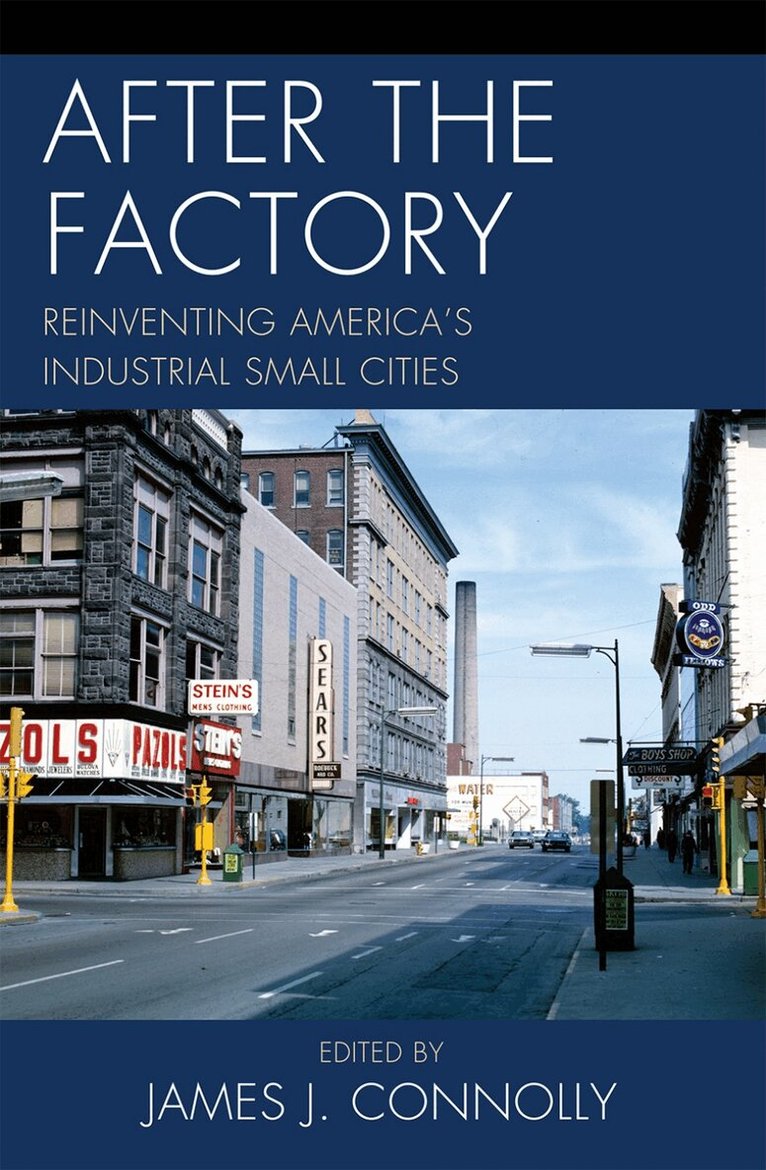
    After the Factory

    Reinventing America's Industrial Small Cities

    AvJames J. Connolly

    Häftad, Engelska, 2012

    Del i serien Comparative Urban Studies

    651 kr

    Beställningsvara. Skickas inom 10-15 vardagar. Fri frakt över 249 kr.

    Beskrivning

    The most pressing question facing the small and mid-sized cities of America's industrial heartland is how to reinvent themselves. Once-thriving communities in the Northeastern and Midwestern U. S. have decayed sharply as the high-wage manufacturing jobs that provided the foundation for their prosperity disappeared. A few larger cities had the resources to adjust, but most smaller places that relied on factory work have struggled to do so. Unless and until they find new economic roles for themselves, the small cities will continue to decline. Reinventing these smaller cities is a tall order. A few might still function as nodes of industrial production. But landing a foreign-owned auto manufacturer or a green energy plant hardly solves every problem. The new jobs will not be unionized and thus will not pay nearly as much as the positions lost. The competition among localities for high-tech and knowledge economy firms is intense. Decaying towns with poor schools and few amenities are hardly in a good position to attract the "creative-class" workers they need. Getting to the point where they can lure such companies will require extensive retooling, not just economically but in terms of their built environment, cultural character, political economy, and demographic mix. Such changes often run counter to the historical currents that defined these places as factory towns. After the Factory examines the fate of industrial small cities from a variety of angles. It includes essays from a variety of disciplines that consider the sources and character of economic growth in small cities. They delve into the history of industrial small cities, explore the strategies that some have adopted, and propose new tacks for these communities as they struggle to move forward in the twenty-first century. Together, they constitute a unique look at an important and understudied dimension of urban studies and globalization.

    Produktinformation

    • Utgivningsdatum:2012-06-21
    • Mått:152 x 228 x 15 mm
    • Vikt:404 g
    • Format:Häftad
    • Språk:Engelska
    • Serie:Comparative Urban Studies
    • Antal sidor:254
    • Förlag:Bloomsbury Publishing Plc
    • ISBN:9780739148242

    Utforska kategorier

    • Sociala grupper och identitet inom Samhälle och politik
    • Industrialismen och industrihistoria inom Historia och arkeologi

    Mer om författaren

    James J. Connolly is professor of history and director of the Center for Middletown Studies at Ball State University.

    Recensioner i media

    This compendium of essays looking at the impact of the new US economy upon the country's small to medium industrial cities asks whether or not such urban centers can make a successful transition to the global economy of the 21st century. Contributors examine smaller 20th-century industrial towns like Gary, Indiana, and Steubenville, Ohio, and the relationships to their larger, better-known regional powerhouses like Chicago and Pittsburgh. The essays trace the origins of the industries in the smaller cities as well as the problems confronting these cities in an era of deindustrialization in the late-20th-century US. The authors do a good job enumerating the challenges posed by change and describe the intellectual, cultural, and economic resources, or lack thereof, possessed by each individual city in meeting those challenges. An underlying theme is the complexity of the problems facing the cities involved. The book proffers a new way of tackling those problems through a more regional approach that moves away from the earlier urban model of a 'Darwinian' competition among cities. A useful contribution to urban historiography. Summing Up: Recommended. Upper-division undergraduates and above.

    Innehållsförteckning

    • Chapter 1 Can They Do It? The Capacity of Small Rust-Belt Cities to Reinvent Themselves in a Global EconomyChapter 2 Model Cities, Mill Towns, and Industrial Peripheries: Small Industrial Cities in Twentieth-Century AmericaChapter 3 From Satellite City to Burb of the 'Burgh: DeIndustrialization and community Identity in Steubenvill, OhioChapter 4 Creating an "Image Center": Reimagining Omaha's Downtown and Riverfront, 1986-2003Chapter 5 The Gravity of Capital: Spatial and Economic Transformation in Muncie, Indiana, 1917-1940Chapter 6 Curing the Rustbelt?: Neoliberal Health Care, Class, and Race in Mansfield, OhioChapter 7 Do Economic Growth Models Explain Midwest City Growth Differences?Chapter 8 Explaining Household Income Patterns in Rural Midewestern Counties: The Importance of Being UrbanChapter 9 Small, Green, and Good: The Role of Neglected Cities in a Sustainable Future