• Fri frakt över 249 kr
  • •
  • Snabba leveranser
  • •
  • Billiga böcker
Kundservice

Du är på sajten för privatpersoner.

Företag, bibliotek eller offentlig verksamhet?

Du handlar på classic.bokus.com, där alla dina funktioner finns intakta.
Till classic.bokus.com
Bokus logotyp. Gå till startsidan.
  • Erbjudanden
  • Nyheter
  • Student
  • Topplistor
  • Barn & ungdom
  • Bokus Play
  • E-böcker
  • Pocketböcker
  • Spel & pussel

10% rabatt på allt med kod: NYSTART10 →

Sidfot

Mina sidor

    Hjälp

    • Kundservice
    • Vanliga frågor och svar
    • Frakt och leverans
    • Retur vid ångerrätt
    • Reklamera vara
    • Betalning
    • Köpvillkor
    • Allmänna villkor
    • Information om webbplatsens tillgänglighet

    Om Bokus

    • Om oss
    • Pressrum
    • För studenter
    • För företag
    • För bibliotek och offentlig verksamhet
    • För leverantörer
    • Hållbarhet

    Populärt

    • Aktuella erbjudanden
    • Presentkort
    • Studentlitteratur
    • Nya böcker
    • Topplistor
    • Signerade böcker
    • Engelska böcker

    Inspiration

    • Boktips
    • BookTok
    • Populära bokserier
    • Barnbokskaraktärer
    • Populära författare
    Logotyp för Bokus
    Följ oss på Facebook (extern länk)Följ oss på Instagram (extern länk)Följ oss på YouTube (extern länk)Följ oss på TikTok (extern länk)
    bokus @ CookiesAnpassa cookiesIntegritetspolicyKöpvillkor
    Till Citymail hemsida (extern länk)Till Budbee hemsida (extern länk)Till Postnord hemsida (extern länk)Till Schenker hemsida (extern länk)Till Early Bird hemsida (extern länk)Till Walleys hemsida (extern länk)
    1. Historia och arkeologi
    2. Historia
    3. Asiens historia

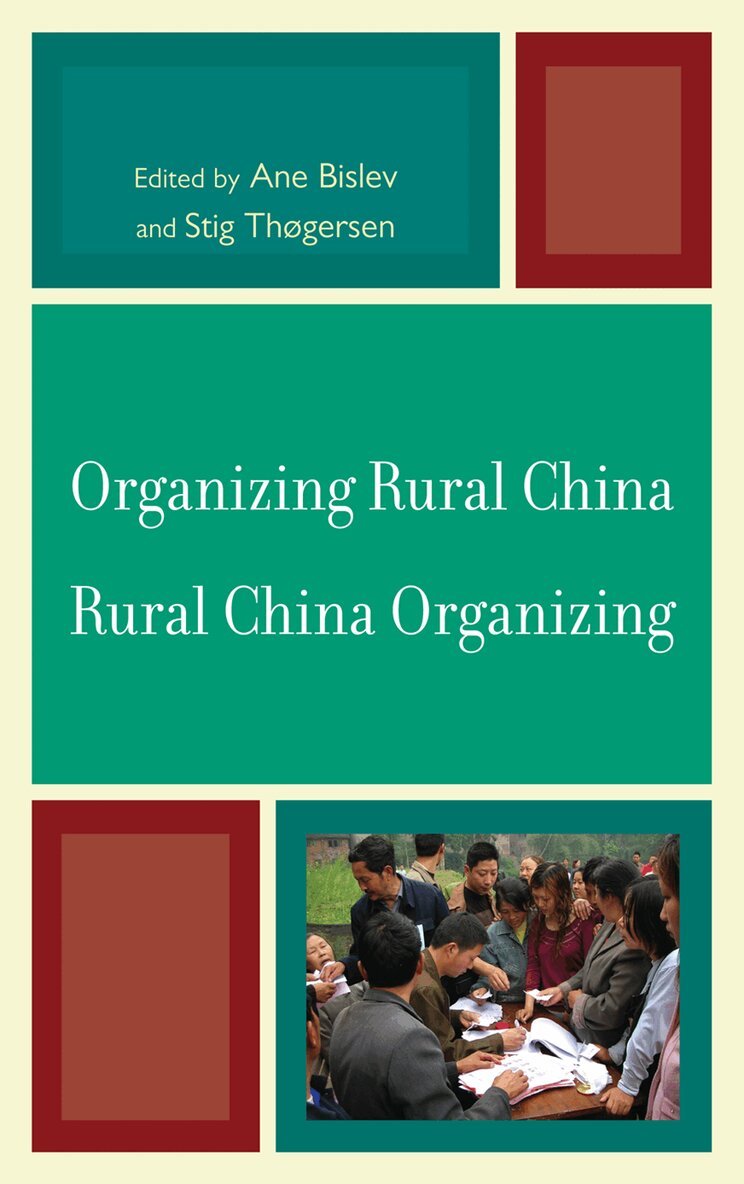
    Organizing Rural China — Rural China Organizing

    AvAne Bislev,Stig Thogersen

    Inbunden, Engelska, 2012

    Del i serien Challenges Facing Chinese Political Development

    1 436 kr

    Beställningsvara. Skickas inom 10-15 vardagar. Fri frakt över 249 kr.

    Beskrivning

    During the early 1980s China embarked on what can be seen as one of the world’s largest social experiments ever. Decollectivization meant much more than the reorganization of agricultural production into family based farming. It signaled significant changes to rural social relations, when privatization, marketization and increased geographical mobility started tearing apart the economic and social institutions that had structured collective village life under Mao. The focus of this book is on how rural society has been reorganized in the 21st century. The first chapters outline the basic organizational structure of rural China and can be used as an introduction to the topic in a classroom setting. They show how the state and its social scientists draw up plans to overcome the perceived lack of rural social organization, and discuss the often problem-ridden implementation of their ideas. The second section presents case studies of institutions that organize key aspects of rural life: Boarding schools where rural children learn to accept organizational hierarchies; lineage organizations carving out new roles for themselves; “dragonhead enterprises” expected to organize agricultural production and support rural development, and several others. The book is of theoretical interest because of its focus on the re-embedding, or reintegration, of individuals into new types of collectivities, which are less predetermined by tradition and habit and more a matter of, at least perceived, individual choice. Most chapters are based on extensive fieldwork and contain vivid examples from daily life, which will make the book attractive to anyone who wants to understand how Chinese villagers experience the extraordinary social changes they are going through.

    Produktinformation

    • Utgivningsdatum:2012-04-05
    • Mått:161 x 238 x 22 mm
    • Vikt:535 g
    • Format:Inbunden
    • Språk:Engelska
    • Serie:Challenges Facing Chinese Political Development
    • Antal sidor:248
    • Förlag:Bloomsbury Publishing Plc
    • ISBN:9780739170090

    Utforska kategorier

    • Asiens historia inom Historia och arkeologi
    • Sociala grupper och identitet inom Samhälle och politik

    Mer om författaren

    Stig Thøgersen is professor of China studies at Aarhus University. He is the author of A County of Culture – Twentieth century China seen from the village schools of Zouping, Shandong (University of Michigan Press, 2002) and Doing Fieldwork in China (ed. with Maria Heimer, NIAS Press 2006). He has published several articles on social, political and cultural change in rural China in journals such as China Quarterly, China Journal, and Journal of Contemporary China. Besides rural organizations and rural reconstruction his main present research interest is in the life histories of Chinese overseas students.Ane Bislev is a postdoctoral fellow at the Department of Culture and Society at Aarhus University. She did her PhD on microcredit and social capital in Yunnan and Guizhou and is currently working on a project on the informal credit markets in rural China. She is the author of The Need for Capital: Social Capital and Microcredit in Southwest China (2010).

    Recensioner i media

    The essays weave a fascinating landscape of contemporary rural society in China dominated no longer by homogenizing and centralizing policies but by an astonishing diversity of practices and temporalities. Long submerged temple communities, lineage structures, socialist ownership principles and cooperatives, urban initiatives, powerful agro-businesses and digital networks jostle and compete to offer new kinds of community and livelihood for the long-enduring peoples of this good earth.

    Innehållsförteckning

    • IntroductionChapter 1: Introduction, by Ane Bislev and Stig Thøgersen Imagining Rural China: Policies, Discourses, IdealsChapter 2: Continuity and Change in Rural China’s Organization, by Jonathan UngerChapter 3: Organizing Rural China: Political and Academic Discourses, by Stig ThøgersenChapter 4: Government Propaganda and the Organization of Rural China, by Christian GöbelChapter 5: Stitching it All Back Up: The Role of Sent-Down Cadres in Rural Community Building?, by Unn Målfrid RolandsenChapter 6: Reconstructing Rural China from the Bottom: A Discussion of Some Recent Chinese Experiments, by Xu Yong and Ma HuaChapter 7: Governing China’s Failed Villages: Between a “Weak State” and a Fragmented Society, by Liu YiqiangOrganizing Rural China: Actors and Local PracticesChapter 8: Life in a Rural Boarding School: Learning to Organize and to Be Organized, by Mette Halskov HansenChapter 9: Organizing Rural Health Care, by Mikkel BunkenborgChapter 10: Lineages and the State: Re-inventing Lineages and Ancestor Ceremonies as Cultural Heritage, by Marina SvenssonChapter 11: Native Place in Cyberspace: The Civic Enagement of an Internet Community, by Pang CuimingChapter 12: Embedded Microcredit—Creating Village Cohesion on the Basis of Existing Social Networks, by Ane BislevChapter 13: A Value Chain Gone Awry: Implications of the “Tainted Milk Scandal” in 2008 for Political and Social Organization in Rural China, by Jørgen Delman and Yang MinghongReflectionsChapter 14: Modern/Rural China: State Institutions and Village Values, by Vivienne ShueIndexAbout the Editors