• Fri frakt över 249 kr
  • •
  • Snabba leveranser
  • •
  • Billiga böcker
Kundservice

Du är på sajten för privatpersoner.

Företag, bibliotek eller offentlig verksamhet?

Du handlar på classic.bokus.com, där alla dina funktioner finns intakta.
Till classic.bokus.com
Bokus logotyp. Gå till startsidan.
  • Erbjudanden
  • Nyheter
  • Student
  • Topplistor
  • Barn & ungdom
  • Bokus Play
  • E-böcker
  • Pocketböcker
  • Spel & pussel

10% rabatt på allt med kod: NYSTART10 →

Sidfot

Mina sidor

    Hjälp

    • Kundservice
    • Vanliga frågor och svar
    • Frakt och leverans
    • Retur vid ångerrätt
    • Reklamera vara
    • Betalning
    • Köpvillkor
    • Allmänna villkor
    • Information om webbplatsens tillgänglighet

    Om Bokus

    • Om oss
    • Pressrum
    • För studenter
    • För företag
    • För bibliotek och offentlig verksamhet
    • För leverantörer
    • Hållbarhet

    Populärt

    • Aktuella erbjudanden
    • Presentkort
    • Studentlitteratur
    • Nya böcker
    • Topplistor
    • Signerade böcker
    • Engelska böcker

    Inspiration

    • Boktips
    • BookTok
    • Populära bokserier
    • Barnbokskaraktärer
    • Populära författare
    Logotyp för Bokus
    Följ oss på Facebook (extern länk)Följ oss på Instagram (extern länk)Följ oss på YouTube (extern länk)Följ oss på TikTok (extern länk)
    bokus @ CookiesAnpassa cookiesIntegritetspolicyKöpvillkor
    Till Citymail hemsida (extern länk)Till Budbee hemsida (extern länk)Till Postnord hemsida (extern länk)Till Schenker hemsida (extern länk)Till Early Bird hemsida (extern länk)Till Walleys hemsida (extern länk)
    1. Historia och arkeologi
    2. Historia
    3. Asiens historia

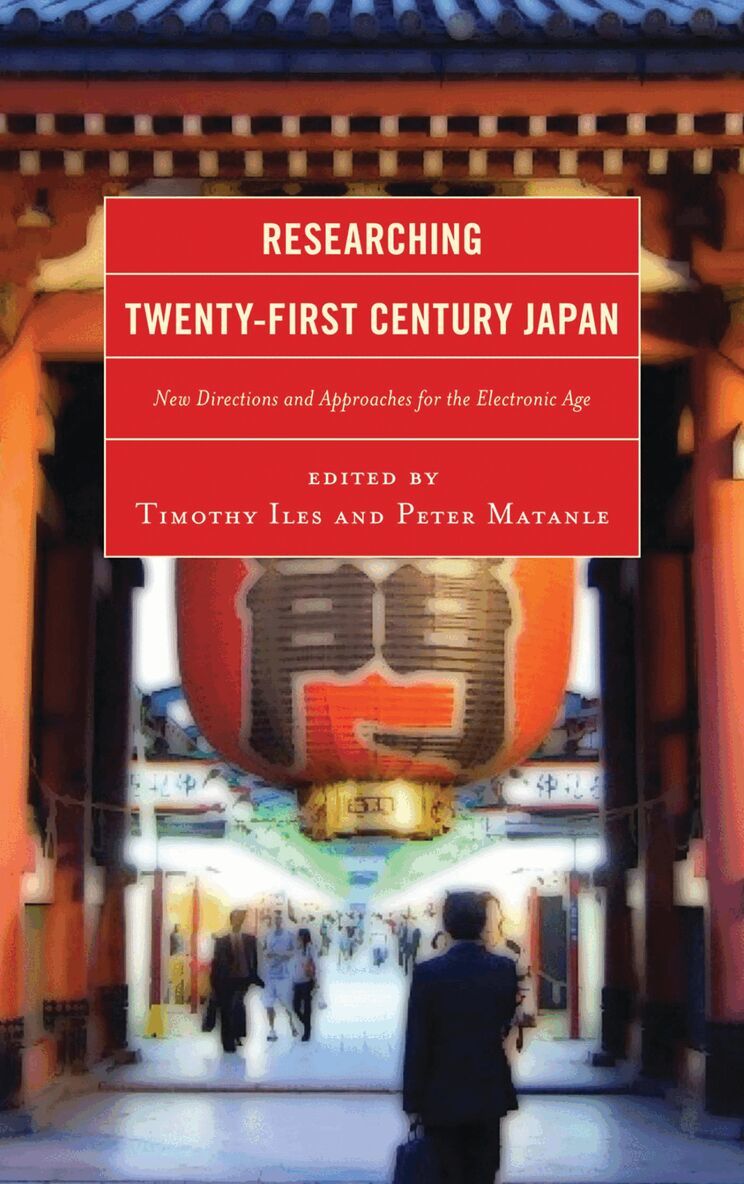
    Researching Twenty-First Century Japan

    New Directions and Approaches for the Electronic Age

    AvTimothy Iles,Peter Matanle

    Inbunden, Engelska, 2012

    1 867 kr

    Beställningsvara. Skickas inom 10-15 vardagar. Fri frakt över 249 kr.

    Beskrivning

    The aim of this project is to bring together fifteen extensively revised, peer-reviewed articles by international scholars covering a diverse range of fields—from cinema to economics to history to the social sciences—addressing issues in contemporary Japan. These fifteen are all contributors to the first ten years of the EJCJS—the Electronic Journal of Contemporary Japanese Studies. The principal strengths of this volume are its diversity of approaches and its fundamentally interdisciplinary nature: it allows researchers in different fields to contribute to an overall understanding of Japan from the 1950s to the present. This ‘understanding’ is indeed comprehensive: chapters range from economics to politics to theatre, literature, immigration issues, religion, and multiculturalism. The chapters are uniformly precise in their analyses, drawing on many different forms of research, from textual analysis, historical documentation, linguistic analysis, to participant interviews and media studies. The diverse range of subject matter holds together very well, in that the contributors operate within a set of similar central values: the primacy of practical research over theory; the centrality of Japan even in studies which situate that country internationally; clarity of expression over jargon; and the desire to include readers through rhetorical care rather than exclude through esoteric applications of over-specialised terminology or assumptions. The chapters, while academic and informed by current scholarship, are accessible to general readers with interest in contemporary Japan. In this, the volume distinguishes itself as a highly readable, pertinent compendium of scholarship on contemporary Japan. It does not aim to be ‘all things for all readers’ but rather demonstrates to its readership the ways in which diverse aspects of contemporary Japan interlock and influence each other. Thus, aspects of contemporary religion show the influence of current economic conditions, while questions of Japanese identity reflect immigration issues and aspects of multiculturalism, while emerging in contemporary Japanese forms of mobile communication and linguistic change. Japan emerges as a complex, interwoven whole in this volume, but a whole which, as the chapters demonstrate, is amenable to scholarship from both insider and ‘outsider’ alike. The international contributors all have equal merit and equal voice here, to give a true multidisciplinary portrait of this intricate, culturally, historically, and economically vital nation.

    Produktinformation

    • Utgivningsdatum:2012-01-12
    • Mått:162 x 238 x 29 mm
    • Vikt:771 g
    • Format:Inbunden
    • Språk:Engelska
    • Antal sidor:394
    • Förlag:Bloomsbury Publishing Plc
    • ISBN:9780739170144

    Utforska kategorier

    • Asiens historia inom Historia och arkeologi
    • Sociologi inom Samhälle och politik

    Mer om författaren

    About the Editors:Timothy Iles is an Associate Professor of Japanese Studies at the University of Victoria, British Columbia, Canada, where he teaches Japanese culture, cinema, and language. He has an MA from the University of British Columbia in Modern Japanese Literature, and a PhD from the University of Toronto, also in Modern Japanese Literature. He has taught courses on Japanese literature, theatre, culture, and cinema in Canada and the United States, and has published articles on those subjects. He is also author of Abe Kobo: an Exploration of his Prose, Drama, and Theatre (Fuccecio: European Press Academic Publishers, 2000), and The Crisis of Identity in Contemporary Japanese Film (Brill, 2008).Peter Matanle is a Lecturer in Japanese studies at the School of East Asian Studies (SEAS), University of Sheffield. He is the author of numerous publications in the sociology of work in Japan, including Japanese Capitalism and Modernity in a Global Era (Routledge, 2003) and Perspectives on Work, Employment and Society in Japan (Co-edited with Wim Lunsing, Palgrave, 2006). He is the founder and general editor of the electronic journal of contemporary japanese studies.Contributors:Darren-Jon Ashmore, Mio Bryce, Christoher Burgess, Paul James Cardwell, Andrew Elliott, Patrick Galbraith, Angelos Giannakopoulos, Mitsutoshi Horii, Kuniko Ishiguro, Wendy Nakanishi, Yoshiko Okuyama, Anthony Rausch, David Rear, Tomoko Shimoda, Utpal Vyas

    Recensioner i media

    Researching Twenty-First Century Japan brings together 15 of the best papers published in the journal’s first ten years. It is, appropriately, a very eclectic collection, with papers on such diverse topics as municipal mergers and manga, political financing scandals and Buddhist priests. Readers looking for a full set of wide ranging explorations of modern Japan will find informative and insightful essays. ... This book provides important insights about contemporary scholarly publishing. It reveals the depth and range of ejcjs’s intellectual contributions. ... Together, ejcjs and Researching Twenty-First Century Japan demonstrate the potential, achievements and unrealized opportunities of e-journals. ... this collection is a very good representation of the contributions that ejcjs has made and continues to make to modern Japan studies. The richness of the papers leads one to wish ejcjs all the best for continued good health and to make us all look forward to the next print collection of the 'best of' this useful e-journal.

    Innehållsförteckning

    • List of FiguresList of TablesPreface, Peter MatanleIntroduction, Timothy IlesChapter 1: The Japan Foundation in China: An Agent of Japan’s Soft Power?, Utpal VyasChapter 2: Regulatory Reform in Japan 1994-2010 and the Influence of the European Union, Paul James CardwellChapter 3: Party Financing in Germany and Japan: Comparative Perspectives of Political Corruption, Angelos Giannakopoulos, Konstadinos Maras, Shinya AmanoChapter 4: The Heisei Mergers in Contemporary Japan: A Step on the Road to a Doshu-sei Realignment?, Anthony RauschChapter 5: The Dilemma of “Critical Thinking”: Conformism and Non-Conformism in Japanese Education Policy, David RearChapter 6: The Emergence of Positive Fathering Roles in Japanese Social Marketing, Tomoko ShimodaChapter 7: Cell Phone as Metaphor: Japanese Deaf and Hearing High School Students’ Concepts of Mobile Communication,Yoshiko OkuyamaChapter 8: Japanese Employment in Transformation: The Growing Number of Non-Regular Worker, Kuniko IshiguroChapter 9: Deprofessionalization of Buddhist Priests in Contemporary Japan, Mitsutoshi HoriiChapter 10: Celebrating ‘Multicultural Japan’: Writings on ‘Minorities’ and the Discourse on ‘Difference’, Chris BurgessChapter 11: Ito and Isabella in the Contact Zone:Interpretation, Mimicry and Unbeaten Tracks in Japan, Andrew ElliottChapter 12: ‘Desperate Housewives’ in Modern Japanese Fiction—Three Novels by Ariyoshi Sawako, Wendy NakanishiChapter 13: Kiritake Masako’s Maiden’s Bunraku, Darren-Jon AshmoreChapter 14: Manga and Anime: Fluidity and Hybridity in Global Imagery, Mio Bryce, Christie Barber, and Amy PlumbChapter 15: Moe: Exploring Virtual Potential in Post-Millennial Japan, Patrick W. Galbraith