• Fri frakt över 249 kr
  • •
  • Snabba leveranser
  • •
  • Billiga böcker
Kundservice

Du är på sajten för privatpersoner.

Företag, bibliotek eller offentlig verksamhet?

Du handlar på classic.bokus.com, där alla dina funktioner finns intakta.
Till classic.bokus.com
Bokus logotyp. Gå till startsidan.
  • Erbjudanden
  • Nyheter
  • Student
  • Topplistor
  • Barn & ungdom
  • Bokus Play
  • E-böcker
  • Pocketböcker
  • Spel & pussel

10% rabatt på allt med kod: NYSTART10 →

Sidfot

Mina sidor

    Hjälp

    • Kundservice
    • Vanliga frågor och svar
    • Frakt och leverans
    • Retur vid ångerrätt
    • Reklamera vara
    • Betalning
    • Köpvillkor
    • Allmänna villkor
    • Information om webbplatsens tillgänglighet

    Om Bokus

    • Om oss
    • Pressrum
    • För studenter
    • För företag
    • För bibliotek och offentlig verksamhet
    • För leverantörer
    • Hållbarhet

    Populärt

    • Aktuella erbjudanden
    • Presentkort
    • Studentlitteratur
    • Nya böcker
    • Topplistor
    • Signerade böcker
    • Engelska böcker

    Inspiration

    • Boktips
    • BookTok
    • Populära bokserier
    • Barnbokskaraktärer
    • Populära författare
    Logotyp för Bokus
    Följ oss på Facebook (extern länk)Följ oss på Instagram (extern länk)Följ oss på YouTube (extern länk)Följ oss på TikTok (extern länk)
    bokus @ CookiesAnpassa cookiesIntegritetspolicyKöpvillkor
    Till Citymail hemsida (extern länk)Till Budbee hemsida (extern länk)Till Postnord hemsida (extern länk)Till Schenker hemsida (extern länk)Till Early Bird hemsida (extern länk)Till Walleys hemsida (extern länk)
    1. Samhälle och politik
    2. Samhälle och kultur
    3. Kultur och medier
    4. Referensverk och tvärvetenskap

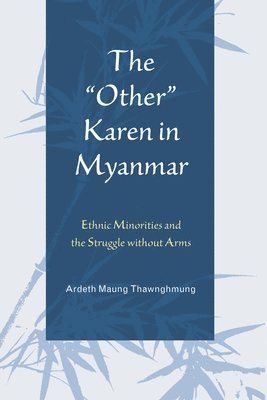
    "Other" Karen in Myanmar

    Ethnic Minorities and the Struggle without Arms

    AvArdeth Maung Thawnghmung

    Häftad, Engelska, 2013

    Del i serien AsiaWorld

    933 kr

    Beställningsvara. Skickas inom 3-6 vardagar. Fri frakt över 249 kr.

    Beskrivning

    The “Other” Karen in Myanmar looks at the “other” or “quiet” minorities, who are members of ethnic groups associated with well-known armed resistance organizations, but who pursued non-violent approaches to promote their individual and collective interests. This is the first in-depth study to uncover the existence and activities of the “other” Karen and analyze the nature of relationships with their “rebel” counterparts and the state authorities.  It also discusses other ethnic armed organizations that have experienced similar situations and assesses their implications for inter-ethnic relations, negotiations with state authorities and political reform. Most previous studies have focused on violent aspects of ethnic relations and on ethnic armed organizations, such as the Karen National Union (KNU) in Burma, the Moro Islamic Liberation Front (MNLF) in the Philippines, and the LTTE in Sri Lanka. However, even among these minorities which are locked in armed conflicts, the majority of people have shunned armed resistance and sought to remain ‘quietly’ beyond the struggle and pursued non-violent approaches to promote their individual and collective interests in the face of authoritarian, governments.  This study, which sheds light on the lives and growing political significance of non-armed, non-insurgent members of ethnic minorities in Burma, draws heavily on opinion surveys and open-ended interviews among Karen diaspora (among individuals who lived a minimum of 20 years in Burma), “quiet Karens” who live inside Burma, KNU officials, personnel, and soldiers, and Karen refugees and IDPs who are currently living in Thai-Burma border areas. These interviews, which covered approximately two hundred respondents, have been conducted since 2002. It is mainly directed toward social scientists, historians, humanitarian workers, policy makers, and practitioners, and non-specialist ordinary audience who are interested in Southeast Asian/Burmese politics and society, comparative politics, identity politics, ethnic conflict, social movements, conflict resolution, and political reform.

    Produktinformation

    • Utgivningsdatum:2013-06-22
    • Mått:162 x 240 x 21 mm
    • Vikt:513 g
    • Format:Häftad
    • Språk:Engelska
    • Serie:AsiaWorld
    • Antal sidor:232
    • Förlag:Bloomsbury Publishing Plc
    • ISBN:9780739184523

    Utforska kategorier

    • Referensverk och tvärvetenskap inom Samhälle och politik
    • Etnicitet inom Samhälle och politik

    Mer om författaren

    Ardeth Maung Thawnghmung is associate professor of political science at the University of Massachusetts, Lowell. She is the author of Beyond Militant Resistance: The Non-insurgent Members of Ethno-national Groups in Myanmar (2011), The Karen Revolution: Diverse Voices, Uncertain Ends (2008), and Behind the Teak Curtain: Authoritarianism, Agricultural Policies and Political Legitimacy in Rural Burma (2004). Her areas of specialization are on Southeast Asian and Burmese politics, ethnic politics, identity politics, political economy and comparative politics.

    Recensioner i media

    This study of the Karens of Burma has several strengths. First, an indigenous Karen who was educated initially in Myanmar/Burma and then abroad wrote it; today, she teaches political science in a US university. Second, Thawnghmung (Univ. of Massachusetts, Lowell) brings a new approach to the subject by concentrating on the Karen "others." Internal wars between the Karens and the state have been ongoing for more than six decades; however, the author's focus is on the Karens who have not joined in the fighting. As a result, the study is different from most of the writings about the second-largest minority in Burma. Third, she devotes a good deal of attention to a comparative discussion of the Karens and ethnic minorities in other countries around the world. Because of these differences from most of the literature on Burma and the Karens, this study is new and original. Moreover, it is well written and thoughtful and should find readers beyond the usual Burma and area specialists because it is placed in a comparative context that offers fresh ideas and information for political comparativists to consider. Summing Up: Recommended.

    Innehållsförteckning

    • ContentsAcknowledgmentsIntroductionGrowing up in Burma—a personal accountThe international Phenomenon of the “Silent Majority”Theme, Approach, and Method of the BookChapter 1: Who are the “Other” or “Quiet” Minorities?Who are the “other” or “quiet” Minorities?The Political Significance of the “Other” MinoritiesChapter 2: The Emergence of the Karen Ethno-National MovementThe Construction of Karen ethno-nationalist identitiesSaw Ba U Gyi and the Insein Ceasefire talksKNU in the 21st CenturyConclusionChapter 3: Kawthoolei Karen: A Fragmented Constituency Government-Controlled zonesRebel-controlled and Contested ZonesThe “Refugees”The DiasporaConclusionChapter 4: The “Rebel” and the “Accomomodator”The Early Stages of the Armed Resistance MovementThe Later Stages of the Armed RebellionConclusionChapter 5: The “Other” Ethnonationalities in Myanmar/BurmaA changing Political Landscape in SPDC and Post-SPDC PeriodsThe ‘other’ Nationalities in Burma/MyanmarThree Patterns of civilian Politics among Ethnic minoiritesConclusionChapter 6: The “other” Ethnonationalities in Comparative perspectiveCompeting IdentitiesDivide and Rule StrategiesThe Role of the “other” Minorities in Ethnic PoliticsConclusionBibliographyIndexAbout the Author