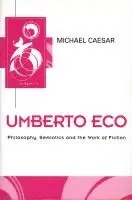
Michael Caesar is Professor of Italian and Head of Italian Studies at the University of Birmingham.
Recensioner i media
"It is a full, clear and authoritative account of Eco's work, with an emphasis on his development as a theorist and in particular his semiotic theory. But it includes a lively discussion of Eco's novels, which teases out their links with the theory most effectively. It shows the remarkable range and coherence of Eco as a writer, and is notably interesting on the ways in which his ideas have evolved in response to a changing cultural environment. Rich in details, cool, well-paced and incisive, it provides an excellent introduction to, as well as a sympathetic critique of, Eco the thinker." David Robey, Department of Italian Studies, Reading University "This wonderfully lucid and thorough exposition of Eco's major works will be indispensable to scholars and students alike. Michael Caesar explores the interconnectedness of the 'theoretical' and 'narrative' writings with analytical rigour, balancing appreciation with careful criticism. Caesar makes brilliant use of his own reading of the works to discuss the 'role of the reader', showing the limits as well as the possibilities in Eco's approach to texts." Robert Lumley, Director of the Centre for Italian Studies, University College, London
Innehållsförteckning
Acknowledgement ix Note on References x Introduction 1 1 Form, Interpretation and the Open Work 6On form and interpretation: from Croce to Pareyson 6Art and rationality 10The appearance of Opera aperta 15The poetics of the open work 18Beyond ‘openness’ 23 2 A Critical View of Culture: Mass Communications, Politics and the Avant-garde 28The role of the avant-garde 29Mass communications and theories of mass culture 37Television and semiotic guerrilla war 43Openness and structure 47 3 Introducing the Study of Signs 54Signals and sense 55Ambiguity, self-reflexivity and the aesthetic message 64The critique of iconism 67Some provisional conclusions on the aesthetic message 69 4 A Theory of Semiotics 76From La struttura assente to A Theory of Semiotics 76Communication, code and signification 81Sign and sign-function 83Sign production, iconism and the aesthetic message (again) 90 5 Semiotics Bounded and Unbound 100The boundaries of semiotics 102The dynamics of semiosis 111 6 Theory and Fiction 120Readers and worlds Texts 120 7 Secrets, Paranoia and Critical Reading 145 8 Kant, the Platypus and the Horizon 162 Notes 171 Select Bibliography 184Index 193