• Fri frakt över 249 kr
  • •
  • Snabba leveranser
  • •
  • Billiga böcker
Kundservice

Du är på sajten för privatpersoner.

Företag, bibliotek eller offentlig verksamhet?

Du handlar på classic.bokus.com, där alla dina funktioner finns intakta.
Till classic.bokus.com
Bokus logotyp. Gå till startsidan.
  • Erbjudanden
  • Nyheter
  • Student
  • Topplistor
  • Barn & ungdom
  • Bokus Play
  • E-böcker
  • Pocketböcker
  • Spel & pussel

10% rabatt på allt med kod: NYSTART10 →

Sidfot

Mina sidor

    Hjälp

    • Kundservice
    • Vanliga frågor och svar
    • Frakt och leverans
    • Retur vid ångerrätt
    • Reklamera vara
    • Betalning
    • Köpvillkor
    • Allmänna villkor
    • Information om webbplatsens tillgänglighet

    Om Bokus

    • Om oss
    • Pressrum
    • För studenter
    • För företag
    • För bibliotek och offentlig verksamhet
    • För leverantörer
    • Hållbarhet

    Populärt

    • Aktuella erbjudanden
    • Presentkort
    • Studentlitteratur
    • Nya böcker
    • Topplistor
    • Signerade böcker
    • Engelska böcker

    Inspiration

    • Boktips
    • BookTok
    • Populära bokserier
    • Barnbokskaraktärer
    • Populära författare
    Logotyp för Bokus
    Följ oss på Facebook (extern länk)Följ oss på Instagram (extern länk)Följ oss på YouTube (extern länk)Följ oss på TikTok (extern länk)
    bokus @ CookiesAnpassa cookiesIntegritetspolicyKöpvillkor
    Till Citymail hemsida (extern länk)Till Budbee hemsida (extern länk)Till Postnord hemsida (extern länk)Till Schenker hemsida (extern länk)Till Early Bird hemsida (extern länk)Till Walleys hemsida (extern länk)
    1. Historia och arkeologi
    2. Historia
    3. Historia: särskilda händelser och ämnen
    4. Socialhistoria och kulturhistoria

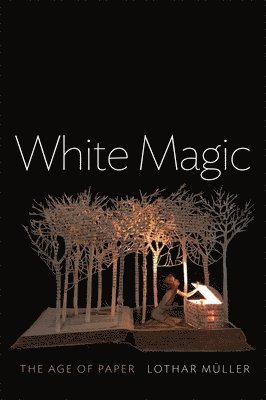
    White Magic

    The Age of Paper

    AvLothar Müller

    Häftad, Engelska, 2016

    153 kr

    Beställningsvara. Skickas inom 5-8 vardagar. Fri frakt över 249 kr.

    Fler format och utgåvor

    Inbunden

    511 kr

    Beskrivning

    Paper is older than the printing press, and even in its unprinted state it was the great network medium behind the emergence of modern civilization. In the shape of bills, banknotes and accounting books it was indispensible to the economy. As forms and files it was essential to bureaucracy. As letters it became the setting for the invention of the modern soul, and as newsprint it became a stage for politics. In this brilliant new book Lothar Müller describes how paper made its way from China through the Arab world to Europe, where it permeated everyday life in a variety of formats from the thirteenth century onwards, and how the paper technology revolution of the nineteenth century paved the way for the creation of the modern daily press. His key witnesses are the works of Rabelais and Grimmelshausen, Balzac and Herman Melville, James Joyce and Paul Valéry. Müller writes not only about books, however: he also writes about pamphlets, playing cards, papercutting and legal pads. We think we understand the ?Gutenberg era?, but we can understand it better when we explore the world that underpinned it: the paper age. Today, with the proliferation of digital devices, paper may seem to be a residue of the past, but Müller shows that the humble technology of paper is in many ways the most fundamental medium of the modern world.

    Produktinformation

    • Utgivningsdatum:2016-03-04
    • Mått:152 x 229 x 25 mm
    • Vikt:522 g
    • Format:Häftad
    • Språk:Engelska
    • Antal sidor:328
    • Förlag:John Wiley and Sons Ltd
    • ISBN:9780745672540

    Utforska kategorier

    • Socialhistoria och kulturhistoria inom Historia och arkeologi
    • Referensverk och tvärvetenskap inom Samhälle och politik
    • Sociologi inom Samhälle och politik

    Mer om författaren

    Lothar Müller is editor of the features section of the Süddeutsche Zeitung. He taught general and comparative literature at Berlin Free University and, since 2010, he has been an Honorary Professor at the Humboldt University in Berlin. In 2013 he was awarded the Berlin Prize for Literary Criticism.

    Recensioner i media

    "Balanced and intelligent... Even those who are happy with e-books will be grateful to Muller's publishers for printing White Magic on good, thick, creamy paper and including, at the end, a dozen blank pages, all of which I have covered with untidy, handwritten notes, to make this mechanical mass-produced artifact intimately my own."—New York Review of Books"A richly sprawling history"—Times Literary Supplement"A panoramic literary-historical work reminiscent of Erich Auerbach's Mimesis"—The Washington Post"What a great read! It is a book to warm up the brain on a day of mental fog."—Inside Higher Education"Most of this erudite, engaging work is concerned with the rise of paper and its dominance as civilisation's archive and its role as a 'metaphorical resource': the origin of phrases such as 'a blank page'. As well as being a historical account of the way paper came to permeate every aspect of life, Muller mines European literature for the role paper has played in the stories we tell ourselves."—Sydney Morning Herald"Lothar Müller... tells an alternative history of paper. He argues, convincingly, that paper has been, and continues to be, integral to our civilisation and the modern world. Through a carefully structured sequence of illuminating vignettes, he brings together fascinating facts from across the globe and the centuries to reveal the long-running and fundamental impact of paper on human life, work and culture."—Times Higher Education"Müller's work leaves the reader admiring something that feels magical."—Publishers Weekly"...the tale that Lothar Müller spins in White Magic: The Age of Paper is one that brings paper—as both physical material and a playing field on which the human imagination can run wild—to vivid life. Incorporating a wealth of historical detail, technical information, and critical analysis, Müller makes his account lively and compelling, giving paper a personality and substance that is on par with any words that may appear on it. In his book, paper is not just the silent partner of the printing press. Instead, it is an extremely versatile substance—one whose uses and forms shape human thought and behavior in many ways."—The Nomadic Press"As paper increasingly fades into history, the story of its role and evolution is at risk of being lost, erasing the roadmap that brought us to the digital era. Lothar Müller's White Magic: The Age of Paper goes a long way to averting that fate, going back in time to record and describe in intricate detail how paper came to be, and what it came to be."—South China Morning Post"Consistently readable and highly entertaining, this witty and learned book deftly decouples paper's history from the story of printing to tell new and surprising tales about a medium that continues to pervade our daily life. You'll never look at a blank page in quite the same way again."—Catherine Robson, New York University"This is an absorbing history of paper, fascinating in its detail and magisterial in its scope. Muller writes with the authority of a scholar and the imagination of a poet, filling his book with curious but essential facts and astute perceptions. It is a delight to read."—Jeremy Adler, King's College London"Müller's history of paper is original, engaging and breathtakingly erudite. It explores paper in its materiality, but also as a source of inspiration which has shaped the history of knowledge and creativity. In tracing paper's vital role in the development of human civilisation, the author also argues for its continued importance in the digital age."—Carolin Duttlinger, Wadham College, Oxford"Lothar Müller set out dazzling new insights into the creation of our world, building on Harold Innis’ work on the long and complex emergence of paper. Unique in his White Magic is his subtle blending of cultural and media history with sociological understanding and literary reflexion."—Philippe Despoix, Center of Intermedial Research in Arts, Literatures and Technologies, Université de Montréal

    Innehållsförteckning

    • Thanks viiiPROLOGUE The Microbe Experiment ixPART ONE The Diffusion of Paper in Europe 1CHAPTER 1 Leaves from Samarkand 31.1 The Arab Intermediate Realm 31.2 Calligraphy and the Cairo Wastepaper Basket 101.3 In Scheherazade’s World 131.4 Timur and Suleika 17CHAPTER 2 The Rustling Grows Louder 222.1 The European Paper Mill Boom 222.2 Paper, Scholars, and Playing Cards 262.3 The Rise of the File: Paper Kings, Chanceries, and Secretaries 312.4 The Merchant of Genoa and His Silent Partner 372.5 Ragpickers, Writers, and the Pulpit 46CHAPTER 3 The Universal Substance 523.1 Marshall McLuhan and the Pantagruelion of Rabelais 523.2 Harold Innis, the Postal System, and Mephisto’s Scrap 613.3 The World in a Page: Watermarks, Formats, Colors 70PART TWO Behind the Type Area 79CHAPTER 1 The Printed and the Unprinted 811.1 The Pitfalls of a Formula: “From Script to Print” 811.2 The White Page 851.3 “Found among the Papers ...” 89CHAPTER 2 Adventurers and Paper 942.1 Don Quixote, the Print Shop, and the Pen 942.2 Picaresque Paper: Simplicius Simplicissimus and the Schermesser 992.3 Robinson’s Journal, Ink, and Time 104CHAPTER 3 Transparent Typography 1083.1 The Epistolary Novel’s Mimicry of Letter Paper 1083.2 Laurence Sterne, the Straight Line, and the Marbled Page 1153.3 The Fragmentation of the Printed Page: Jean Paul, Lichtenberg, and Excerpts 119PART THREE The Great Expansion 127CHAPTER 1 The Demons of the Paper Machine 1291.1 The Mechanization of Sheet-Making 1291.2 The Loom of Time, the French Revolution, and Credit 1401.3 Balzac, Journalism, and the Paper Scheme in Lost Illusions 1521.4 The Secrets of the Scriveners: Charles Dickens and Mr. Nemo 1631.5 Foolscap and Factory Workers: Herman Melville and the Paper Machine 168CHAPTER 2 Newsprint and the Emergence of the Popular Press 1802.1 The Boundless Resource Base 1802.2 The Newspaper, the Price of Paper, and the Patrioteer 1892.3 Émile Zola, the Petit Journal, and the Dreyfus Affair 196CHAPTER 3 Illuminated Inner Worlds 2013.1 Wilhelm Dilthey, Historism, and Literary Estates 2013.2 Henry James, Edith Wharton, and the Autograph Hunt 2073.3 Laterna Magica: Paper and Interiors 215CHAPTER 4 The Inventory of Modernity 2264.1 Typewriter Paper, Deckle Edges, and White Space 2264.2 James Joyce, Newsprint, and Shears 2364.3 William Gaddis, the Paperwork Crisis, and Punch Cards 2424.4 Rainald Goetz, the Mystic Writing Pad, and the Smell of Paper 249EPILOGUEThe Analog and the Digital 253Notes 265Bibliography 274Image Credits 292Index of Names 293