• Fri frakt över 249 kr
  • •
  • Snabba leveranser
  • •
  • Billiga böcker
Kundservice

Du är på sajten för privatpersoner.

Företag, bibliotek eller offentlig verksamhet?

Du handlar på classic.bokus.com, där alla dina funktioner finns intakta.
Till classic.bokus.com
Bokus logotyp. Gå till startsidan.
  • Erbjudanden
  • Nyheter
  • Student
  • Topplistor
  • Barn & ungdom
  • Bokus Play
  • E-böcker
  • Pocketböcker
  • Spel & pussel

Må bättre, för mindre! Upp till 50% rabatt på hälsoböcker

Sidfot

Mina sidor

    Hjälp

    • Kundservice
    • Vanliga frågor och svar
    • Frakt och leverans
    • Retur vid ångerrätt
    • Reklamera vara
    • Betalning
    • Köpvillkor
    • Allmänna villkor
    • Information om webbplatsens tillgänglighet

    Om Bokus

    • Om oss
    • Pressrum
    • För studenter
    • För företag
    • För bibliotek och offentlig verksamhet
    • För leverantörer
    • Hållbarhet

    Populärt

    • Aktuella erbjudanden
    • Presentkort
    • Studentlitteratur
    • Nya böcker
    • Topplistor
    • Signerade böcker
    • Engelska böcker

    Inspiration

    • Boktips
    • BookTok
    • Populära bokserier
    • Barnbokskaraktärer
    • Populära författare
    Logotyp för Bokus
    Följ oss på Facebook (extern länk)Följ oss på Instagram (extern länk)Följ oss på YouTube (extern länk)Följ oss på TikTok (extern länk)
    bokus @ CookiesAnpassa cookiesIntegritetspolicyKöpvillkor
    Till Citymail hemsida (extern länk)Till Budbee hemsida (extern länk)Till Postnord hemsida (extern länk)Till Schenker hemsida (extern länk)Till Early Bird hemsida (extern länk)Till Walleys hemsida (extern länk)
    1. Filosofi och religion
    2. Religion och tro
    3. Religion: allmänt

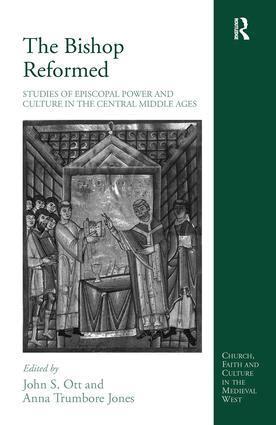
    Bishop Reformed

    Studies of Episcopal Power and Culture in the Central Middle Ages

    AvAnna Trumbore Jones,John S. Ott

    Inbunden, Engelska, 2007

    Del i serien Church, Faith and Culture in the Medieval West

    2 421 kr

    Beställningsvara. Skickas inom 10-15 vardagar. Fri frakt över 249 kr.

    Fler format och utgåvor

    E-bok

    805 kr

    E-bok

    805 kr

    Beskrivning

    In the period following the collapse of the Carolingian Empire up to the Fourth Lateran Council (1215), the episcopate everywhere in Europe experienced substantial and important change, brought about by a variety of factors: the pressures of ecclesiastical reform; the devolution and recovery of royal authority; the growth of papal involvement in regional matters and in diocesan administration; the emergence of the "crowd" onto the European stage around 1000 and the proliferation of autonomous municipal governments; the explosion of new devotional and religious energies; the expansion of Christendom's borders; and the proliferation of new monastic orders and new forms of religious life, among other changes. This socio-political, religious, economic, and cultural ferment challenged bishops, often in unaccustomed ways. How did the medieval bishop, unquestionably one of the most powerful figures of the Middle Ages, respond to these and other historical changes? Somewhat surprisingly, this question has seldom been answered from the bishop's perspective. This volume of interdisciplinary studies, drawn from literary scholarship, art history, canon law, and history, seeks to break scholarship of the medieval episcopacy free from the ideological stasis imposed by the study of church reform and episcopal lordship. The editors and contributors propose less a conventional socio-political reading of the episcopate and more of a cultural reading of bishops that is particularly concerned with issues such as episcopal (self-)representation, conceptualization of office and authority, cultural production (images, texts, material objects, space) and ecclesiology/ideology. They contend that ideas about episcopal office and conduct were conditioned by and contingent upon time, place and pastoral constituency. What made a "good" bishop in one time and place may not have sufficed for another time and place and imposing the absolute standards of prescriptive ideologies, medieval and modern, obfuscates rather than clarifies our understanding of the medieval bishop and his world.

    Produktinformation

    • Utgivningsdatum:2007-07-28
    • Mått:156 x 234 x 25 mm
    • Vikt:453 g
    • Format:Inbunden
    • Språk:Engelska
    • Serie:Church, Faith and Culture in the Medieval West
    • Antal sidor:296
    • Förlag:Taylor & Francis Ltd
    • ISBN:9780754657651

    Utforska kategorier

    • Religion: allmänt inom Filosofi och religion
    • Kristendom inom Filosofi och religion
    • Medeltiden inom Historia och arkeologi

    Mer om författaren

    John S. Ott is Associate Professor of History at Portland State University, USA. Anna Trumbore Jones is Assistant Professor of History at Lake Forest College, USA.

    Recensioner i media

    ’It is rare that a volume of essays by numerous contributors....is as successful as this book in fulfilling its aim.’ Journal of Ecclesiastical History ’This is a wide-ranging and eye-opening collection of case studies that examines the multifaceted role of bishops in post-Carolingian Europe. ... Historians of medieval religion will find much food for thought in this volume, which at its best invites us to reconsider our presumptions about the role of the bishop in medieval society by taking into account all of the richness and complexity of his local milieu.’ Early Medieval Europe

    Innehållsförteckning

    • Contents: Introduction: the bishop reformed, John S. Ott and Anna Trumbore Jones; Lay magnates, religious houses, and the role of the bishop in Aquitaine (877-1050), Anna Trumbore Jones; Bishops and religious law, 900-1050, Greta Austin; Sovereignty and social order: Archbishop Wulfstan and the Institutes of Polity, Renée R. Trilling; The image of the bishop in the Middle Ages, Eric Palazzo; Building the body of the Church; a bishop's blessing in the Benedictional of Engilmar of Parenzo, Evan A. Gatti; Bishop Gerard I of Cambrai-Arras, the 3 orders, and the problem of human weakness, T.M. Riches; 'Both Mary and Martha': Bishop Lietbert of Cambrai and the construction of episcopal sanctity in a border diocese around 1100, John S. Ott; Driving the chariot of the Lord: Siegfried I of Mainz (1060-1084) and episcopal identity in an age of transition, John Eldevik; Pastoral care as military action: the ecclesiology of Archbishop Alfanus I of Salerno (1058-1085), Valerie Ramseyer; What made Ivo mad? Reflections on a medieval bishop's anger, Bruce C. Brasington; The bishops of Piacenza, their cathedral, and the reform of the Church, Dorothy F. Glass; Urban space, sacred topography, and ritual meanings in Florence: the route of the bishop's entry, c1200-1600, Maureen C. Miller; Postscript: the ambiguous bishop, Thomas Head; Index.