• Fri frakt över 249 kr
  • •
  • Snabba leveranser
  • •
  • Billiga böcker
Kundservice

Du är på sajten för privatpersoner.

Företag, bibliotek eller offentlig verksamhet?

Du handlar på classic.bokus.com, där alla dina funktioner finns intakta.
Till classic.bokus.com
Bokus logotyp. Gå till startsidan.
  • Erbjudanden
  • Nyheter
  • Student
  • Topplistor
  • Barn & ungdom
  • Bokus Play
  • E-böcker
  • Pocketböcker
  • Spel & pussel

10% rabatt på allt med kod: NYSTART10 →

Sidfot

Mina sidor

    Hjälp

    • Kundservice
    • Vanliga frågor och svar
    • Frakt och leverans
    • Retur vid ångerrätt
    • Reklamera vara
    • Betalning
    • Köpvillkor
    • Allmänna villkor
    • Information om webbplatsens tillgänglighet

    Om Bokus

    • Om oss
    • Pressrum
    • För studenter
    • För företag
    • För bibliotek och offentlig verksamhet
    • För leverantörer
    • Hållbarhet

    Populärt

    • Aktuella erbjudanden
    • Presentkort
    • Studentlitteratur
    • Nya böcker
    • Topplistor
    • Signerade böcker
    • Engelska böcker

    Inspiration

    • Boktips
    • BookTok
    • Populära bokserier
    • Barnbokskaraktärer
    • Populära författare
    Logotyp för Bokus
    Följ oss på Facebook (extern länk)Följ oss på Instagram (extern länk)Följ oss på YouTube (extern länk)Följ oss på TikTok (extern länk)
    bokus @ CookiesAnpassa cookiesIntegritetspolicyKöpvillkor
    Till Citymail hemsida (extern länk)Till Budbee hemsida (extern länk)Till Postnord hemsida (extern länk)Till Schenker hemsida (extern länk)Till Early Bird hemsida (extern länk)Till Walleys hemsida (extern länk)
    1. Ekonomi och Ledarskap
    2. Industrier och branscher
    3. Servicesektorn

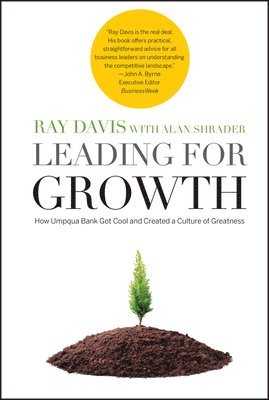
    Leading for Growth

    How Umpqua Bank Got Cool and Created a Culture of Greatness

    AvRaymond P. Davis,Alan R. Shrader

    Inbunden, Engelska, 2007

    Del 37 i serien Jossey-Bass Leadership Series

    208 kr

    Beställningsvara. Skickas inom 5-8 vardagar. Fri frakt över 249 kr.

    Beskrivning

    How any business leader can create an atmosphere of competitiveness for exceptional growth When Ray Davis took over the local 40-person South Umpqua Bank in 1994, many people in the industry poked fun at his insistence that employees answer the phone with a cheery "World's Greatest Bank." Eleven years, $7 billion in assets, and 128 branches (or " bank stores" in Umpqua lingo) later, the moniker seems quite apt. Other banks scratched their heads when Davis sent his tellers to Ritz-Carlton to learn customer service and were intrigued when he hired a cutting-edge design firm to completely re-think retail layout. Now, with a top design award under their belt, a name change (there never was a North Umpqua bank), and a completely new definition of the banking business, Umpqua has become the darling of the entrepreneurial press and a growth powerhouse. The New York Times calls Umpqua "Starbucks with tellers."Ray Davis (Portland, OR), named by U.S. Banker as one of the 25 most influential people in the financial industry in 2005, is President and CEO of Umpqua Holdings Corporation. Alan Shrader (Moraga, CA) is an experienced writer and editor of business books.

    Produktinformation

    • Utgivningsdatum:2007-04-05
    • Mått:155 x 226 x 23 mm
    • Vikt:431 g
    • Format:Inbunden
    • Språk:Engelska
    • Serie:Jossey-Bass Leadership Series
    • Antal sidor:240
    • Förlag:John Wiley & Sons Inc
    • ISBN:9780787986070

    Utforska kategorier

    • Servicesektorn inom Ekonomi och Ledarskap
    • Finansiering inom Ekonomi och Ledarskap
    • Affärsstrategi inom Ekonomi och Ledarskap

    Mer om författaren

    The Authors Ray Davis—Ernst & Young’s 2004 Regional Retail Entrepreneur of the Year—is a pioneer of change in the banking industry, revolutionizing how banks look, feel, sound, and operate. He is the president and CEO of Umpqua Holding Corporation and has been featured in the Wall Street Journal, the New York Times, Fast Company, BusinessWeek, Business 2.0, Newsweek, and CNBC. Umpqua was named to Fortune Magazine’s “100 Best Companies to Work For” list in 2007. Ray lives with his wife, Bobbi, in Portland, Oregon. Alan Shrader is managing editor of Leader to Leader and an experienced writer and editor of business books.

    Innehållsförteckning

    • Introduction: There is No Door Number Three 1The pursuit of relentless growth has one underlying premise: You get better or you get worse. You can’t stay the same. This book is for all companies that are tired of treading water.Part One: Prerequisites for Relentless Growth 71. What Business Are You Really In? 9Umpqua started to take off when we decided we were really in the retail business, not just the banking business, and started learning from successful retailers like Nordstrom. This chapter offers advice to help you discover what business you are really in.2. Never-Ending Discipline 23Leaders need to realize that growth is not a project, not a quick fix. You must have the discipline to realize you never have it made.3. Have Positive Passion 30Be relentless about your vision. Know what you stand for. We call ourselves The World’s Greatest Bank. It helps us stand out with our customers, but more than that, it creates positive passion within the company.4. Snap the Rubber Band Syndrome 40Each of us has a rubber band attached to our backside, connected to tradition. This chapter offers strategies to help people overcome the pull of comfortable routines.5. What’s Going On Behind Your Back? 49Having the right strategy is meaningless unless you can execute it flawlessly on the ground. This chapter explains how to put systems in place to inspect the execution of strategy at the lowest level.Part Two: Roles of a Leader 576. Support Your People—and Hold ’Em Accountable 59Leaders have many roles, but support and accountability are critical—and they go hand in hand.7. Give Them the Power 69In the past, the leader was the guy with the answers. Today, you have to empower the people closest to the action to come up with their own answers.8. Rise Above the Battlefield 79Leaders need to rise above the battlefield to achieve a strategic perspective on the company. I explain the tactics I use to get above the fray and—just as important—how I help the people on my executive team do this as well.9. Explain Your Movie 87Leaders cannot delegate the job of explaining their vision for the company—what I call “this movie that’s playing in my head.”10. Be Real 94If you can’t be yourself, you can’t lead. It’s as simple as that.Part Three: Master the Basics 10111. Sweat the Small Stuff 103Every great company sweats the details. In this chapter, I talk about how great companies such as Disney sweat the small stuff.12. Who Do You Want on Your Bus? 109In Good to Great, Jim Collins says that you’ve got to get the right people on the bus. I think that is exactly right. But who are the right people?13. Keep Your Board Strong—and Informed 118Companies can’t move fast if the executive team has to drag the board of directors along with it. This chapter describes how I work with my board to keep us all aligned and on track.14. Intangibles Matter Most 128In a service business like ours, the most important metrics measure things that are intangible.Part Four: Marketing, Marketing, Marketing 13915. Find the Revolution Before It Finds You 141Revolutions are going on all the time in consumer preferences, in technology, in marketing, and in other areas. We do a number of things at Umpqua to find these revolutions before they overwhelm us.16. Your Brand is You 150People don’t like faceless bureaucracies. They like real people, real personalities. We’ve achieved remarkable success by staying true to ourselves. Some people say we’re corny, but it’s who we are—and people respond.17. Serve the Customer 158This chapter details our Universal Associates program: every associate in our stores is trained to be able to handle any task a customer requires. This sharply sets us apart from our competition. What are you doing to set yourself apart?18. Put Design into Everything You Do 165Design encompasses much more than just the physical layout of stores or products. When design is used effectively, it brings every aspect of your business into alignment so that everything reinforces and supports everything else.Part Five: Leading Your Culture 17319. Be There 175Maintaining a culture is like raising a teenager. You’re constantly checking in. “What are you doing? Where are you going? Who are you hanging out with?”20. Keep Your Balance 184Leading for growth is a high-wire act—and there are many dimensions to keeping your balance.21. Remember Who You Are 193The biggest danger of relentless growth is that your very growth will undermine the qualities that produced that growth in the first place. You’ve also got to know what not to change—what to maintain if you want to stay on track.22. Mergers and Acquisitions Done Right 201A lot of Umpqua’s growth has come from acquisitions, which have the potential to disrupt or dilute the acquiring company’s culture. We have not allowed that to happen.Conclusion: Making Relentless Progress 211The key to growth is making progress every single day.Acknowledgments 215The Authors 217Index 219