• Fri frakt över 249 kr
  • •
  • Snabba leveranser
  • •
  • Billiga böcker
Kundservice

Du är på sajten för privatpersoner.

Företag, bibliotek eller offentlig verksamhet?

Du handlar på classic.bokus.com, där alla dina funktioner finns intakta.
Till classic.bokus.com
Bokus logotyp. Gå till startsidan.
  • Erbjudanden
  • Nyheter
  • Student
  • Topplistor
  • Barn & ungdom
  • Bokus Play
  • E-böcker
  • Pocketböcker
  • Spel & pussel

10% rabatt på allt med kod NYSTART10 →

Sidfot

Mina sidor

    Hjälp

    • Kundservice
    • Vanliga frågor och svar
    • Frakt och leverans
    • Retur vid ångerrätt
    • Reklamera vara
    • Betalning
    • Köpvillkor
    • Allmänna villkor
    • Information om webbplatsens tillgänglighet

    Om Bokus

    • Om oss
    • Pressrum
    • För studenter
    • För företag
    • För bibliotek och offentlig verksamhet
    • För leverantörer
    • Hållbarhet

    Populärt

    • Aktuella erbjudanden
    • Presentkort
    • Studentlitteratur
    • Nya böcker
    • Topplistor
    • Signerade böcker
    • Engelska böcker

    Inspiration

    • Boktips
    • BookTok
    • Populära bokserier
    • Barnbokskaraktärer
    • Populära författare
    Logotyp för Bokus
    Följ oss på Facebook (extern länk)Följ oss på Instagram (extern länk)Följ oss på YouTube (extern länk)Följ oss på TikTok (extern länk)
    bokus @ CookiesAnpassa cookiesIntegritetspolicyKöpvillkor
    Till Citymail hemsida (extern länk)Till Budbee hemsida (extern länk)Till Postnord hemsida (extern länk)Till Schenker hemsida (extern länk)Till Early Bird hemsida (extern länk)Till Walleys hemsida (extern länk)
    1. Filosofi och religion
    2. Filosofi

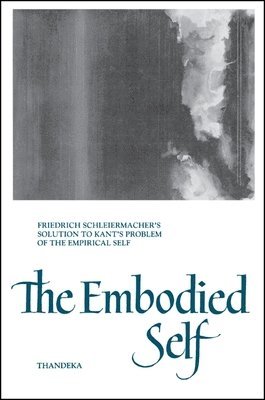
    Embodied Self

    Friedrich Schleiermacher's Solution to Kant's Problem of the Empirical Self

    AvThandeka

    Inbunden, Engelska, 1995

    Del i serien SUNY series in Philosophy

    1 076 kr

    Tillfälligt slut

    Fler format och utgåvor

    Häftad

    441 kr

    Beskrivning

    Schleiermacher presents a viable, systematic approach to self-consciousness that unifies thinking, feeling, and life itself—that reconfigures the whole of human experience. He presents a self capable of generating coherence amidst ethnic conflicts and the environmental crisis.This book investigates the philosophic notion of self-consciousness found in the work of Immanuel Kant, Johann Gottlieb Fichte, Friedrich Wilhelm Joseph von Schelling, Georg Wilhelm Friedrich Hegel and Friedrich Ernst Daniel Schleiermacher. Its central focus is on Schleiermacher's Dialektik, a posthumously published series of lectures delivered in Berlin between 1811 and 1831. In these lectures, we find Schleiermacher's most detailed delineation of the two-tiered structure of feeling (Gefühl) that established him as the father of modern Protestant theology. We also find his solution to the gap between the noumenal and empirical self in Kant's theory of self-consciousness that post-Kantian idealists attempt but failed to resolve. Schleiermacher correctly foresaw the nihilistic end to which the philosophical tradition of speculative self-consciousness would lead.

    Produktinformation

    • Utgivningsdatum:1995-08-10
    • Mått:153 x 229 x 8 mm
    • Vikt:390 g
    • Format:Inbunden
    • Språk:Engelska
    • Serie:SUNY series in Philosophy
    • Antal sidor:151
    • Förlag:State University of New York Press
    • ISBN:9780791425756

    Utforska kategorier

    • Filosofi inom Filosofi och religion

    Mer om författaren

    Thandeka is Assistant Professor, Department of Religion, Williams College. The name "Thandeka" was given to her by Archbishop Desmond Tutu in 1984.

    Recensioner i media

    "What I like most about this book is its presentation and elaboration of Schleiermacher's lectures on dialectics, which is probably the most important untranslated material in fundamental philosophy of nineteenth-century European thought. Previous English accounts have not brought out the contemporary impact of this work."The topic is certainly important since it addresses basic issues that arise out of the world of Kant, the most influential philosopher of the modern world. The author's view that Kant loses the unity of human selfhood and that Schleiermacher viably meets this problem with his analysis of the philosophical ingredients of knowing and being locates the book in a prominent area of continuing interest." — Jack Verheyden, The Claremont Graduate School

    Innehållsförteckning

    • List of Abbreviations Preface Acknowledgments Introduction Schleiermacher's Critique of Modern PhilosophySchleiermacher's Dialektik: An Unfamiliar StorySchleiermacher's Reconstruction of the SelfChapter One. Kant's Problem Schleiermacher Discovers KantKant's Moral Link to GodSchleiermacher's Existential Link to 'God'Kant Discovers the Gap in His Critical PhilosophyKant's a priori Aporia: The Two Selves in Kant's First CritiqueIdealism's One-sidednessChapter Two. Fichte's Insight Beck's Standpoint: Original ReconciliationFichte's Standpoint: Intellectual IntuitionSchleiermacher's Scant PraiseKant's Conflicted CondemnationChapter Three. Schleiermacher's New Vocabulary for ConsciousnessThe Two-fold Nature of an Act of Thinking: The Organicand Intellectual FunctionsConsciousnessObjective and Subjective ConsciousnessConcepts and JudgmentsThe Limits of Determinate ThinkingDenkenwollen vs. Denken: The Will to Think vs. Actual ThinkingThe Ethical SubjectThe Physical SubjectSchleiermacher's Three-fold StrategySchleiermacher's Master KeyKant, Beck, and Fichte RevisitedChapter Four. Schleiermacher's Original Insight The Point of IndifferenceThe Common BorderThe Means of TransitionAnschauung: Object-less AwarenessGefühl: Subject-less AwarenessThe Source of CertitudeThe Two Tiers of FeelingConsciousness of GodConclusionChapter Five. The Embodied Self The Two Canons of Schleiermacher's DialektikConclusionNotes Selected Bibliography Index