• Fri frakt över 249 kr
  • •
  • Snabba leveranser
  • •
  • Billiga böcker
Kundservice

Du är på sajten för privatpersoner.

Företag, bibliotek eller offentlig verksamhet?

Du handlar på classic.bokus.com, där alla dina funktioner finns intakta.
Till classic.bokus.com
Bokus logotyp. Gå till startsidan.
  • Erbjudanden
  • Nyheter
  • Student
  • Topplistor
  • Barn & ungdom
  • Bokus Play
  • E-böcker
  • Pocketböcker
  • Spel & pussel

Må bättre, för mindre! Upp till 50% rabatt på hälsoböcker

Sidfot

Mina sidor

    Hjälp

    • Kundservice
    • Vanliga frågor och svar
    • Frakt och leverans
    • Retur vid ångerrätt
    • Reklamera vara
    • Betalning
    • Köpvillkor
    • Allmänna villkor
    • Information om webbplatsens tillgänglighet

    Om Bokus

    • Om oss
    • Pressrum
    • För studenter
    • För företag
    • För bibliotek och offentlig verksamhet
    • För leverantörer
    • Hållbarhet

    Populärt

    • Aktuella erbjudanden
    • Presentkort
    • Studentlitteratur
    • Nya böcker
    • Topplistor
    • Signerade böcker
    • Engelska böcker

    Inspiration

    • Boktips
    • BookTok
    • Populära bokserier
    • Barnbokskaraktärer
    • Populära författare
    Logotyp för Bokus
    Följ oss på Facebook (extern länk)Följ oss på Instagram (extern länk)Följ oss på YouTube (extern länk)Följ oss på TikTok (extern länk)
    bokus @ CookiesAnpassa cookiesIntegritetspolicyKöpvillkor
    Till Citymail hemsida (extern länk)Till Budbee hemsida (extern länk)Till Postnord hemsida (extern länk)Till Schenker hemsida (extern länk)Till Early Bird hemsida (extern länk)Till Walleys hemsida (extern länk)
    1. Samhälle och politik
    2. Samhälle och kultur
    3. Kultur och medier
    4. Kulturvetenskap

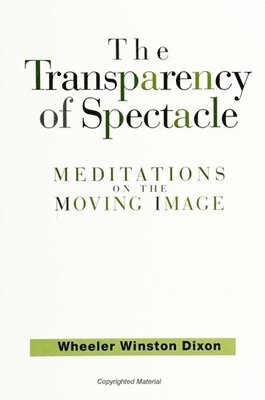
    Transparency of Spectacle

    Meditations on the Moving Image

    AvWheeler Winston Dixon

    Inbunden, Engelska, 1998

    Del i serien SUNY series in Postmodern Culture

    1 076 kr

    Tillfälligt slut

    Fler format och utgåvor

    Häftad

    Tillf. slut

    Beskrivning

    Considers the ephemeral nature of the cinematic experience as we now apprehend it, and examines the ways in which technological advances in film and moving image production have changed this experience over the course of the last thirty-odd years.While agreeing that the "digitization" of the cinema is inevitable, and even a necessary adjustment to the economic realities of end-of-the-millennium cinema production, Dixon argues that it represents a fundamental representational shift in the relationship between the spectator and the image-production apparatus of the cinematograph. More than ever all visual input is merely raw material which is then subjected to digital "polishing" and "tweaking" until it attains a sheen of artificial splendor that is utterly removed from the photographic reproduction of the object and/or person originally photographed.

    Produktinformation

    • Utgivningsdatum:1998-05-20
    • Mått:153 x 229 x 12 mm
    • Vikt:499 g
    • Format:Inbunden
    • Språk:Engelska
    • Serie:SUNY series in Postmodern Culture
    • Antal sidor:223
    • Förlag:State University of New York Press
    • ISBN:9780791437810

    Utforska kategorier

    • Kulturvetenskap inom Samhälle och politik
    • Film inom Kultur

    Mer om författaren

    Wheeler Winston Dixon is Chair of the Film Studies Program and Professor of English at the University of Nebraska. He is the author of The Films of Jean-Luc Godard; It Looks at You: The Returned Gaze in Cinema; The Exploding Eye: A Re-Visionary History of 1960s American Experimental Cinema; and Re-Viewing British Cinema 1900–1992: Essays and Interviews, all published by SUNY Press, as well as The Early Film Criticism of François Truffaut.

    Recensioner i media

    "This is an exciting book, bursting with insights and information on virtually every page. A vast range of films and an equally astonishing range of references combine to present a dazzling array of thought-provoking discussions which range across virtually all of film history and geography. Both a meditation on the past and a call to arms for the future, this book truly sets a new agenda for film and media studies." — David Desser, University of Illinois"Dixon suggests that what others have seen as a crisis of the moving image can better be regarded as a singular transformation point, laden with new possibilities. The spread of video, the Internet, etc., has indeed created difficulties for filmmaking as traditionally conceived. Digital processes have permitted an ever-more-thorough destruction of real referentiality. The technological boom as a whole has allowed for multinational corporations to exploit and control the media of expression as never before. But at the same time, Dixon argues, the technological revolution has unleashed a wide new variety of possibilities for critical discourse, and for a process of 'non-colonial, non-canonical revision' of the standards of cinema. Dixon covers a dazzling range of alternative film practices, ranging from post-Revolutionary Iranian cinema to feminist genre revisionism, from the race-conscious films of the Sankofa collective to the passionate low-budget filmmaking of Roger Corman. He also detours into the past to take up the fascinating cases of such forgotten earlier directors as Reginald LeBorg and John H. Collins. And he touches on crucial issues in contemporary film theory, such as the nature of the gaze in horror films. I found this book exhilarating for the way in which it displays a panoply of alternative strategies for cinematic production, which have survived despite being marginalized by mainstream Hollywood, and whose potentialities are, in spite of appearances, increasing at the present moment." — Steven Shaviro, University of Washington

    Innehållsförteckning

    • Acknowledgments Chapter OneMoving the Center: The Reconfiguration of the Moving Image Chapter TwoImages of Empire Lost (Losey, Wallace, and the Danzigers) and Empire Regained (the Sankofa Collective) Chapter ThreeThe Limits of Cinematic Spectacle: Considerations on the Horror Film Chapter FourSpectacles of Impoverishment: Recycling the Image Bank Bibliography About the Author Index