• Fri frakt över 249 kr
  • •
  • Snabba leveranser
  • •
  • Billiga böcker
Kundservice

Du är på sajten för privatpersoner.

Företag, bibliotek eller offentlig verksamhet?

Du handlar på classic.bokus.com, där alla dina funktioner finns intakta.
Till classic.bokus.com
Bokus logotyp. Gå till startsidan.
  • Erbjudanden
  • Nyheter
  • Student
  • Topplistor
  • Barn & ungdom
  • Bokus Play
  • E-böcker
  • Pocketböcker
  • Spel & pussel

10% rabatt på allt med kod: NYSTART10 →

Sidfot

Mina sidor

    Hjälp

    • Kundservice
    • Vanliga frågor och svar
    • Frakt och leverans
    • Retur vid ångerrätt
    • Reklamera vara
    • Betalning
    • Köpvillkor
    • Allmänna villkor
    • Information om webbplatsens tillgänglighet

    Om Bokus

    • Om oss
    • Pressrum
    • För studenter
    • För företag
    • För bibliotek och offentlig verksamhet
    • För leverantörer
    • Hållbarhet

    Populärt

    • Aktuella erbjudanden
    • Presentkort
    • Studentlitteratur
    • Nya böcker
    • Topplistor
    • Signerade böcker
    • Engelska böcker

    Inspiration

    • Boktips
    • BookTok
    • Populära bokserier
    • Barnbokskaraktärer
    • Populära författare
    Logotyp för Bokus
    Följ oss på Facebook (extern länk)Följ oss på Instagram (extern länk)Följ oss på YouTube (extern länk)Följ oss på TikTok (extern länk)
    bokus @ CookiesAnpassa cookiesIntegritetspolicyKöpvillkor
    Till Citymail hemsida (extern länk)Till Budbee hemsida (extern länk)Till Postnord hemsida (extern länk)Till Schenker hemsida (extern länk)Till Early Bird hemsida (extern länk)Till Walleys hemsida (extern länk)
    1. Filosofi och religion
    2. Filosofi
    3. Filosofiska discipliner

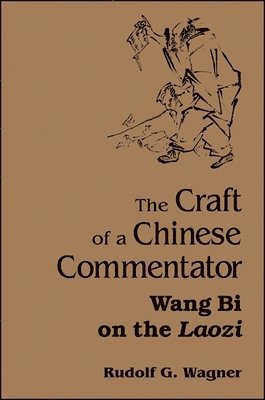
    Craft of a Chinese Commentator

    Wang Bi on the Laozi

    AvRudolf G. Wagner

    Häftad, Engelska, 2000

    Del i serien SUNY series in Chinese Philosophy and Culture

    410 kr

    Tillfälligt slut

    Beskrivning

    A systematic study of Wang Bi's (226-249) commentary on the Laozi, this book provides the first systematic study of a Chinese commentator's scholarly craft and introduces a highly sophisticated Chinese way of reading the Taoist classic, one that differs greatly from Western interpretations.The Laozi has been translated into Western languages hundreds of times over the past two hundred years. It has become the book of Chinese philosophy most widely appreciated for its philosophical depth and lyrical form. Nevertheless, very little attention has been paid to the way in which this book was read in China. This book introduces the reader to a highly sophisticated Chinese way of reading this Taoist classic, a way that differs greatly from the many translations of the Laozi available in the West.The most famous among the Chinese commentators on the Laozi-a man appreciated even by his opponents for the sheer brilliance of his analysis-is Wang Bi (226–249). Born into a short period of intellectual ferment and freedom after the collapse of the Han dynasty, this self-assured genius, in the short twenty-three years of his life, dashed off two of the most enduring works of Chinese philosophy, a commentary on the Laozi and another on the Book of Changes.By carefully reconstructing Wang Bi's Laozi text as well as his commentary, this book explores Wang Bi's craft as a scholarly commentator who is also a philosopher in his own right. By situating his work within the context of other competing commentaries and extracting their way of reading the Laozi, this book shows how the Laozi has been approached in many different ways, ranging from a philosophical underpinning for a particular theory of political rule to a guide to techniques of life-prolongation. Amidst his competitors, however, Wang Bi stands out through a literary and philosophical analysis of the Laozi that manages to "use the Laozi to explain the Laozi," rather than imposing an agenda on the text. Through a critical adaptation of several hundred years of commentaries on the classics, Wang Bi reaches a scholarly level in the art of understanding that is unmatched anywhere else in the world.

    Produktinformation

    • Utgivningsdatum:2000-01-06
    • Mått:153 x 229 x 19 mm
    • Vikt:522 g
    • Format:Häftad
    • Språk:Engelska
    • Serie:SUNY series in Chinese Philosophy and Culture
    • Antal sidor:372
    • Förlag:State University of New York Press
    • ISBN:9780791443965

    Utforska kategorier

    • Filosofiska discipliner inom Filosofi och religion

    Mer om författaren

    Rudolf G. Wagner is Professor of Chinese Studies at the Institute of Chinese Studies, University of Heidelberg, Germany. His previous books include Reenacting the Heavenly Vision: The Role of Religion in the Taiping Rebellion, The Contemporary Chinese Historical Drama: Four Studies, and Inside a Service Trade: Studies in Contemporary Chinese Prose. He received the Leibnitz Award for scholarly excellence from the German Research Foundation in 1993.

    Innehållsförteckning

    • PrefaceIntroduction 1. Wang Bi: A Biographical Sketch Wang Bi's LifeWang Bi's Afterlife 2. The System of the Classics A Sketch of Commentary Strategies during the Han Dynasty 3. Technique and the Philosophy of Structure: Interlocking Parallel Style in Laozi and Wang Bi IntroductionThe Discovery of Parallel Style in WesternThe Problem: Molecular CoherenceOpen Interlocking Parallel Style in the LaoziClosed Interlocking Parallel Style in the LaoziInterlocking Parallel Style in Early TextsInterlocking Parallel Style in Wang Bi's TimeConclusionScholarshipOutside the Laozi 4. Deconstructing and Constructing Meaning The Hidden MeaningThe Implied Author and His Authority: Kongzi and LaoziThe Status of the Laozi and the TextsAscribed to ConfuciusThe Implied Reader and His EducationThe CountertextsThe Homogeneity HypothesisThe Potentiality of the Text: ComparingDifferent Commentary Constructions of the LaoziExample 1: Laozi 17.1Example 2: Laozi 6Example 3: Laozi 11Conclusions 5. The Craft of Wang Bi's Commentary IntroductionIntegration of Commentary and TextEmphatic Rejection of Other ReadingsExplaining Metaphors, Similes,Comparisons, and SymbolsInsertion of SubjectDefining Terms through EquivalenceTranslating the TextMerging Terms and StructuresConclusions NotesBibliographySubject Index